Batteries for a 30ft liveaboard

I live aboard in the Med. 4 Trojan T105s, 200W solar with a Victron mppt controller, plus alternator and mains charger running a small fridge, six fans (I fitted three just for English summers) and the usual lights, instruments and chargers for phones and tablets on a 10m boat. I'm well happy with them.
We have sustained greater than 50 percent charge after 10 days at anchor in summer, changing the angle of the panels once or twice a day on most days. In winter they need mains charging once a week, more on the rare cloudy weeks.
The Trojans are six years old now and seem to be holding up well.
The solar panels never get the battery bank up to full charge. We need mains or long engine runs for that. I had a Sterling alternator charge controller that used to be great at squeezing in the last 20% until it went kaputt. I can't afford to replace it and haven't the skill to repair it. But its a piece of kit worth having if you go off grid and will need to use your engine for bringing the batteries up to 100% charged.
I bought a generator thinking I'd need it living on the hook. Couldn't fit it in when we left the UK so I sold it. Haven't missed it.
After installing a battery monitor I watched what the alternator feeds. Not encouraging anyone to install an automotive alternator but the 50A Valeo with internal regulator i got from my sister's old Peugeot before we recycle it, works great. While motoring for several hours noticed that it started feeding around 35 amps with the voltage increasing (bulk charge) until the voltage stabilized and the current decreased gradually to around 2 amps, which is 1% of the 200AH bank, evidence that a full charge was done.
 
After installing a battery monitor I watched what the alternator feeds. Not encouraging anyone to install an automotive alternator but the 50A Valeo with internal regulator i got from my sister's old Peugeot before we recycle it, works great. While motoring for several hours noticed that it started feeding around 35 amps with the voltage increasing (bulk charge) until the voltage stabilized and the current decreased gradually to around 2 amps, which is 1% of the 200AH bank, evidence that a full charge was done.
What voltage did it regulate to though? 1% of capacity won't indicate a fully charged battery if the voltage isn't up towards 14.8v.
Temperature makes a big difference as well.
 
What voltage did it regulate to though? 1% of capacity won't indicate a fully charged battery if the voltage isn't up towards 14.8v.
Temperature makes a big difference as well.
Battery's specs mention 14.4v to 14.8v for charging, and 15.5 for equalizing. I cant recall the voltage at the time reading was <2amps, i believe it was somewhere between 14.4-14.6 but not 14.8v. That was during a summer day
 
Flooded open cell batteries were a huge pain on my last boat, as they were quite inaccessible regularly watering 6 of them didn't get done quite as often as it should have done. AGM prices are good now, and you can just forget about them for a few years. Get a decent charger / monitor and as many Ah as you can afford.
 
Battery's specs mention 14.4v to 14.8v for charging, and 15.5 for equalizing. I cant recall the voltage at the time reading was <2amps, i believe it was somewhere between 14.4-14.6 but not 14.8v. That was during a summer day
Sounds similar to my 2 x T105, tail current was down somewhere below 2A >
7xsWNjQ.png
 
Flooded open cell batteries were a huge pain on my last boat, as they were quite inaccessible regularly watering 6 of them didn't get done quite as often as it should have done. AGM prices are good now, and you can just forget about them for a few years. Get a decent charger / monitor and as many Ah as you can afford.

Thats a fair point about good access being vital to service Trojans and the like. I built battery boxes in the cabin specifically to make it easy (and to get them out of the bilge and above 'floating sole boards' level - ever the pessimist!)
If good access isn't possible then AGMs are the way to go.

And, yes, as many Amp Hours as possible. My 450Ah feeds my fridge, fans, instruments, phones, tablets for 10 days on the hook in the sunny Med with only 200W solar. On my 10m boat I can't find space for more. But I do need a night in a marina on the mains every 10 days or less to charge them fully, or a longish trip on the engine (which is not unusual in the Med.)

The other side of the equation is minimising use of electricity. Footpumps for the water system (alongside electric pumps of course), LED bulbs, manual shower, autopilot and windlass only when under engine, lots of deck shading, an efficient fridge (keel cooled ideally though water temperatures up to 26 degrees in the summer must hinder that, surely?) etc
 
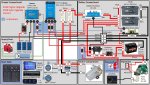
My boat is an 11,5m AWB in the Adriatic. My setup is enough to power all the things you mentioned (fridge, laptop etc.) from solar, but it will only work from May to September .... it is inadequate for winter.

It looks like this ...

View attachment 102712
I've now got Circuit diagram envy! ?

Fair point about the seasons. OP says he has a very limited budget so might struggle when the sun is lower, the days are shorter and its cloudier. Engine charging or a generator are a pita
 
Thank you for replying!
I realise now people can’t read my mind haha, I plan on using shore power as sparsely as I can.
Ive been spending the last leg of lockdown working on the boat, and plan on placing 2 100W solar panels, with all the kit, above a home made Bimini.
I plan on sailing to the med and making sure I see everything along the way- but I will have quite a small budget of a few hundred pounds a month- with friends and family dotted around for a few cheaper stays haha

I have a new starter battery from my experimental trip around the south coast of the England, so hopefully this shouldn’t need replacing.

Trojan batteries are looking like a good place to start looking into.

Thanks to everyone on this thread it’s been incredibly useful!

Taylor
great , good luck (y) ,, thats fairly tight budget and i understand why you envisage using shore power saparingly ( no marinas ) i think maybe a wind genny might be of some free ( after purchase ) aditional help
 
My boat is an 11,5m AWB in the Adriatic. My setup is enough to power all the things you mentioned (fridge, laptop etc.) from solar, but it will only work from May to September .... it is inadequate for winter.

It looks like this ...

View attachment 102712
thats a pretty comprehensive ( and useful ) diagram ,, i notice no wind genny , do you not consider it useful , no eng alt output ( that i can see )
 
Heya,

I am looking to replace my leisure battery on my 30ft sail boat, I’m new to boating and don’t know a lot about electrics!
I am planning to live on board, and run minimal electrics: phone and laptop charge, cold plate for fridge, led lights, led deck light? VHF radio charge maybe a small fan if we have allowance for it.

I am looking to also get two solar panels and all the bits that go along with them- however, what confuses me are the reviews of lithium vs gel vs traditional batteries. I’ve seen Trojan deep cycle recommended for live aboard...

What have people had good experiences with?
What’s your set up? Does it work well?
What would you change?
What is the standard to have aboard? I purchased my boat with a pretty agricultural set up, but that was reflected in the price.

Thanks,
any comments greatly appreciated,
Taylor

I thoroughly recommend Trojans. I have four T105's that are now in their 6th year. I fully expect to get 10 years out of them. Mine are supported by 300 watts of solar and a Victron MPPT solar controller. My only real problem is that the system would be much improved if the climate was better!
 
thats a pretty comprehensive ( and useful ) diagram ,, i notice no wind genny , do you not consider it useful , no eng alt output ( that i can see )

Solar is silent and in the Adriatic, there is enough sunshine that over the last 2 years I have never needed anything other than solar and my normal engine usage. In the UK, Scandinavia and Baltic, a wind gen would probably make a lot of sense, but in the med, solar is king IMO.

There is an output from the engine labelled "Alternator" which charges the starter battery. The service batteries are then charged via the Victron Cyrix-ct 230 combiner.

The engine connections (starter and alternator) are not accurately represented as I haven't changed them - they are as Bavaria original, other than I have disconnected the charging circuit going to the service batteries.
 
Here's my quick and dirty summary of the battery types.

1. FLA (Flooded Lead Acid). This is the regular liquid filled battery. Come in a few sub types: starter and deep cycle are the two main ones. Trojan T105 is a high quality deep cycle.

2. Sealed lead acid batteries. Comes in AGM and Gel types.

3. Lithium. Also comes in various types but when not otherwise specified for boats usually means LiFePO (Lithium Ferrous Phosphate).

Which to use?

1. FLA up front cost the lowest for the most capacity. Also most robust and tolerant of abuse for those that don't have electrical expertise.

2. AGM and Gel. No maintenance since they're sealed so good for installation in hard to access spots. Much more expensive than FLA and less tolerant of abuse. Will accept a higher rate of charge

3. Lithium. Very high initial cost but with proper care can be the cheapest in the long run. But they can be easily damaged if you aren't careful or do not have a proper BMS (Battery Management System).
 
To the non wind genny types , the well known youtube luvvies Ruby Rose say that they get most of their power from wind gennys ( if i heard it correctly )
 
3. Lithium. Very high initial cost but with proper care can be the cheapest in the long run. But they can be easily damaged if you aren't careful or do not have a proper BMS (Battery Management System).

A small amendment to this. I would think that all LFP batteries marketed as drop-ins have a functioning BMS. The problem is that the BMS is to protect the battery from excessive damage, it has no interest in protecting the boat or its occupants. Anyone thinking of using a drop-in has to ask themselves what they will do if the battery suddenly stops giving and receiving power when the BMS isolates the battery to protect itself. The answer to that question determines whether the person has a safe, thought-out system or a potentially dangerous one.
 
Last edited:
...
As for batteries, as a liveaboard, unless you're going to be hooked up to shore power almost all the time, there's no such thing as too many amp hours; .....
That's not really true.
Because Lead Acid batteries charge less efficiently the closer they are to fully charged, if your inputs (solar, engine hours, small mains charger) are struggling to keep up with the outputs, having bigger batteries can make it harder to ever get them fully charged, and hence shorten life.
 
Solar is silent and in the Adriatic, there is enough sunshine that over the last 2 years I have never needed anything other than solar and my normal engine usage. In the UK, Scandinavia and Baltic, a wind gen would probably make a lot of sense, but in the med, solar is king IMO.

Solar is King here in the UK too. During the Summer i'm self sufficient unless we get 2 or 3 really cloudy day, then i need a top up from shore power or the engine.

I'm curious, why did you use 95mm battery cable ? Is that the original Bav spec, they do go right over the top with battery cables.
 
Solar is King here in the UK too. During the Summer i'm self sufficient unless we get 2 or 3 really cloudy day, then i need a top up from shore power or the engine.

I'm curious, why did you use 95mm battery cable ? Is that the original Bav spec, they do go right over the top with battery cables.

95mm was what was in it ... so all the wiring I added had to be 95mm too.
 
95mm was what was in it ... so all the wiring I added had to be 95mm too.

Thought that might be the case. Bavaria seem to use a standard wiring harness, which covers every possible option and giant size cables, to power everything that could possibly be added. Nothing wrong with that though.
 
A small amendment to this. I would think that all LFP batteries marketed as drop-ins have a functioning BMS. The problem is that the BMS is to protect the battery from excessive damage, it has no interest in protecting the boat or its occupants. Anyone thinking of using a drop-in has to ask themselves what they will do if the battery suddenly stops giving and receiving power when the BMS isolates the battery to protect itself. The answer to that question determines whether the person has a safe, thought-out system or a potentially dangerous one.
Some of the "drop in" LiFePOs do come with a BMS but I believe most (all?) do not monitor individual cells but just the 12V unit. According to the "experts" the individual 3.2V cells can get out of balance in a 12 combo which can lead to imbalance in charging and death of the cell.

Here's a link to a very interesting, somewhat technical article written by someone that sells and installs LiFePO systems.

Of Service to you, Professional Engineering Opinion on AGM vrs Lithium - Cruisers & Sailing Forums
 
Top