Batteries discharged by faulty VSR

I don't know the BEP VSR but typical VSR has a relay coil which operates the make contacts. The relay coil is driven by the sensing circuit. Now it does seem that the sensing circuit on OP VSR has dies in operate mode. Which means the coil current is draining at all times. The coil current is dependent on the size of the relay and has to be significant to operate a relay capable of handling starter motor currents. (hundreds of amps) So despite Little sister assertions I think the coil current could kill both batteries over a long period. So 10 days is 240 hrs so a coil of .5 amp drain would take 120 amp hours enough to kill to 110AH batteries if they are a bit tired. Even at .25 amp drain the 60 AH drained could kill old batteries. So can anyone tell use the current drain when relay is activated? These kind of currents would be significant to a small solar charging set up. VSR should be on load side of isolation switches. ol'will
 
My Vctron is quoted as 4mA when open. It would take nearly 3 years for it to flatten my house battery to 50%.
That's for standby when open. The BEP one is 1.8mA. William_H's point was the power used when it's closed due to the relatively large coil in the failure condition discussed above. He was trying to explain where the power went, and is probably right if the batteries aren't simply broken, since nothing else is connected when the switches are off.
 
Typical iso coil ( cube type found predominantly on your car ) has a activated coil draw of circa 200 mA . Not sure of the VSR type.
 
Thank you everyone who has replied to my questions. Just to be clear, when it was working correctly the VSR only takes charging current through its contacts. At rest and whilst the engine is being cranked its contacts should be open and starting current is drawn from the engine start battery only.

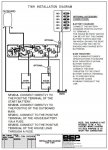
I've attached a standard BEP wiring diagram which is how ours is connected; just substitute 'Beta 20 diesel' for 'Outboard' as the alternator charge comes back to the batteries via the engine leads. The VSR is the item on the left of the cluster as drawn.

Thanks,
Bill
Screenshot 2022-06-15 090223.jpg
 
I've done a simple numerical analysis of responses to this question with the following results (approximately). VSR problems - 3, No problems - 25. The nays have it, the nays have it.
I've had two boats with VSR system, neither had any problems.
My pal, a vastly experienced sailer with two circumnavigations and several Atlantic crossings under his keel preferred the 123B system (keep it simple). He forgot to switch to house only position and found himself with two flat batteries one day and unable to start his engine. Had to row ashore, remove his car battery, row back and jump start the boat. Also had to pay to reset his car as removing the battery for a considerable time had cleared the radio memory.
He hasn't changed to a VSR though!
 
I've done a simple numerical analysis of responses to this question with the following results (approximately). VSR problems - 3, No problems - 25. The nays have it, the nays have it.
I've had two boats with VSR system, neither had any problems.
My pal, a vastly experienced sailer with two circumnavigations and several Atlantic crossings under his keel preferred the 123B system (keep it simple). He forgot to switch to house only position and found himself with two flat batteries one day and unable to start his engine. Had to row ashore, remove his car battery, row back and jump start the boat. Also had to pay to reset his car as removing the battery for a considerable time had cleared the radio memory.
He hasn't changed to a VSR though!
OK, a new BEP VSR (now a DVSR) is on order as until now the original was trouble-free for ten or so years. I've managed to redeem both the deeply discharged batteries, to a certain extent, by a series of long charges at a low rate although the engine battery (the older of the two) has been reluctant to accept charge so I've ordered a replacement as a precaution.

Thanks again everyone for constructive and helpful comments.
Bill
 
OK, a new BEP VSR (now a DVSR) is on order as until now the original was trouble-free for ten or so years. I've managed to redeem both the deeply discharged batteries, to a certain extent, by a series of long charges at a low rate although the engine battery (the older of the two) has been reluctant to accept charge so I've ordered a replacement as a precaution.

Thanks again everyone for constructive and helpful comments.
Bill

Thanks for letting us know. (All too often, much advice is given on here but the recipient never bothers to report the outcome.)

Note that some chargers use a short spell of higher than normal voltage (15v?) on tired batteries to seek to recover them to some extent. (I think I've read it is intended to blast scale off the battery plates.) Your retained batteries may well be fine, but if you find they have significantly reduced capability you may want to look into that technique.
 
Top