Battens in head sail

Joker

Well-Known Member
Joined
2 Jul 2010
Messages
1,079
Location
location location ...
Visit site
I spent quite some time at SIBS today talking to sailmakers, as I need a new headsail.

Two suggested battens in the leech, which would help spread the load.

Has anyone any experience of this, or knows more about it?
 
Battens in the leach AFAIK are to support the leach to stop flutter. So completely different to battens in a mainsail used to hold out a roach (outward curve) of the leach.
Flutter is caused by the mass of the trailing edge of the sail flapping about in wind flow. It can be minimised by using a leach cord to to put tension on the leach but this unfortunately usually gives a hook in the leach which is detrimental to air flow.
Battens will keep the after part of the sail nice and flat. They can however cause foul ups when tacking ie pulling the jib around an inner forestay and can also cause a foul up when hoisting. Obviously not much good for a furling jib.
I have a small jib where the leach is simply hot cut with no hem or leach cord. The idea being to reduce the weight at the leach. It seems to be effective at minimising flutter. Another option is to put a concave curve in the leach with a hem and leach cord so natural load downward tends to tension the leach so hopefully stopping flutter.
All very difficult I admit I tend to put up with leach flutter. olewill
 
I have 4 self tacking jibs & all, bar one, have battens. Battens are an absolute pain in the rear.
if I want to change from ST to genoa I cannot just drop the jib on deck & roll it I have to faff about removing battens which (because I have a luff grouve not hanks) means that I have to try & stop the sail going over the side whilst I get them out. On my latest laminate by Optimum they are so tight it takes a good 15 minutes to get them in or out. I cannot just stuff the sail down the hatch. ( not that I would with an expensive laminate) When at sea & being single handed it is not really an option.
One of my ST's does not have battens & I asked Lonton & Gray the sail maker why. His comment was " If you want a tent then go to a tent maker". His sail was as good as the others. It just wore out after lots of use.
My Optimum laminate sail still suffers from leach flutter & I often have to adjust the leach line. My Hyde Marblehead does not suffer nearly so much but does not have the power of the laminate. It is annoying because I can carry the Hyde in F8 ( but not the Optimum)& often want to change the laminate to the Hyde if it is going to be very windy, but have the hassle of the battens to change

A properly cut genoa should not need battens so if the sailmaker is suggesting battens in that I would try another sailmaker who can make one that works properly
 
I have two self tacking jibs, both with vertical battens, and a very high aspects ratio sail plan. The battens give some roach and help to stop leach flutter.
The both furl without a problem, but they are a pain to rig, it really needs a clam day, because the the battens have to be inserted as the sail is hoisted. Not really a problem when cruising, but I see it could be a pain if you wanted to do a rapid sail change, single or short handed.
 
Obviously a non-starter if you have a furling headsail.

Otherwise they must offer some benefit in sail shape but at the cost of making it harder to change headsails Probably OK if you keep your headsails along the guard rails - but much more effort if you keep them below or in a locker.
 
I spent quite some time at SIBS today talking to sailmakers, as I need a new headsail.

Two suggested battens in the leech, which would help spread the load.

Has anyone any experience of this, or knows more about it?

I am assuming you are talking about a 110% or smaller headsail here as battens are not used on the big overlapping genoa's.

As the others have said the big benefit of battens in a headsail is that they reduce flutter on the leach, which significantly increases the longevity of the sail (I think every catastrophic failure I have had on headsails has been the leach failing in some way). They do also allow the sailmaker to add more area to the sail high up which also increases power.

The main snag with having battens can be handling the sail. If it is a non roller furling headsail as long as you are careful with the way you flake / fold the sail you can generally get away with leaving the battens in when you drop it - but you have to accept you will snap the odd one now and again but they aren't difficult to change so not a big problem. With a roller furling headsail that is being left up all the time long vertical battens in the leach are fine - but are an absolute PITA if you should have to drop the sail for some reason whilst going along or solo. If you have a roller furler but don't generally leave the headsail on when your not on the boat then flexible horizontal roller furler battens work very well and there aren't really any issues with handling the sail - the only slight snag with these is you don't get quite as tight a furl so I probably wouldn't want to leave a sail up with them in unattended all summer.
 
Had them on a previous boat and would avoid at all costs in future.

They furl ok as are parallel to the forestay but as others have said, they make changing, lowering or hoisting the sail a job for a calm day.

The other consideration is where to keep the battens when the sail is not hoisted. Mine had a course or of full length battens that must have been 30 feet plus in length. I left them on the side deck where they were a hazard that could roll underfoot or down belowdecks where they were a trip hazard.

They might be fine if you are doing everything else to scrape the last 0.01knot of boat speed but if you're not sailing Hugo Boss then run away from the idea. Fast.
 
A properly cut genoa should not need battens so if the sailmaker is suggesting battens in that I would try another sailmaker who can make one that works properly

I don't agree with that. Battens are there for a reason.

I am a bit surprised you take the battens out of your sail every time you stow it. The battens can't be terribly lone, so I would have thought you could easily flake the sale onto the deck and fold it in a way that the battens are not bent.
 
I don't agree with that. Battens are there for a reason.

I am a bit surprised you take the battens out of your sail every time you stow it. The battens can't be terribly lone, so I would have thought you could easily flake the sale onto the deck and fold it in a way that the battens are not bent.

I have 3 vertical battens on my 106% jib, they are a meter or so long so I haven't managed to work out a way of fitting it in the 'sausage' bag without taking them out.
 
'I assume by "battens in the leach" the OP means battens parallel in to the foot of the sail (as with most mainsails)'

No - in the leech parallel to the forestay.

They do sound like a lot of bother for little gain. No battens would also be cheaper!

And thanks for your input.
 
I don't agree with that. Battens are there for a reason.

I am a bit surprised you take the battens out of your sail every time you stow it. The battens can't be terribly lone, so I would have thought you could easily flake the sale onto the deck and fold it in a way that the battens are not bent.

Cannot do that, For a start they are close together from bottom of one to the top of the next & being about 750-900mm long but with only 250mm between them I cannot flake the sail on the deck. have tried on grass & gave up. ( no I do not have a lawn on the deck like some - or on the hull like many:ambivalence:)
 
If you're talking about a 105% or less jib, rather than a genoa, then battens will make a big difference to the performance.

The best solution is battens parallel with the foot, but then this is tricky with a roller furling sail. There is such a thing as battens that fold, rather like a tape measure, but they are still not suitable for jibs kept on the forestay (as opposed to J Boats etc who only firl their jibs during racing, and will drop them at the end of the day).
So most cruising sails go for vertical battens parallel to the forestay. Not as good as parallel to the foot (and have to be a lot longer) but better than no battens. Primarily because of the increased area that they allow the jib to have.
The only drawback of them is the handling issue, but if you're the sort of person who hoists their jib in March and drops it in November.... It's a small deal compared to the benefits I think.
 
If you're talking about a 105% or less jib, rather than a genoa, then battens will make a big difference to the performance..... most cruising sails go for vertical battens parallel to the forestay.

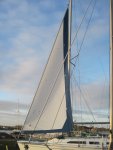
My jib is about 107%, it can't be much bigger as it sheets inside of the shrouds and would foul on the spreaders. Steve Goacher who made the sail said that with such a small overlap every inch is precious and battens would maximise the overlap by obviating the need for any hollow in the leach. I was concerned that the battens, which are parallel to the forestay, would thicken the roll of sail on the furler foil and increase windage but this hasn't been the case. The sail definitely sets and pulls better than the previous unbattened sail. I'm attaching a photo of the jib: the three white spots are the ends of the battens, they are fed in from the bottom.

New Jib 1 (768x1024).jpg
 
My jib is about 107%, it can't be much bigger as it sheets inside of the shrouds and would foul on the spreaders. Steve Goacher who made the sail said that with such a small overlap every inch is precious and battens would maximise the overlap by obviating the need for any hollow in the leach. I was concerned that the battens, which are parallel to the forestay, would thicken the roll of sail on the furler foil and increase windage but this hasn't been the case. The sail definitely sets and pulls better than the previous unbattened sail. I'm attaching a photo of the jib: the three white spots are the ends of the battens, they are fed in from the bottom.

View attachment 66434

The leech looks hollow in the picture!!. Furthermore a hollow leech in this situation would have allowed more sail area as there would have been a chance to extend the clew further aft & cut the clew close in to the spreader. Making the leech rounded just moves it close to the spreaders but the clew further forward. Why not move the clew further aft & have a hollow leech with the leech at the same point next to the spreader. Seems like Goacher are giving you the wrong advice. As for being better than the old sail- Well one would expect that because that is why you bought a new sail.
 
No - in the leech parallel to the forestay.

They do sound like a lot of bother for little gain. No battens would also be cheaper!

And thanks for your input.

There is a definite gain in performance. Without them you'd need a hollow leech. Those on my new jib furl perfectly. It is a little bit of hassle taking the battens out if you do a sail change but in extremis you could bundle the sail down the forehatch with the battens still in place.
 
The leech looks hollow in the picture!!.
If you think the leech looks hollow in the picture I think you cannot have studied the latter very closely. The wind is blowing the sail away from the camera and the clew of the sail is tied to the handrail nearest the camera, so the sail is not in one plane - it is describing a deep curve athwartships.

The following is copied from the Elvstrom Sails website and corresponds closely to what I was told by Goachers:

"Furling jibs may have battens to ensure that the leech of the jib overlaps the main as much as possible. Without battens the leech would have to be cut with a hollow, and this overlap would not exist. With swept-back spreaders this „overlap" should be possible.

This is not at all about area - its the MOST important part of the jib, and its missing. It is an aerodynamic disaster.

Using leech battens being orientated to be parallel to the forestay („vertical") allows the sail to furl well. And makes a sail which is a little larger, and most importantly, a much better shaped aerodynamic „wing."
 
The following is copied from the Elvstrom Sails website and corresponds closely to what I was told by Goachers:

"Furling jibs may have battens to ensure that the leech of the jib overlaps the main as much as possible. Without battens the leech would have to be cut with a hollow, and this overlap would not exist. With swept-back spreaders this „overlap" should be possible.

This is not at all about area - its the MOST important part of the jib, and its missing. It is an aerodynamic disaster.

Using leech battens being orientated to be parallel to the forestay („vertical") allows the sail to furl well. And makes a sail which is a little larger, and most importantly, a much better shaped aerodynamic „wing."

If the distance aft that the leech can go is restricted by the spreader then the overlap will be the same at that point whether rounded or hollow. ( provided the leech is cut to reach that point). If it is hollow it will allow the clew to extend further aft thus increasing overlap. So what is said above does not stand up to scrutiny.
 
Top