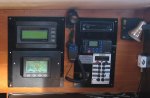
Awkward old instrument holes

webcraft

Well-Known Member
Joined
8 Jul 2001
Messages
40,436
Location
Cyberspace
www.bluemoment.com
.
I need to refit the instruments with a new, bigger one near the top, but cannot completely overlap the existing holes due to restrictions inside.

holes.jpg


I am thinking of cutting out a much bigger area then putting a new piece of fibreglass/plastic/wood over the area and cutting the new holes in that.

Anyone done anything like this or got any ideas?

Would this stuff be any good?

https://www.ebay.co.uk/itm/POLYPROP...Plastics-Chemical-White-Polyprop/400721728191


- W
 
Last edited:
I have had to fill similar size apertures in large electrical panels.

I used aluminium reinforcing mesh, affix with epoxy putty blobs just inside the blind hole, then fill with plastic padding marine filler pressed firmly into the mesh to give the finished repair strength, leaving the layer at least 1-2mm below the surface. Once it has gone off fill to the surface with gel coat plastic padding, but first prep the surrounding area by giving it a thorough scrub and light sanding with very fine grit paper. An expert could colour match the gel coat to provide an almost invisible repair. Once the gel coat is applied lay a piece of clean polythene over the surface and use a wide roller to get the surface reasonably smooth. When cured smooth flat with finer and finer grits and then finally polish, although you may have to fill any minute blemishes of air bubbles with small qtys of gel filler.
 
Bodge, cut a section out and relay with new mat, several sections there are umpteen you tube videos showing how to do it.
 
Polypropylene is useful for many boat projects but I wouldn't use it in this situation as it is difficult to bond. Use epoxy or polyester resin with a compatible cloth, then finish off with a surface skim of gelcoat. As mentioned above, there are countless previous threads and utube videos showing how to carry out this common job.
 
I've just done a similar project a couple of years ago. I made a piece of teak which covered the complete area, fixed to the grp with a ss screw in each corner, rubber sealing tape around the periphery. I then fitted the new instruments in the piece of teak which was about ¾" thick. Two fitted and have room for another two. All nicely varnished. The existing holes were ok for leading new wires to the instrument panel.
 
I have filled a similar but round instrument hole in my little boat where I abandoned a log instrument. It is not difficult to fill the hole. The hard part is getting a decent finish to the surface. I had long ago abandoned the gel coat on the boat for a polyurethane paint so not so difficult but clearly not as pretty as new gel coat. In my case I was not concerned about the look of the back of the hole (inside the cabin) as I mounted a switch box over the area. I cut out a piece of GRP to cover the back with overlap and glued (epoxy) this in place. Then it was fairly easy to fill the actual hole with glass and epoxy. Smooth with filler that can be sanded down to get a smooth finish. Finally painting it. If you want a tidy finish on the inside then chamfer the edges of both inside and outside. Place a temporary cover lined with cling wrap over the inside of the hole and lay up glass in the hole overlapping to the chamfer. When this is hard remove the temporary cover and lay up on the inside as well. Fill and paint. You could use polyester resin and gel coat (flow coat) if you can get the right colour. But never adhering as well as epoxy. ol'will
 
I've just done a similar project a couple of years ago. I made a piece of teak which covered the complete area, fixed to the grp with a ss screw in each corner, rubber sealing tape around the periphery. I then fitted the new instruments in the piece of teak which was about ¾" thick. Two fitted and have room for another two. All nicely varnished. The existing holes were ok for leading new wires to the instrument panel.

+1

Or use teak-faced ply with a teak edging strip around it. You could even incorporate a little rack for sunnies and phone, handheld VHF etc.
 
Yes I have done exactly this using a fibreglass panel to cover the old ,fairly unsuccessful patching to older instruments,and provide a clean surface for my new instrument cut-outs.You can buy one of the standard fibreglass panels offered buy East Coast Fibreglass ,e.g. 300 x 300 or 600 x 600 that will give you a perfect new surface for bonding to the old surface with polyester resin.A 2mm thick panel is useful.Make the new cut outs first ,assuming they lap the old ,and that allows you to clamp thro.The old surface must be well abraded and accurate masking is essential.You can shape the top of the new panel to be parallel to the coachroof etc. and get an excellent result.I can PM a close up photo tomorrow.
 
I used about about 4mm white acrylic sign plastic, sized slightly bigger than the old hole, edges rounded off and polished up, then simply stuck on with white PU40. Little structural strength, but in he location concerned that was unimportant. Cosmetically good, and easier to get a good finish and keep clean than the polyethylene stuff, also easier to bond on acrylic. Nothing sticks to polyethylene.

Glassing in the hole is ideal, but far far more work to get a neat result.
 
I've just done a similar project a couple of years ago. I made a piece of teak which covered the complete area, fixed to the grp with a ss screw in each corner, rubber sealing tape around the periphery. I then fitted the new instruments in the piece of teak which was about ¾" thick. Two fitted and have room for another two. All nicely varnished. The existing holes were ok for leading new wires to the instrument panel.

another +1
coz in the future when you want the next latest toys in there you dont have to carve up the bat yet again, just replace the panel.

edit add:
And put it on hinges so you can rewire to your hearts content without wearing out screw holes. Hinges will also assist a nice swan neck cable form behind the panel.
 
We had similar and used a sheet of aliumimium drilled and counter sunk and etched primed and then spray to match gel coat, looked very clean and then used it to fit new plotter central to plate, looked like it had always been there
 
really making good the fibreglass by simply rebuilding is an easy job and it leaves everything as it was originally anything else is just bodging what is an easy repair, if you don't try you will never learn. The only problem you have at the moment is temperature but you can do all the prep work now and the glass work later when it warms up. I know that it does occasionally exceed 10° in Scotland so it's possible. It's your boat though.
 
Black perspex ( acrylic sheet ) makes a very smart backing, has the advantage over teak ply that you don't see rough edges. Hopefully attached a pic of reorganised instruments, from quite a time ago hence the dated equipment. Not a cheap material however if I recall.
 

Attachments

  • IMG_0973 cropped.jpg
    IMG_0973 cropped.jpg
    179.9 KB · Views: 2
Top