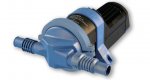
Automatic bilge pump advice please

My experie
£100+ to replace ????? a bilge pump ????? What is it gold plated ?

My auto pumps are complete .... £19 with free delivery .... AND fitted with knob to flip the float to test

12V 1100GPH Automatic Submersible Bilge Pump Fully Auto Float Switch Internal | eBay
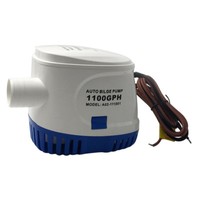
s-l200.jpg


Of course you will probably snear at it because its chinese ... but having had a Brand name same design and a chinese one as above frozen one winter ... it ruins them !! I broke them open to see if I could fix ... they were IDENTICAL ... but the chinese one was less than half the price.
my experience of the pumps with integral float switches is that they are a pain when they go wrong. I always opt for a separate pump and float switch. Mount the float switch on a stick such that you can unbolt the stick and lift the float switch clear of the deep bilge. Easy to replace without groping in a dirty and deep sump.
In addition, I install the largest pump that I can fit. If you get a leak you want that pump, not a piddling little one. Nobody in an emergency says I wish I had fitted that cheaper small pump?
 
My experie

my experience of the pumps with integral float switches is that they are a pain when they go wrong. I always opt for a separate pump and float switch. Mount the float switch on a stick such that you can unbolt the stick and lift the float switch clear of the deep bilge. Easy to replace without groping in a dirty and deep sump.
In addition, I install the largest pump that I can fit. If you get a leak you want that pump, not a piddling little one. Nobody in an emergency says I wish I had fitted that cheaper small pump?

Fair enough - I was once like you ...but then after wasting money on Waterwitch's and various - it was plain that the simple solution was as linked ..

That pump may be small to you - but I can tell you that when working it pumps a fair whack through that 1" hose ... in fact its that much - my sink which drains via the same outfall starts to fill. I keep meaning to fit a valve between the two.

I have two Whale Gusher hand pumps as well ... and that 'piddly little pump' as you call it pumps more than they do combined.

If you need more than that - you better be grabbing your lifejacket ...
 
Fair enough - I was once like you ...but then after wasting money on Waterwitch's and various - it was plain that the simple solution was as linked ..

That pump may be small to you - but I can tell you that when working it pumps a fair whack through that 1" hose ... in fact its that much - my sink which drains via the same outfall starts to fill. I keep meaning to fit a valve between the two.

I have two Whale Gusher hand pumps as well ... and that 'piddly little pump' as you call it pumps more than they do combined.

If you need more than that - you better be grabbing your lifejacket ...
No lifejacket required just good pumping capacity.
The ironic thing is, smaller boats are likely to need the same size pumps as larger boats in an emergency. Assume a similar skin fitting failure on any boat and it is going to let in just as much water, regardless of the size of boat. If said hole allows 10,000litres per hour in to the hull, it will very quickly overwhelm a small boat. Not so on a larger, higher volume hull.
Even a 1.5 inch toilet outlet seacock failure will let in more than 10,000l/hr. if you are considering dealing with this kind of emergency then invest in the largest pump you can fit. It buys you time in an emergency so you can concertrate on finding the leak and dealing with it. Forget manual pumps. You dont want to be pumping to stay afloat. You need to be finding/fixing the leak as fast as possible. Fine if you have a large crew where you can rotate crew members on manual pumps. Try pumping hard on a manual pump and time yourself to see how long you can last. 5 mins is a long time if its a decent flow manual pump. You soon get tired.
 
I rather think that in that sort of emergency, your best bet is a set of wooden bungs, and if you can't get at the hole, a good GTFO kit.
Agreed. That is what you will be trying to fit instead of using the manual bilge pump. Large lecky pumping capacity will be keeping the water level down whilst you grope around, possibly with water around your ankles trying to fit a bung under water
 
I rather think that in that sort of emergency, your best bet is a set of wooden bungs, and if you can't get at the hole, a good GTFO kit.

Agreed ....

Lets take an average say 25 - 35ft boat ... the bilge space height will be limited and size of pump will be dictated by that. I cannot physically fit a larger pump under in my bilge than the one I linked to earlier.
So where are you going to put this big pump ? and how much time will it really buy you ? Lets say your speed log gives out and the through hull starts gushing water ... forget it - the sheer volume coming in would need serious pump ! ... bung and rag will be the only possible saviour here ... then even my 'piddly' pump can handle the small amount that comes in still.

I've been in situations with holes in hull ... and I can honestly say without reservation - its a losing battle if you rely on a pump ...

Best I ever used was a collision mat ... a method used to refloat or keep boats afloat by a large plastic sheet put under hull that then water pressure holds against the hole. Of course hull design such as keels affects if this can be used ... but even with bilge keels it is possible. A strong bin liner can do this.
 
Agreed. That is what you will be trying to fit instead of using the manual bilge pump. Large lecky pumping capacity will be keeping the water level down whilst you grope around, possibly with water around your ankles trying to fit a bung under water

Honestly - I hope you never have it happen to you because it will be far more and faster than just around your ankles ...

But I can give an example of my 'piddly' pump managing to keep my boat from flooding too much ..

Pal and I went on the river with my motorsailer ... we were about 3nm upriver when I noticed cabin was awash. The plug in the engine block had a hole in it from corrosion ... and when engine was running - of course raw cooling water was blowing out of it .. luckily the rate was nowhere near that of a through hull but was still sufficient to be a concern.
The auto 'piddly' pump - I had still in OFF position ... which I flicked to AUTO .. and she started to pump .... while fishing - the water level soon dropped and auto stopped ..

On starting engine to go home - of course water poured in again ... and the pump just about managed to hold its own with water at sole level.

I know this tale seems to counter my previous statement of pump is really not enough ... but I relate it with the comment that the water flow was substantially less than a through hull would have ... I was lucky in that. IF the plug had completely blown leaving a 2" hole ... then it would never have coped ... and I would doubt a substantially larger pump either.
I would have bung'd the plug hole - but it was so irregular - it was not possible.
 
Agreed ....

Lets take an average say 25 - 35ft boat ... the bilge space height will be limited and size of pump will be dictated by that. I cannot physically fit a larger pump under in my bilge than the one I linked to earlier.
So where are you going to put this big pump ? and how much time will it really buy you ? Lets say your speed log gives out and the through hull starts gushing water ... forget it - the sheer volume coming in would need serious pump ! ... bung and rag will be the only possible saviour here ... then even my 'piddly' pump can handle the small amount that comes in still.

I've been in situations with holes in hull ... and I can honestly say without reservation - its a losing battle if you rely on a pump ...

Best I ever used was a collision mat ... a method used to refloat or keep boats afloat by a large plastic sheet put under hull that then water pressure holds against the hole. Of course hull design such as keels affects if this can be used ... but even with bilge keels it is possible. A strong bin liner can do this.
Maybe its not possible in your boat to install ample pump capacity but some boats do have deep bilges and space for a good sized pumps. I have an emergency Rule 3700gph, the main sump pump is a 2000gph, the shower sump is also a 2000gph and the engine room has a 500gph. In addition we have a roving 500gph with a long pipe. Doing the calculations for lift, pipe resistance, etc my calculations suggest I have over 19,000 litres/hour capacity. This will keep up with a 1.5” hole in our bilge whilst we deal it
 
thanks for replies some really interesting stuff. Salar could you name a few of those pumps you referenced.My problem with the float that works is I cant get at it to transfer the wirng.Maybe there is a float that can be lowered too?
Gulper320-560x296px.jpg
I use this one: Whale Marine - Products but I sourced a heavier strum box made of bronze from ASAP Supplies. Whale supply a strum box but it is plastic and has to be fixed down which is a problem if you can't reach the low point.
 
I had Johnson submersible pumps, never had a failure before extreme old age, 20+ years, but then, regularly used. Wouldn't pump unless submerged, so don't see how it would work above water level with a pickup hose. A washing machine pressure switch is fine for a water level alarm but I don't think it has the capacity to run the pump, you might need a relay. Also the wm switch would cycle on/off endlessly as the pipeful of water drained back down, a mercury or reed switch is more suitable, or manual switch to lower the level further.
My bro and his wife spent 19 hours pumping and bailing, in a S gale 12 nm off Brittany, so a handpump is sometimes useful, as is a bucket. Not having cracked frames in way of the mast partners also a help.
 
Lots of bilge pump tests on youtube.

None of the branded pumps reached the advertised capacity.
Suspect the generic knock offs were worse . simply less power motors installed perhaps to get the price point down.

None of the comparo pump tests were in real world situation the pump head of water being mostly no more than a few cms.
On my boat its probably more like a metre to get the water up and over the side then add some friction due to pipe length and bend or two.

600 GPH more like 2-300 if you have actually got 12volts.
Have two pumps in my main bilge. hopefully will keep me afloat until I run the boat aground,step ashore and find the nearest pub, my emergency liferaft can stay exactly where it is.

Worth a read.
Know how: Is Your Bilge Pump up to the Job?
 
I don't anyone in their right mind really believes the rates claimed by any pump brand.

I have a professional Peristaltic pump for putting fuel additives into ships cargoes ... spec says 1 cu.m per 10 minutes against a cargo pipe line pressure of 10bars. YEH !! forget it ... the true rate is 1 cu.m in 20 mins at best. Even when 'free pumping' with no pressure to pump into - it will not make it in 10 mins.
 
Lots of bilge pump tests on youtube.

None of the branded pumps reached the advertised capacity.
Suspect the generic knock offs were worse . simply less power motors installed perhaps to get the price point down.

None of the comparo pump tests were in real world situation the pump head of water being mostly no more than a few cms.
On my boat its probably more like a metre to get the water up and over the side then add some friction due to pipe length and bend or two.

600 GPH more like 2-300 if you have actually got 12volts.
Have two pumps in my main bilge. hopefully will keep me afloat until I run the boat aground,step ashore and find the nearest pub, my emergency liferaft can stay exactly where it is.

Worth a read.
Know how: Is Your Bilge Pump up to the Job?
There's a huge market for that sort of pump, pumping rain and spray out of Dory type boats, RIBs,, circulating water for fishing tanks etc.
They're not really intended for emergency bilge pumps in sailing yachts, but they look good in the chandlery.
The one in our RIB is great for lifting water 400mm over the transom through a short pipe, but use it to lift water 2m out of a yacht bilge and it slows to a trickle. Add the drag of a 5 metre hose, you'll need double the power. Don't even show it a non-return valve.
And the other reason there's loads of them looking shiny in chandlers' shops is that they typically fail every couple of years.


When you suddenly want a lot of gallons moved up hill fast, it's not really a job for a plastic 12V toy.
For under £100 you can get a mains submersible pump that will shift 10x as much.

But how often do GRP yachts actually sink because the bilge pump is not fast enough? Sinkings are very rare anyway, and the few are either complete neglect or collisions usually. The only cases I've heard of where vessels have been saved by pumps, you are talking about serious fire pumps, diesel pumps described in terms of multiple inches of hose bore size and lots of HP.
Wooden boats which are getting old, different game. I was on a certain French vessel last year, auto bilge pump came on a couple of times an hour, in harbour. There was a serious engine-driven pump available.

If you're thinking your auto pump will look after your yacht while you're away, even our pathetic RIB pump draws 2A, so if you had a leak keeping it busy full time, our battery bank wouldn't last a week.
 
There's a huge market for that sort of pump, pumping rain and spray out of Dory type boats, RIBs,, circulating water for fishing tanks etc.
They're not really intended for emergency bilge pumps in sailing yachts, but they look good in the chandlery.
The one in our RIB is great for lifting water 400mm over the transom through a short pipe, but use it to lift water 2m out of a yacht bilge and it slows to a trickle. Add the drag of a 5 metre hose, you'll need double the power. Don't even show it a non-return valve.
And the other reason there's loads of them looking shiny in chandlers' shops is that they typically fail every couple of years.


When you suddenly want a lot of gallons moved up hill fast, it's not really a job for a plastic 12V toy.
For under £100 you can get a mains submersible pump that will shift 10x as much.

But how often do GRP yachts actually sink because the bilge pump is not fast enough? Sinkings are very rare anyway, and the few are either complete neglect or collisions usually. The only cases I've heard of where vessels have been saved by pumps, you are talking about serious fire pumps, diesel pumps described in terms of multiple inches of hose bore size and lots of HP.
Wooden boats which are getting old, different game. I was on a certain French vessel last year, auto bilge pump came on a couple of times an hour, in harbour. There was a serious engine-driven pump available.

If you're thinking your auto pump will look after your yacht while you're away, even our pathetic RIB pump draws 2A, so if you had a leak keeping it busy full time, our battery bank wouldn't last a week.

My main sump pump is a Rule 2000gph. My shower sump pump is also a Rule 2000gph. Both pumps were on the boat in 2012 when we bought it and they are still going strong. Being a liveaboard for 6 years of that period those pumps get a regular work out.
We dont install our 19,000 litre pumping capacity to protect the boat when we are away. We have seacocks to do that. Those that are left open such as cockpit drains are in good condition so pumping capacity when you are not with the boat should not be necessary unless you own a particularly leaking wooden boat.
In reality, more than half of our emergency pumping capacity comes from pumps used routinely on the boat such as engine bilge pump, shower pump, main sump pump. The only addition for us is the Rule 3700 emergency pump.
If you are crossing an ocean or Biscay and you hit bad weather, water ingress can come from several sources, not just holes in the bottom of the boat. You may lose a hatch or portlight. Have a dorade ripped off, get dismasted and have a hole in the deck. Get rolled and have water come in via the main hatch. In this situation and well set up boat will have batteries that will still operate with a foot of water in the boat. A generator or engine will provide battery charging to meet pump demands.
 
If you want serious capacity then get a suitably big Jabsco belt driven off the engine. You have to get a PTO shaft, make a stand for it with adjustment, if your engine is flexible mount the pump has to be mounted to the engine. It will only work until the belt is submerged, as your electric one will until the battery is gone.
Fitted with a manifold to switch inlets, this also gives you deckwash and firefighting, and, with mine, drenching anyone within 30 feet at the regatta (with small nozzles fitted).
 
lw395 post is correct about needing serious pump capacity if its to save a boat from sinking ... but I have to say that in terms of general use - I do not agree.

I have a 5m ex soviet mobo :

9G2EVWZ.jpg


Sitting in the engine well is a Seaflo 1100GPH so called 12V plastic toy .... it is powered from a 7A/hr SLA battery - same as what you find in a House Alarm ...
You can see the small Solar panel just in front of the outboard tiller arm.

That system sits there working day in day out and that battery is kept near full by that small panel easily.

Of course if the pump was to run for more than ~3hrs ... then the panel would never keep up with it ... but if I was connected to mains with a simple charger - then that's not an issue.

On my main boat 25ft motorsailer - I have same pump ... identical in fact except without Seaflo name (shown earlier post) - that is max size I can get under the sole ... but it pumps very well ... keeps my old 1970's boat dry ...

My 5.5m Kormoran through lack of use and laying up the bank at an angle when river level rose ended up flooded ...

I used the Seaflo and another garden pump .... an impellor pump designed to provide water supply for flowers etc. in large gardens ... designed for working to 3m head..... and that can actually deliver very good output ... (the blue pumps in the photo ).

pTbOMaa.jpg


They could not beat the inflow till I rolled up trousers and stood in the boat to tip her over to reduce water inflow.

I honestly think that many do not realise the flow that a hole or failed fitting can have ... to think in terms of pumps to combat ? In most cases I would suggest concentrate on REDUCING inflow of water ... instead of wasting time trying to pump.
 
lw395 post is correct about needing serious pump capacity if its to save a boat from sinking ... but I have to say that in terms of general use - I do not agree.

I have a 5m ex soviet mobo :

9G2EVWZ.jpg


Sitting in the engine well is a Seaflo 1100GPH so called 12V plastic toy .... it is powered from a 7A/hr SLA battery - same as what you find in a House Alarm ...
You can see the small Solar panel just in front of the outboard tiller arm.

That system sits there working day in day out and that battery is kept near full by that small panel easily.

Of course if the pump was to run for more than ~3hrs ... then the panel would never keep up with it ... but if I was connected to mains with a simple charger - then that's not an issue.

On my main boat 25ft motorsailer - I have same pump ... identical in fact except without Seaflo name (shown earlier post) - that is max size I can get under the sole ... but it pumps very well ... keeps my old 1970's boat dry ...

My 5.5m Kormoran through lack of use and laying up the bank at an angle when river level rose ended up flooded ...

I used the Seaflo and another garden pump .... an impellor pump designed to provide water supply for flowers etc. in large gardens ... designed for working to 3m head..... and that can actually deliver very good output ... (the blue pumps in the photo ).

pTbOMaa.jpg


They could not beat the inflow till I rolled up trousers and stood in the boat to tip her over to reduce water inflow.

I honestly think that many do not realise the flow that a hole or failed fitting can have ... to think in terms of pumps to combat ? In most cases I would suggest concentrate on REDUCING inflow of water ... instead of wasting time trying to pump.
Or do both as has been suggested on this forum. Let electric pumps pump like crazy whilst you find and deal with the hole. If you dont have space for electric pumps then I hope you find the hole and deal with it quickly. Smaller boats with less volume will sink faster than a larger volume boat for the same size skin fitting failure
 
Or do both as has been suggested on this forum. Let electric pumps pump like crazy whilst you find and deal with the hole. If you dont have space for electric pumps then I hope you find the hole and deal with it quickly. Smaller boats with less volume will sink faster than a larger volume boat for the same size skin fitting failure
My only experience of a leak at sea last year completely overwhelmed the Jabsco pump. Even after 4 hours of continuously clearing the filter as every bit of underfloor debris floated into the sump it could not even half keep up so needed one of the two of us to use a jug from sump to sink continuously.
The other had to keep a lookout and dive into the nooks and crannies to identify the leak.

I hadn’t used the manual pump for years and weirdly didn’t consider it as a serious help for a few hours. Then found it was way more powerful than the electric one - and the combination of much wider pipe and no filter helped I think.

We had wooden bungs but as I could see no leaks in any of the 11 seacocks or in the hoses to their destinations I’d started down a Cheeky Rafiki thought process.
 
Top