Autohelm 6000 linear drive disassembly

garvellachs

Well-Known Member
Joined
23 Mar 2002
Messages
912
Location
Dorset
Visit site
IMG_20170823_165103770_HDR.jpgIMG_20170823_165142728_HDR.jpg
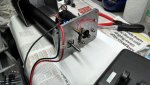
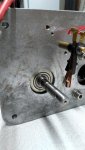
I'm trying to service my very old Autohelm 6000 linear drive. It predates SeaTalk and has the clutch with brushes, probably an original fit to our 1984 boat. It works OK most of the time, but it has become a bit notchy when in standby and I'd like to try and replace the balls in the re-circulating ball nut. However, I can't get the ball screw/nut out. I'm aware of how the ST6000 version disassembles, but this older version is different. There's a (ball?) bearing in the recess. There was a washer on top and a circlip holding that in place, now removed. I'd expect the shaft to slide out but it doesn't. Tapping it doesn't produce any movement either way either. Anyone done this before maybe?

(And yes it's old and past it, but the boat only has 2000 engine hours and a new linear drive is megabucks.)
 
I found really good video instructions for repairing the fault on my 1998 vintage drive on google...

Yes, I've scoured the internet for info but there's next to nothing on this older generation, much more on the one after with the brushless clutch etc.

The obvious thing is to drive the shaft out through the bearing but I'm reluctant to hit it/push it hard enough until I'm certain that's the way to go.
 
The obvious thing is to drive the shaft out through the bearing but I'm reluctant to hit it/push it hard enough until I'm certain that's the way to go.

If there's nothing obviously holding it in the bearing, then logically it should come out. It would be nice to have an exploded drawing of the assembly though.
 
On my later model on a Moody 44, I was warned here not to open up the bit with the multiple balls in it, as they would fall out, and muck would get inside, no matter how careful I was......

Are you certain there is a problem beyond, or are you just covering all the bases.

On mine, the main issue were the plastic helical gears, which wore down, and needed replacing with metal ones, (the correct way up!!)

Not sure if this is of any help :)
 
You could try to warm the surrounding "plate" up carefully and use plumbers "freezing spray" on the ball race and shrink it out that way.
I should add I've never tried it myself except on dents in car bodies and I used a hot air gun then.
Mike
 
On my later model on a Moody 44, I was warned here not to open up the bit with the multiple balls in it, as they would fall out, and muck would get inside, no matter how careful I was......

Are you certain there is a problem beyond, or are you just covering all the bases.

On mine, the main issue were the plastic helical gears, which wore down, and needed replacing with metal ones, (the correct way up!!)

Not sure if this is of any help :)

There is a problem - in standby it has become quite hard to turn to starboard, because I think the ball nut is not sliding smoothly. The worry is that it will jam. Others have stripped them down and replaced the balls, the first thing to wear I understand. Mine doesn't have the planetary gears - the clutch rotates and is powered by the brushes you can see. I appreciate the input though.
 
You could try to warm the surrounding "plate" up carefully and use plumbers "freezing spray" on the ball race and shrink it out that way.
I should add I've never tried it myself except on dents in car bodies and I used a hot air gun then.
Mike

Good idea with the freezing spray. I could try that on the screw shaft, which I think really should slide back out through the plate/bearing with enough force applied sensibly.
 
I think you are worried that opening it up without knowing the actual technique could do some unnecessary damage. You are hoping that someone will have done it before, and will have the definitive answer. In fact, if you know of people who have replaced their balls, do you know them well enough to find out how they did it?

When I was messing about with mine, someone at Raymarine sent me a technical drawing of the whole assembly, which he asked me to keep a secret as it wasnt for the public domain, (why, I have no idea?). This was my lightbulb moment, in terms of getting things working again.

In my case it was to show me which way up the planetary gears should be fitted, (they had a lip on one side, and not the other). Fitted the wrong way up, and the whole thing had a tendency to jam on a regular basis.

Given that yours is so old, is it possible that someone at Raymarine may have a diagram and instructions, which might not be such a secret over 30 years on?
 
I think you are worried that opening it up without knowing the actual technique could do some unnecessary damage. You are hoping that someone will have done it before, and will have the definitive answer. In fact, if you know of people who have replaced their balls, do you know them well enough to find out how they did it?

When I was messing about with mine, someone at Raymarine sent me a technical drawing of the whole assembly, which he asked me to keep a secret as it wasnt for the public domain, (why, I have no idea?). This was my lightbulb moment, in terms of getting things working again.

In my case it was to show me which way up the planetary gears should be fitted, (they had a lip on one side, and not the other). Fitted the wrong way up, and the whole thing had a tendency to jam on a regular basis.

Given that yours is so old, is it possible that someone at Raymarine may have a diagram and instructions, which might not be such a secret over 30 years on?

I have an exploded drawing of the more modern version with the gears but of course mine is different. I'll try Raymarine but I think I know their answer!
 
OK, I got a reply from the Cruisers and Sailing Forum from someone who has done this. He said it should just push out. So I put a two-leg puller on the motor plate and squeezed the end of the ball screw rod. It moved with a little bit of pressure and simply wound out with the puller, through the bearing. Result!

The ball nut seems to be in good condition still with little or no play. I can't get it off the screw but I have washed it with paraffin and all seems smooth enough now. I'm going to use a synthetic EP2 grease (Mobil Mobilith SHC 220). The ball-screw manufacturers rule out graphite and moly greases because they are too slippery for ball bearings and cause skidding rather than rolling apparently. It's hard to be definite but I think the ball screw was lubricated with a graphite or moly grease before, judging by its dark grey colour and by the way it left a grey film on everything.
 
OK, I got a reply from the Cruisers and Sailing Forum from someone who has done this. He said it should just push out. So I put a two-leg puller on the motor plate and squeezed the end of the ball screw rod. It moved with a little bit of pressure and simply wound out with the puller, through the bearing. Result!

The ball nut seems to be in good condition still with little or no play. I can't get it off the screw but I have washed it with paraffin and all seems smooth enough now. I'm going to use a synthetic EP2 grease (Mobil Mobilith SHC 220). The ball-screw manufacturers rule out graphite and moly greases because they are too slippery for ball bearings and cause skidding rather than rolling apparently. It's hard to be definite but I think the ball screw was lubricated with a graphite or moly grease before, judging by its dark grey colour and by the way it left a grey film on everything.
I have the exact issue you had and basically arrived to where you are in the picture. The rod in the center has jogged loose and now falls down into the arm. I'm not sure how to get the bearing out. I pulled rather hard but no movement. You said you used a puller.... Did you press the bearings into the arm and then they fell back out? Or is there something keeping them from going in?
view
 
Welcome to the Forum SVSUNYATA. This was a while ago but I think the issue I had was to remove the shaft from the bearing in order to access the ball screw inside. As explained above, in the end I used a 2 arm gear puller to push the shaft out of the bearing in the plate to release it. I hooked the arms onto the plate and screwed the central screw onto the end of the shaft and the shaft went back through without fuss. I left the bearing in place. I guess it could be tapped out with a suitable drift (typically a socket of appropriate diameter?).

To be clear, by "bearing" I mean the bearing in the plate holding the shaft. The shaft (do you call it the rod?) is held in the bearing by a circlip.
 
Top