Auto change over switch question

cygnusv

Well-Known Member
Joined
12 Feb 2013
Messages
287
Location
Yorkshire, UK
www.best-camping-stoves.com
Hi. I'm looking for an inexpensive switch to isolate an inverter automatically when mains current is 'on'. Making it impossible for mains and inverter power to exist at the same time.
Additionally, given that the inverter is off when mains is on, would mains power damage the inverter if mains power was applied to the inverter output cables. This would occur because I was planning for the inverter to directly replace mains input in the event of power cut or off-grid.
Alternative ideas welcome too.
Many thanks, cv
 
I wired one similar to this between shore power socket and rcd. It's double pole 2 way with centre off so won't allow shore power and inverter to be connected at the same time and stops the shore power socket being live when inverter is on. No probs having inverter output permanently connected to mains circuit.

20 AMP MAINS ROTARY CAM SWITCH, MOUNTED SWITCH PANEL CAM GENERATOR | eBay
 
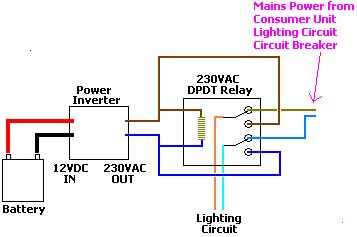
A simple and cheap solution would be a DPDT mains relay, with the coil connected to the inverter output. When the inverter is on, the shorepower would be disconnected automatically. When the inverter is off, the mains isn't connected to the inverter output. The following diagram came from Switch from Inverter to Mains Automatically | REUK.co.uk

auto-switch-from-inverter-to-mains-circuit.jpg
 
You can fit an inverter/charger that automatically changes over if the shore power supply is cut.

You can fit an automatic change over switch.

Neither of those option are exactly "inexpensive" though.

Inexpensive is a 3 position rotary switch.

Be aware, that you won't want the battery charger on when the inverter is on, but there are ways to prevent that, automatically.
 
Inexpensive is a 3 position rotary switch . Be aware, that you won't want the battery charger on when the inverter is on, but there are ways to prevent that, automatically.

Not only the least expensive option but also the one least likely to fail. Our 350w inverter alarm lets out a squeal of protest and then it auto trips with overload when I've occasionally forgotten to switch battery charger or water heater off, if we've previously been in a marina. I suspect most if not all will have overload trip so shouldn't be damaging.
 
Hi. I'm looking for an inexpensive switch to isolate an inverter automatically when mains current is 'on'. Making it impossible for mains and inverter power to exist at the same time.
Additionally, given that the inverter is off when mains is on, would mains power damage the inverter if mains power was applied to the inverter output cables. This would occur because I was planning for the inverter to directly replace mains input in the event of power cut or off-grid.
Alternative ideas welcome too.
Many thanks, cv
Sterling Power offer a range of manual and an automatic crossover switches. The manual switches are only a few tens of £s but the Automatic one cannot be considered to be inexpensive
 
Thanks guys. The answers I hoped to get!

I fitted a very similar item though mine has shore - off - inverter settings. I simply put it into the circuit feeding the sockets as that limits the inverter to powering the sockets. Mains charger and water heater are on a different circuit and cannot draw power from the inverter. I still need to consider what is plugged into a socket (e.g. Toaster, kettle and iron would be a bad idea). However, I do the same thing on shore power as water heater, fan heater, kettle and microwave would certainly be too much at once. It is just a matter of thinking about what you are plugging in to the system.

An automatic system might be worse in some ways as shore power might fail suddenly when you are running lots of things and overload the inverter. Of course it should cutout on overload either way. You could also flatten the batteries without noticing it. I imagine the extra features (warning, safety, auto-cutoff on low battery, auto switching, etc.) all add to the cost. I think that my manual switch was only about £10, certainly the cheaper option.

The most important thing to note is that any simple changeover switch should be "break before make". Anything saying "make before break" wouldn't be suitable. All the changeover switches I looked at were "break before make"
 
Last edited:
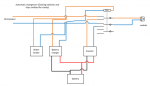
I have done a similar automatic changeover using a similar circuit to that of pvb (#3) but with the shorepower connected to the 240V relay coil. Battery charger and water heater can be connected to the shorepower supply and not via the relay. When shorepower is on the sockets will be connected to shorepower. When the shorepower goes off the sockets connect to the inverter automatically and the battery charger and water heater will be off. This assumes you will have the inverter ticking over when on shorepower ready to go when required. If there is a remote switch on the inverter use a 3 pole relay and use the spare contacts to switch off the inverter or use the spare contacts to switch off any other high power devices.
Some sort of warning indication would be good so you know that the shorepower is off and you are discharging the batteries.
1580667160965.png
 
Given that the OP is concerned about an inverter not a high output generator then I would suggest trying to power the ring main on the boat is asking for trouble. Trouble like uninformed people plugging in a load that will be excessive. (like a hair dryer). So I would suggest possibly better/safer to have a separate circuit or individul sockets for inverter in places where only your selected devices can be run from the inverter. So pull a plug out from one socket and insert in another for changeover. ol'will
 
Given that the OP is concerned about an inverter not a high output generator then I would suggest trying to power the ring main on the boat is asking for trouble. Trouble like uninformed people plugging in a load that will be excessive. (like a hair dryer). So I would suggest possibly better/safer to have a separate circuit or individul sockets for inverter in places where only your selected devices can be run from the inverter. So pull a plug out from one socket and insert in another for changeover. ol'will
The system could be wired so that just these sockets are supplied from the change over switch and used for items that might be powered from the inverter when the shorepower is not available . High load items would be plugged in to the other sockets that are only powered from the shore power. This would avoid having to swap from one socket to another
 
A simple and cheap solution would be a DPDT mains relay, with the coil connected to the inverter output. When the inverter is on, the shorepower would be disconnected automatically. When the inverter is off, the mains isn't connected to the inverter output. The following diagram came from Switch from Inverter to Mains Automatically | REUK.co.uk

auto-switch-from-inverter-to-mains-circuit.jpg
I have been using similar system for years with one little hiccup: I am running a normal 240V compressor fridge. I found out, when the change-over occurs while the fridge is running, the compressor starts pumping liquid. The system gets overloaded and the fridge destroyed eventually. I got in the habit of turning the fridge off (if it is running) before the switch-over and leave it off for at least 1 minute afterwards. No problems since. If you forget to do it OCCASIONALLY, the fridge usually survives - but don't tempt your luck.
 
Top