Attaching a drogues bridle. Shock and wear

pcatterall

Well-Known Member
Joined
2 Aug 2004
Messages
5,507
Location
Home East Lancashire boat Spain
Visit site
Still working on the drogue issue and now considering best way to attach.
My reading suggests that a purpose made chain plate at the rear is best but at this time I am just considering using what we have.
The loads can be considerable, measured on a PBO test at 200kg but that was just towing a drogue in calm conditions, obviously there will be more shock/higher loads in serious waves.
I had considered securing the bridle with a turn around the stern cleat then one around the winch and secured to the midships cleat. I just wonder what part of the load is taken by a full turn around a cleat? my instinct is 'most of it' !! I think a very small part would be taken by the winch. Another option could be direct to the winch for one turn and made off at the midships cleat as I guess the winch would take more like 50% of the initial shock? Are there any other suggestions please?
I don't suppose there is a use for a device like a mooring snubber in this situation?
 
Some thoughts; shock loads are absorbed by the material that the line is made from, so choose a suitable material such as nylon. I would be very reluctant to wrap a bridle around cleats and winches as it uses up valuable attachment points which may be required for something else. far better to take the time to instal dedicated mounting points: samson posts on each quarter are in my mind the best option, round or capstan style, not square profile; a dedicated horizontal bar that can be used to extend the bridle attachment points outboard may be required if the yacht has a narrow stern, aluminium and or section shape can be used to give stiffness, need to make sure that it can be secured to the quarter conveniently and strongly; dedicated padeyes bolted to the hull below deck line at each quarter, well backed inside, but you are working by leaning over the side to attach shackles.
 
Some thoughts; shock loads are absorbed by the material that the line is made from, so choose a suitable material such as nylon. I would be very reluctant to wrap a bridle around cleats and winches as it uses up valuable attachment points which may be required for something else. far better to take the time to instal dedicated mounting points: samson posts on each quarter are in my mind the best option, round or capstan style, not square profile; a dedicated horizontal bar that can be used to extend the bridle attachment points outboard may be required if the yacht has a narrow stern, aluminium and or section shape can be used to give stiffness, need to make sure that it can be secured to the quarter conveniently and strongly; dedicated padeyes bolted to the hull below deck line at each quarter, well backed inside, but you are working by leaning over the side to attach shackles.

Thanks, all good points! There seems to be debate about the desirability of stretch in drogue line as the drogues braking effect is reduced. I will be using nylon as I want to use my existing line. ( 3 strand with swivel) My current requirement is just to prepare the boat as well as possible using existing equipment and not using too much storage space. Having the gear and a plan is what I need to do.
I realise that there are other connected issues regarding secure stowage of equipment on and below decks also, from sole boards to the 'cocktail cabinet' !!
 
Much depends on the drogueo and the type of conditions you're likely to face. If offshore where dangerous breakers are the issue then the forces could be very high. Again if you using a hands off system like a JS Drogue then again the forces are higher again. I'm currently fitting specific chain plates which are massive and probably going to reinforce the hull where they are attached. The boat is 17t displacement and the worst case scenario could see a load of 8t on each chainplate given a huge wave stern on the stern. Needless to say the bow shackles are huge Crosby ones.
 
If attaching to sheet winches, it would be worth checking that the winches are installed so that they can happily take the load in the required direction. Sometimes sheet winches are fastened down so that they can take the sheet load from the expected direction of the sheet. Depending on your sheeting arrangement, the drogue load may well be in a totally different direction.
 
Much depends on the drogueo and the type of conditions you're likely to face. If offshore where dangerous breakers are the issue then the forces could be very high. Again if you using a hands off system like a JS Drogue then again the forces are higher again. I'm currently fitting specific chain plates which are massive and probably going to reinforce the hull where they are attached. The boat is 17t displacement and the worst case scenario could see a load of 8t on each chainplate given a huge wave stern on the stern. Needless to say the bow shackles are huge Crosby ones.


Just a point on the Jordan series loading. As there are many drogues spread along the line I guess that the loading will be ( relatively) constant as opposed to my idea of just two drogues where snatch is likely to give high shock loads ??
 
A few obvious thoughts:

1. Shock is NOT absorbed by the rope except for large chutes. Big mistake, because the drogue will not function until the line stretches (both Jordan and Sea Brake Specifically require low stretch line, and JSDs are often built with Dyneema).
2. Shock is absorbed by the drogue pulling through the water. The load cannot exceed the resistance of the drogue at the boat speed. This depends on the drogue, but for all but a large chute or long JSD is not that great (a ton or so). Show me math that proves that wrong. This is NOT like anchoring.

Yes, Jordan shows some very high design loads, but those are for a long JSD AND have a substantial safety factor. Nearly every other drogue tops out below 2000 pounds at 15 knots.
 
Just a point on the Jordan series loading. As there are many drogues spread along the line I guess that the loading will be ( relatively) constant as opposed to my idea of just two drogues where snatch is likely to give high shock loads ??

See Thinwaters posts. The loads shouldn't really be snatching. It should be a fairly constant pull providing your line is long enough that the drogue isn't popping out of a wave face.

I only carry a drogue for survival situations whereby breaking waves are unmanageable because of surfing or the sea state means two of us can't continue to sail the boat due to fatigue and we need a safe hands off solution, where heaving-to is no longer viable.

I see you are in the Med and I would question the need for a drogue. Remember you will keep sailing so you need a lot of sea room if you deploy. If you're generally doing 1-2 day hops then the liklihood of you being caught in a big breaking sea where you had enough searoom to deploy might be limited?

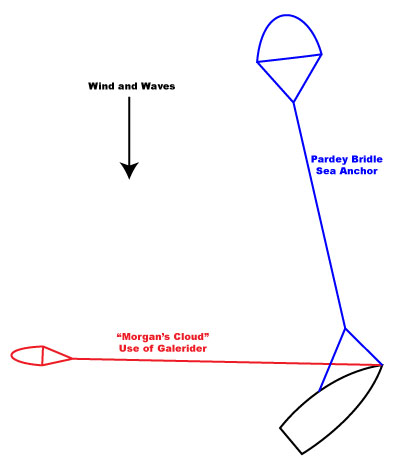
I'd have thought a better system would be the Morgans Cloud heave-to system with a drogue:

harries_galerider-768152.jpg


I.e. Normal heave to but a drogue adds additional support to prevent the boat ever sliding down to a dangerous angle to the waves if they're breaking. I have a Jimmy Green drogue for that purpose and then the JSD for a worst case scenario when well offshore.

Source: https://www.morganscloud.com/2013/06/01/stopping-wave-strikes-while-heaved-to/
 
It is also worth remembering that 200' of polyester is not no stretch; it is about 3x less stretchy than nylon, but will still give 5 feet in a good hit. Amsteel is far more more no-stretch. The manufacturer consensus seems to be that that polyester stretches just the right amount for this purpose.
 
Nylon used for attachment to the boat may MELT under extreme load

suggest chain for the above water bridle attachments

dacron or dyneema/spectra are other good choices
 
^^ Unless there is data (please share), melting at extreme load requires hard cycling (more a problem with chutes than drogues) and large diameter line (anything smaller than 3/4" can dissipate the heat--fat stuff can hold heat). I don't believe this applies to the OP. I studied this for a magazine article on breaking strengths.

However, for drogues other line materials are better (stretch is not good for drogues--manufacture recommendations).
 
A few obvious thoughts:

1. Shock is NOT absorbed by the rope except for large chutes. Big mistake, because the drogue will not function until the line stretches (both Jordan and Sea Brake Specifically require low stretch line, and JSDs are often built with Dyneema).
2. Shock is absorbed by the drogue pulling through the water. The load cannot exceed the resistance of the drogue at the boat speed. This depends on the drogue, but for all but a large chute or long JSD is not that great (a ton or so). Show me math that proves that wrong. This is NOT like anchoring.

Yes, Jordan shows some very high design loads, but those are for a long JSD AND have a substantial safety factor. Nearly every other drogue tops out below 2000 pounds at 15 knots.

I can see that just as you begin sliding down a wave into some bottomless pit you want the immediate brake of your drogue and not to wait until 200 feet of nylon stretches first.
But here is Jimmy Greens take on this
(These Liros octoplait nylon warps are made specifically for use with drogues. Check the chart to find the most suitable size. Each Line is made from top quality Liros Nylon complete with s/s eye splice one end and Loop splice the other. A long Yacht Drogue Warp provides good stretch and therefore means the load builds up gradually on the drogue instead of shock loading. LIROS octoplait nylon has the required stretch properties and balanced construction. 3 strand rope may be liable to twist and cockle when under load due to the length.)
 
I can see that just as you begin sliding down a wave into some bottomless pit you want the immediate brake of your drogue and not to wait until 200 feet of nylon stretches first.
But here is Jimmy Greens take on this
(These Liros octoplait nylon warps are made specifically for use with drogues. Check the chart to find the most suitable size. Each Line is made from top quality Liros Nylon complete with s/s eye splice one end and Loop splice the other. A long Yacht Drogue Warp provides good stretch and therefore means the load builds up gradually on the drogue instead of shock loading. LIROS octoplait nylon has the required stretch properties and balanced construction. 3 strand rope may be liable to twist and cockle when under load due to the length.)

And that just goes to show how much is opinion.

I will say that many authorities (take that for what you will) do not consider plain cone drogues very suitable at high loads and high speeds. They tend to become unstable. I would tend to favor other manufacturer advise, since he is in the distinct minority and seems to be old-tech on this. Having tested drogues, his "shock loading argument doesn't feel valid (there is no opening shock--that isn't how they behave on a long rope).

Also, given how few drogues are sold, I seriously doubt the ropes are purpose-built. Sounds like an exaggeration.
 
Last edited:
Top