At what age should a boats seacocks be replaces or at least removed and checked.

mocruising

Well-Known Member
Joined
21 Mar 2004
Messages
817
Location
TURKEY
Visit site
I am thinking about removing all the seacocks this winter as we are approaching the time of our first transatlantic winter of 2015. What is the general opinion of how frequently they should be removed and replaced or at least removed cleaned and checked over. Bearing in mind we have about fifteen seacocks in total.
 
Surveyors do not remove any, they tap the metal in the vulnerable places, mostly where the section is thinner on hose tails and skin fittings, to detect dezincification. Paul Stevens uses a small hammer and a metal screwdriver. You can probably detect DZ by the change in sound, porous copper sounding dull with no ring.

One of the best ways to detect any problem is to heave the attached hose vigorously side to side. Many whose seacocks have failed have found out accidentally this way, leaning on the hose when doing something else.

Check that the ball in ball valves is still there and doing something, as several users have found that although the handle turned it was not attached to anything.

Clean off antifouling on seacock flanges outside, abrade back and check for pinkness. Many photos on my website, >metallurgy>brass and bronze
 
Surveyors do not remove any, they tap the metal in the vulnerable places, mostly where the section is thinner on hose tails and skin fittings, to detect dezincification. Paul Stevens uses a small hammer and a metal screwdriver. You can probably detect DZ by the change in sound, porous copper sounding dull with no ring.

If you haven't checked them for a while, suggest you do it now. A Beneteau Oceanis here started taking water on a couple of weeks ago, shortly after launching, which was traced to a "crumbled" seacock hose tail. Hauled out again, inspected the rest and found another in the same state. Fortunately, the problem was found when alongside in a marina and he was able to turn the seacocks off.
 
Check ours annually- take them to pieces whenever we haul and give them a good clean and re-treat with copper grease. We have all Blakes seacocks. Boat now 22 and all fittings original. Tend to 'exercise' the fittings every two-three weeks just to make certain that everything is moving well.
 
I am thinking about removing all the seacocks this winter as we are approaching the time of our first transatlantic winter of 2015. What is the general opinion of how frequently they should be removed and replaced or at least removed cleaned and checked over. Bearing in mind we have about fifteen seacocks in total.

It's advisable to check on every lift-out. My main toilet seacock failed by the actuating shaft shearing after 12 years - there was no other sign of de-zincification. The seacock tail - in the boat since 1990 (23 years), was showing definite signs of de-zincification.
Unfortunately, a number of boat-builders appear to use conventional brass fittings - raw-water intakes appear to be the first to fail, often within the first 10 years of life.
Glass-reinforced plastic fittings appear to be a better bet than even Admiralty bronze (which the tail was).
 
The following applies to boats kept in salt water in temperate climates.

What follows is based on owning the same boat, fifty years old when I bought her, for thirty years:

Are we talking about taper plug seacocks, as made in bronze by Blakes? If yes, they are good for at least 50 years, absent electrolytic action problems, but change the bolts every twenty years.

Gate valves are unfit for use in any boat.

Ball valves are pretty iffy after ten years

BEWARE the use of brass and manganese bronze in valves and in through hulls where the through hull is not integral as it is with a Blakes' seacock .
 
Whenever we slip I check all seacocks and through hulls, luckily most of mine are Blakes or the admiralty equivalent, (no longer available) I pull a couple of bolts from the blakes and if any corrosion on them, replace the lot, with silicon bronze. Including nuts and washers, often forgotten!! Hose tails are aldso checked at this time, its not a lot of work even on my twelve below the waterline, seven of which are blakes, valves and through hulls. I am also extremely careful with anything I have to replace in seacock area, to ensure its real bronze and compatable. Lots of so called "bronze" is just expensive brass. With a quite high zinc content and if theres zinc in there, it can and will de-zincify.
 
Even Blake's seacocks fail if neglected. One did in my local marina a few years ago, sinking the yacht. The insurance company refused to cover the damage, on the grounds that the seacock had not been properly maintained. So be warned.
 
Do you know why it failed? I would be interested to what the contentious issue was as the only maintenance I carry out on my Blakes seacocks is to knock out the cone, clean, grease and replace.
 
Do you know why it failed? I would be interested to what the contentious issue was as the only maintenance I carry out on my Blakes seacocks is to knock out the cone, clean, grease and replace.

Years ago, I removed a seized Blakes on our Berwick and found the through hull bolts to be corroded and needed replacing.
 
I had a Rowe (similar design to Blakes) fail because the cone had worn oval and would not seat properly. Made the mistake of slackening off the keep plate to operate it and forgot to tighten it up again. Slight weep but enough in a few days to need a panic haul out. Only really traced the fault when I tried to grind the cone in. Replaced with a new Blakes - no beer for a few weeks!
 
Can't say for certain, but the local rumour mill were giving out that the Blake's seacock failure was caused by electrolytic damage, and the owner had admitted never checking it since the boat was new. There are berths in our local marina which have a reputation for high yacht electrolysis - it is said those close to the lock gates - but no-one knows why.

On my steel yacht all the seacocks - including Blake's - had to be replaced over a period of 20 years, apart from the two that were made of Marelon.

I would guess regular inspection and partial dismantlement every few years would suffice to prove seacocks are being maintained, but getting a professional survey once in a while is the ultimate way to keep insurers satisfied.
 
Last edited:
Thanks for that. I guess electrolysis is of minimal concern for my wooden boat on a swinging mooring. Many more important potential catastrophes to worry about!
 
Stem failure

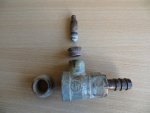
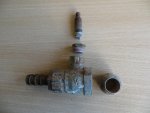
As an example of what can happen, I found my cooling water seacock was not working. The boat is 19 years old, and I believe all the skin fittings and seacocks are original. The skin fittings and seacocks all appear externally sound, with no evident de-zincification, and heaving on them / tapping with a hammer doesn't show anything bad.

I found that the ball wasn't moving on this one, so removed it. The end of the stem that engages with the ball has disappeared, and some sign of de-zincification can be seen on the stem gland nut. The body and ball don't seem to have deteriorated. Not sure what material the body is, but it seems to have had no problems in 19 years.

Looking at available ball valves, I have found ones that are in DZR brass that have DZR brass balls, but do not quote the materials for the stem, and more expensive bronze ones that have 617N [non DZR] brass balls and stem. Not seen any that are fully DZR. I think I'll be replacing it with a plastic valve.
 

Attachments

  • IMG_3052.jpg
    IMG_3052.jpg
    91.9 KB · Views: 5
  • IMG_3053.jpg
    IMG_3053.jpg
    92.5 KB · Views: 3
I found that the ball wasn't moving on this one, so removed it. The end of the stem that engages with the ball has disappeared, and some sign of de-zincification can be seen on the stem gland nut. The body and ball don't seem to have deteriorated. Not sure what material the body is, but it seems to have had no problems in 19 years.

Looking at available ball valves, I have found ones that are in DZR brass that have DZR brass balls, but do not quote the materials for the stem, and more expensive bronze ones that have 617N [non DZR] brass balls and stem. Not seen any that are fully DZR. I think I'll be replacing it with a plastic valve.

In a current production valve in good condition the fluid never sees the stem. The two seats against the ball seal the fluid from the body of the valve. In your pics it would seem that the ball is quite pitted, or rough maybe by fouling, which has allowed seawater to get into the valve body. As valves age the seats tend to leak, which is why there is some sort of seal on the stem. 19 years isn't a bad innings for a valve costing only a few pounds!

Good photos though, may I use them on the website please?
 
Thanks for the comments. Not sure about the stem not seeing the fluids - when the valve is operated, won't the bore cross the seals and allow fluid into the body cavity? I'd be interested in what the valve would have been made of, as it seems to have survived so well for so long, compared with the more recent horror stories. The ball would have been in better condition if it had been working, not sure when the stem gave up - it was fortunate for the engine that it still got enough flow, and fortunate that I didn't have any other problems that would have need the valve to close to keep the water out.

The hose tail came out of the valve quite easily, no signs of de-zincification on the body there either - though possibly a bit on the hose tail thread crests.

You are welcome to use the photos.

Regards
 
Surveyors do not remove any, they tap the metal in the vulnerable places, mostly where the section is thinner on hose tails and skin fittings, to detect dezincification. Paul Stevens uses a small hammer and a metal screwdriver. You can probably detect DZ by the change in sound, porous copper sounding dull with no ring.

One of the best ways to detect any problem is to heave the attached hose vigorously side to side. Many whose seacocks have failed have found out accidentally this way, leaning on the hose when doing something else.

Check that the ball in ball valves is still there and doing something, as several users have found that although the handle turned it was not attached to anything.

Clean off antifouling on seacock flanges outside, abrade back and check for pinkness. Many photos on my website, >metallurgy>brass and bronze

This maybe stating the obvious, but I sugest that the boat is out of the water before carrying out the above checks!
 
What's peoples opinion of this one? It's a Beneteau setup, about 4 years old,

I'm wondering if the pink is dezincification?

The Ball valve is Sferaco ACS No 4 ACC Brass CW 614N (Tonval brass also called CW617N or CZ122 or OT58) + EN 12165(chromed)

It seems? the Beneteau spec for the through hulls was changed in 2006/7? (due to early failures?) from = CuZn40Pb2(CW617N) to CuZn36Pb2As [FIXED] @ 0.1% arsenic DZR protection. The through hulls seem to be made for Beneteau by Plastimo, and have a rubber sealing ring rather than chemical sealant.
 
Last edited:
Top