
Are you a nice person? Do you like BEER? Do you have a Mercruiser D4.2L engine.... Im Willing to trade Beer for oil pressure info!???

propellerpete

New Member
Joined
27 Jun 2014
Messages
12
Location
christchurch
Visit site
Do you own a Mercruiser D4.2l Old school pre d tronic deisel engine cica 1994 - 1999?.... do you like beer? Then I NEED YOU.... Please help!

Hi All, Il cut a long story very short with this, ive been chasing myself around for 5 weeks in talks with various different specialists and even an VM rebuider trying to find out if my oil pressure readings are rite or wrong!

Basically im hoping that a member on here will be able to help me out by taking a oil pressure reading from the location of the oil pressure switch in the oil cooler thermost housing. I am willing to reward with some beers funds for anyone who is willing to help! ?

Basially i have the mercruiser manual 21# which specifys oil pressure at rated rpm but does not specify where that reading should be taken from (I KNOW RITE>>>REAL HELPFUL:unsure:)

"at 80-90*C @ 700 RPM 1.5-2.5 Bar (22 - 36 Psi)
@ 3600RPM 3.5 - 4.0 Bar (50-58Psi)"

I have taken a reading at the oil pressure switch in the oil cooler thermostate housing it read 7.1 bar at 3600 RPM @ 80*C oil temp and again at the oil pressure sender on the third crank journal on the block which read 4.0 Bar at 3600RPM 80*C...... one of these is happy news the other is a dark cloud over me...guess which!


Something doesnt add up and knowone is able to gimmie a straight answer.... either its apsalutely fine and the pressure is being regulated after the oil pressure switch and im chassing myself down a rabit hole or something is up and i need to pull the engine out before something gets mullered. my understanding from my profesion is that to with a few psi oil pressure is linar across the engine so 4 bar at the pump means 4 -3.85 bar at the furthest crank journal.... not 7.1 bar just after the pump and 4 bar everywhere else.

engine has 1200 hours and is meticulously looked after

Ive studied the oil schematic a thousand times and it shows one pressure relief valve fitted directly at the pump that spills excess pressure back to the sump. From there onwards its through thermostatic control then either directly to filter or via cooler to filter and then into the galleys. The oil and filter have been changed, filter replaced again just incase and all is oem spec and oem parts. If the pressure relief valve was stuck shut then i would expect to see the same high pressure across the engine at both locations of measurement...so you see a bit of a mystery.....

Could you help? If youre able to help i require the following,

Please install a manual oil pressure guage in replacement of the oil pressure switch in the oil cooler thermostatic control body. Run the engine up to operating temperture and then take a reading with the engine at 3600 RPM. the boat doesnt have to be in gear or moving to take the final reading, it can be done in neutral. MUST be hot and MUST be those rpm and MUST be that location with a photo of the guage showing the pressure... For this i will happily send you some beer money for your efforts and a massive thankyou!

please help me out if you can, this is my last call to sanity before i remove the engine on a maybe????
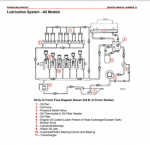
1602507682929.png
 
Last edited:
Are you a nice person?

Not according to my mates who all call me Baaaaarstid

Do you like BEER?

Very much

Do you have a Mercruiser D4.2L engine....

Nope

Im Willing to trade Beer for oil pressure info

@spannerman


Pointing you in the right direction has gotta be worth a six pack right?
 
I dont understand what you are worried about??? you have 4 bar at the oil pressure sender and the manufacturer quotes 3.5 to 4.0 bar ..what are your concerns??
I admit I don't have this engine, but in all engines the oil pressure will decrease from the time it leaves the pump, as each path adds its own restriction to oil movement, down stream the pressure will fall, so in general if you could measure the pressure after every component the pressure would drop incrementally until it reaches the sump. for example I would expect the drop across the oil filter to be about 3psi clean and about 20 psi dirty. similarly things like the oil cooler will have a pressure drop across it as will all the other components each taking their toll on the oil pressure. when you add all this up together it could have a significant decrease in the oil pressure across the two places you have measure it.
 
Last edited:
  • Like
Reactions: vas
the concern is the 7 odd bar pre sender... it shouldnt be that high without reason.... high oil pressure means a restriction somewhere... a restriction means a reduction in oil being fed something.... or worst case an over pressurization of the filter/ oil cooler that could spell disaster if either let go.... 3.5 bar is huge... it is either designed that way or its at fault but neither mercruiser or vm can tell me otherwise..
 
I dont understand what you are worried about??? you have 4 bar at the oil pressure sender and the manufacturer quotes 3.5 to 4.0 bar ..what are your concerns??
I admit I don't have this engine, but in all engines the oil pressure will decrease from the time it leaves the pump, as each path adds its own restriction to oil movement, down stream the pressure will fall, so in general if you could measure the pressure after every component the pressure would drop incrementally until it reaches the sump. for example I would expect the drop across the oil filter to be about 3psi clean and about 20 psi dirty. similarly things like the oil cooler will have a pressure drop across it as will all the other components each taking their toll on the oil pressure. when you add all this up together it could have a significant decrease in the oil pressure across the two places you have measure it.

yes however all these components so far have idenical bores and are 6 iches apart from each other.... the key to lubrication isnt really about pressure its about flow.... high flow low pressure of a few bar is all thats needed to keep the crank bearings floating, the need for greater pressure is as you said and i agree to furfil a pressure simmilar to 1 1.5 bar at the furthest component typically the cam shaft, cam followers and rocker arms. To achive this a greater pressure it is required to make up for all the incremental loses.... but 3-3.5 bar off loss....... put it this way.... lowest oil pressure accepted on the test is 1.5 bar... through the death switch starts shouting at 1.0 bar.... so they are only ever expecting a 0.5 bar loss over the age of an engines wear before they condem it needs overhauling..... seems a bit too narrow to be losing 3.0 - 3.5 bar on a whim unless it has been designed that way....

Im just trying to get to the bottom of it before i either waste a load of money for nothing or ignore it and have my days fishing cut short with in prompture visit from captain conrod blowing through the block (an unlikely occurance but you get my jist!)
 
  • Like
Reactions: B58
I suspect there is nothing wrong - but its a bit odd. Have you got a diagram of the oil thermostat housing? I am pretty sure the oil pump and relief valve cannot created such a high pressure.
I am wondering if somehow the oil is trapped in the thermo housing when the thermostat is closed and the extra pressure you have measured is created by thermal expansion before the oil thermostat opens. Do you know what oil temp the oil thermostat opens at?
 
ive had the oil stat and housing off this weekend, the gallys leading to and from the state are about 1/2" and the stat cleanly moves between its closed and open poisition, no where in its travel is there any less then 1/2" of one or combined galley exposed.... is either designed this way or the issue is now internal to the block.... next plan of action is to remove the PRV and check it but im doubtful in it.... stat operates from 90*C

to make that a bit clearer, it has on entry port and two exits, when closed oil enters and exits straight to the filter, when stat opens it diverts the flow through the oil cooler then to the filter housing.... so all three compononts are seeing 7 bar... oil filter, thermostat and the cooler
 
Last edited:
A canister type filter should be good for at least 300 psi, we used to pulse test oil filters for 5000 pulses at 200psi. In the early days of the spin on canister filters we had cold start failures at the arctic circle so we had to make sure the filters could take some pressure.

is the oil cooler feed and return on flexi hoses?? if so I would suspect internal collapse of the core, I've had this before a piece of the internal opened up like a pocket under flow conditions and blocked the line.

Silly questions :

Is this something that has recently happened if so whats changed?

Is this engine a rebuild or not?, been running for how many hours, new or new to you?

what kit are you using to measure the pressures? one gauge or 2? are they on gauge lines or coupled direct ,have you tried the set up against a reference pressure?

whats the condition of the oil, has the engine oil been changed regularly, are you using the oil that's recommended for the engine?
 
Last edited:
Freebee.... interesting stuff.... id looked up the specs on the filter via a reputable OEM supplier and FRAM rate the filter speced to this engine to a max pressure of 10 bar. reports from other engine posts (not same as this one admittedly) with stuck PRV`s blowout the bottom of the filters and distort the canisters... I could well be chasing my tail but id have thought any pressure difference that great would be common knowledge and clearly refered to by Mercruiser and VM in their workshop manuals as a point of caution when operating and repairing any of the components involved? Trouble is in the 4 years ive owned the boat we have never had reason to suspect the oil pressure because all has been fine on the dash guage which as ive stated is at the point where the manual reading was correct. But by chance having checked the pressure at the oil pressure switch for ease of access when taking the very first manaul reading of this engine im now aware of the high reading and am now concerned!
 
Silly questions :

Is this something that has recently happened if so whats changed?

Had a turbin blade failure on the turbo, lost a 5mm piece of one blade and that wizzed out the exhaust leaving me with an annoying whistle, ran the boat back to the mooring for no more than 30 mins, low revs very litle boost. removed the turbo and had it rebuilt with borg warner parts by turbo dynamics. havinf refitted it and sea trialed all was good, then following week returned to the boat to find an oil leak from the exhaust elbow, popped it off to find a pool of oil in the turbo... spoke to TD they suggested a few checks first before condeming the turbo, removed drain, no blockage, commpression test to check for crank pressurising all in spec and equal. so next port of call was the oil pressure.... ironically since ive not had any further leak from the turbo but now awarte of this high pressure.

FYI turbo oil feed is at far end of the block last thing in the line from the feed far after the oil pressure sender where i measure the 4 bar at so i have no doubt its anytrhing to do with that.... its something between the pump and the third journal via the filter, therm and cooler.

Is this engine a rebuild or not?, been running for how many hours, new or new to you?

Engine is 20 years old, 1200hrs total run time, never been taken apart since new. starts and runs like a dream. been mine for 4 years before that one other owner from new, we took her on with 760 hrs.

what kit are you using to measure the pressures? one gauge or 2? are they on gauge lines or coupled direct ,have you tried the set up against a reference pressure?

using an automotive test kit, following the first test i checked the guage against two other know pressures and against another guage, all correct. replaced the guage out of precation and retested and results the same. guage is on a remote hose but used identically on both locations for measure.

whats the condition of the oil, has the engine oil been changed regularly, are you using the oil that's recommended for the engine?

oil is new, oil get changed every 200 hours or annaully which ever comes first. oil is as speced by the manual, only one listed 15/40W CD
 
Last edited:
could possibly root out the cooler, thats a good call, or remove the thermostate which would mean oil can take either root which would relieve any pressure of a blockage on root B or C... guess if i did that and pressure dropped i know its in root B or C.... if it doesnt change then its not in either.....

read it like this : oil under 90*C Root A feed into the stat housing.... stat is closed so oil returns out to the filter on root B
oil over 90*C Root A feeds into stat housing...stat is open so oil directs down C through cooler and into filter.
so if i remove the stat the oil can take either path and as we all know the rule that energy in all forms will taker the path of least resistance.... therfore bypassing any restriction (IF THERE IS ONE) and lowering my guage reading..... if pressure reads the same then both roots are Good!
 
the concern is the 7 odd bar pre sender... it shouldnt be that high without reason.... high oil pressure means a restriction somewhere... a restriction means a reduction in oil being fed something....

I've tried to forget Bernoulli's Principle and fill my brain with useful things instead.

But I do remember enough to know that you can't take pressure readings in a system with a moving fluid that has a variety of different sized pipes and channels and expect to get consistent readings at all points along the way. A high pressure reading at one point does NOT mean a restriction somewhere else. It just means that the pressure there is higher.
 
FlowerPower mentioning Bernoulli got me thinking.
You are taking measurements at two points in the engine. One where the oil is moving, you are measuring the dynamic (moving liquid) pressure - that's what your engine instrument displays.
the other point in the oil thermostat housing where the oil is not moving (or not much) when the thermostat is closed. At that point you will be measuring the stagnation pressure which will be quite a bit higher.
have a read of this see if it makes sense:
Stagnation pressure - Wikipedia

try measuring again with the thermostat removed so the oil is moving in the thermostat housing all the time and see what results you get.

The other way to think about it is that a moving liquid exerts a lower pressure than a static or slow moving liquid. (Venturi)
Your normal oil pressure (measured near the crank journals) is controlled by the oil pressure relief valve and that's what your engine instrument displays. In places in the engine where the oil is trapped (static) the local pressure will be higher.
I don't think anything is wrong with your engine, you have just stumbled across a static oil point.
 
kashurst says it rather better than I did.

If I remember correctly, liquid in a system that is faster moving will be at a lower pressure than liquid moving more slowly in the same system, which will be at a higher pressure. The equations are complex, and look like Egyptian to me now, plus there are many other variables in a "real" system.
 
Are you a nice person?

Not according to my mates who all call me Baaaaarstid

Do you like BEER?

Very much

Do you have a Mercruiser D4.2L engine....

Nope

Im Willing to trade Beer for oil pressure info

@spannerman


Pointing you in the right direction has gotta be worth a six pack right?

Bruce, you had a six pack but its turned into half a barrel now.
 
Top