Are Volvo Penta in the real world

I am well aware that on some boats it is not as straightforward and had I chosen a boat with this arrangement it would be factored into the decision making process. Not checking simple things before venturing out on the open sea is lazy at best. When I have my family and friends on my boat their safety is my responsibility. A simple break down at sea can escalate very quickly into something much worse . IMHO of course.

Just a quick thanks to Volvopaul and the other valued contributors on this forum. It is their knowledge that makes it such a valuable resource.

Indeed, I believe this chap is a, perhaps slightly extreme but valid, example of the type who doesn't think checks and maintenance are particularly valuable use of his time. https://www.theguardian.com/uk-news...ate-in-speedboat-crash-on-thames-is-in-hiding
 
God BP don't get into flying, the pre-flight checklist will blow your mind in comparison lol.:rolleyes:;)
 
Just a quick thanks to Volvopaul and the other valued contributors on this forum. It is their knowledge that makes it such a valuable resource.

And I hope anyone that generates debate so that people can think, ponder, perhaps learn and decide for them selves having heard several sides to the debate
 
I’d agree that lifting the hatch was a pain when I had the S24.

But I did lift it at the start of the weekend to have a poke around and see that all was well - if the engine on a single engined boat stops working, then that’s not a great situation to be in.

And best of all, perfoming the checks is free. It costs nothing other than 10-15 minutes of time.
 
There are many boats on the Norfolk broads where I am at present. I know this is not the sea.... I wonder how many people do these checks or even know where to look to do them
 
BB, what maintenance do you do. From reading your posts I imagine very little with the cheapest parts used when pushed, every corner cut where possible. Please tell us this is not the case.
For my part I do always check the oil & water, belts etc. (I pay particular attention to rubber residue around belts)
Last thing I want is to run into trouble with family on board.
 
Definitely worth checking oil every trip. I had a leak from oil filter after service, the check I performed caught this before all the oil was in the bilge. Probably saved the engine, they don’t like running with no oil pressure for long,
 
Reading the responses in my oil change thread prompted me to read my KAD32 maintenance manual supplied originally with the boat.

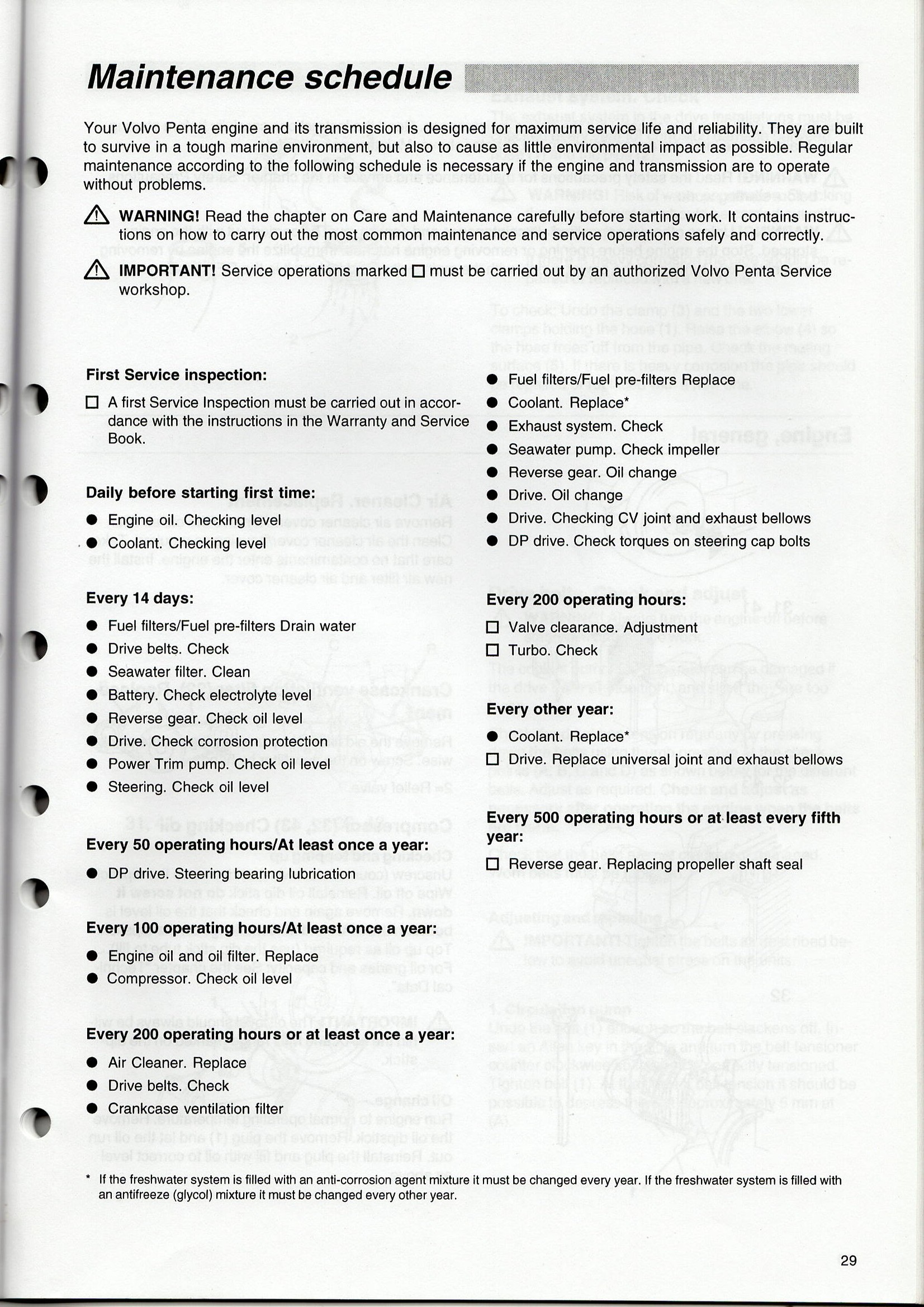
Looking at the maintenance schedule I asked myself the question 'What planet do these guys live on'. I attach a scanned copy and ask myself given the difficulty with engine access on most boats and the effort required just to lift the hatch who on earth (excluding the OCD Brigade) checks their engine oil and coolant level every day before use. Look also at the 14 day checks !.

I am very DIY minded and do 90 % of work on my house, cars, Motorbikes, Toy Planes, and boats etc myself..... How would any less hands on person do all the checks in the time scales detailed in this schedule.


This leaves me thinking are they in the real world and can we believe most of their maintenance advice

EPSON011.jpg

I fail to see the problem? Daily engine checks are essential for most boaters?
 
I don't think it is specific to any manufacturer - we were taught to do a similar set of checks during our Dayskipper Practical.

It is certainly true that they can be a bit of a pain to do on some boats. We've had our current boat for a year - I was tidying up the aft cabin last week, leant on a shelf which moved slightly, investigated and found that it lifted out to expose the coolant header tank, seawater intake filter and gearbox oil dipstick a few inches below... I had been struggling to reach them past the engine through the companionway all last year - Doh!
 
Nattering to chum on the pontoon a day or two ago, long term offshore boater which much experience.
He was recently asked by another club member if there was any chance of him tagging along with his boat when my chum went on a planned trip round to the Solent.
Chum politely said, Sorry but No. He believed the other boat was not looked after well enough for that journey and would prefer not to travel in company with him.
 
Our Broom is B*gger to do full checks but checks I do regardless of what a pain it is.

I can't imagine jumping on the boat firing her up and being away. I would much rather so the checkls and find a potential issue while in the marina rather than bouncimng about at sea, it just eminetly sensible to me.

Go with your regime BP if you are happy with it - I know I would not be.
 
Definitely worth checking oil every trip. I had a leak from oil filter after service, the check I performed caught this before all the oil was in the bilge. Probably saved the engine, they don’t like running with no oil pressure for long,

Interesting that the problem you had which could have been worse was caused by the service work ! presumably carried out to prevent problems
 
Our Broom is B*gger to do full checks but checks I do regardless of what a pain it is.

I can't imagine jumping on the boat firing her up and being away. I would much rather so the checkls and find a potential issue while in the marina rather than bouncimng about at sea, it just eminetly sensible to me.

Go with your regime BP if you are happy with it - I know I would not be.

But you don't know what my regime is...….. You should not assume that because a person seeks to generate a discussion or argue an opposing view at a particular time in order to gauge views...... that they hold one particular view over another.

I have always believed that the 10th Man theory is very important


We need the
 
BB, what maintenance do you do. From reading your posts I imagine very little with the cheapest parts used when pushed, every corner cut where possible. Please tell us this is not the case.
For my part I do always check the oil & water, belts etc. (I pay particular attention to rubber residue around belts)
Last thing I want is to run into trouble with family on board.

When you say what maintenance do I do...… Do you mean what do I personally do with my own hands or what do I pay to have done... The reason I ask this is because I believe there is a big difference.


Firstly you are incorrect in your assumption that I do very little and that I cut corners, When you say cheapest materials are you implying that inexpensive means that they are poor. If people pay it done and just look at bits of paper saying what has been done do they actually know what was done using what materials and parts.


But to answer your question across my 8 or so boats. I personally:

On my outboards (mainly 2 strokes kept out of the water):

Change the gear box oil.
Change the petrol filters.
Change the impellors. and ensure a free flow of cooing water
Spray the various engine parts with WD40 or similar
Ensure that the fuel pipes are free from damage
Grease the various grease points
Change the water separating filter
Generally clean them and paint etc where any corrosion might be happening.
Inspect and change the anodes as necessary.

On my Inboards I:

Change the main engine oil
Change the impellors
On the legs change the gearbox oil
Change the bellows
Change the anodes
Change the belts
Change the spark plugs on my Petrol in board
Keep an eye on the steering and other oils
Keep the anti freeze topped up
Winterize as necessary
Change any air filters
Check and empty any raw water filters
Antifoul the hull and leg as necessary
Keep any eye on and test batteries
And other stuff I cant think of off the top of my head right now

I also have about 7 - 8 trailers that also need maintenance.

As for the intervivals I do these things when from experience and other factors I feel it is necessary.

What I don't do is follow some timescale which is based on a random period of time called a year or bow to what is often OCD or similar.


Does that answer any of the questions you asked

I Have answered your question so perhaps you will answer one of mine:
Tell me do you do your own maintenance or pay others to do it out of interest...………. Much easier to pay others if you have the cash and also much easier to preach
 
Last edited:
It’s not necessarily as clear cut as this though, is it?

BP seems to be referring mainly to inland boating, and most respondents coastal boating.

I do both, and follow a different regime depending what I’m doing.

First off, when we get to the boat I lift the floor and do all the normal checks before first start irrespective.

But, if we’re off on a two week upriver cruise on the upper Thames that is pretty much t for floor lifting. I have two small Inspection hatches at the rear of the engine bay, over the raw water strainers. Every morning after start, I’ll check the hatches. If: there is water flow and the baskets are clean, and the oil pressure rose as expected on start, and there is no water or oil in the bilges, I’m happy and start the days cruise.

However, for coastal cruising I lift the full engine bay hatches and do the works before every trip.

It’s about risk assessment really. Failure at sea = potentially big problems - hence full checks.
Failure on the upper Thames = inconvenience - hence if oil px rises as expected an there is no oil in the bilge it is unlikely that I have a problem.
 
Interesting that the problem you had which could have been worse was caused by the service work ! presumably carried out to prevent problems


Isn’t it. In aircraft engineering (my old profession) this very subject was subject to much debate.

Many years ag a Lockheed TriStar suffered a triple engine failure due to incorrect maintenance leading to all three engines running out of oil on the same post maintenance flight.

Previously, the ethos had been pretty much that there was no such thing as too much maintenance. Following an industry conference named MSG 3, airlines and manufacturers took a more risk based approach to maintenance, and the upshot was a deletion of many checks, and extension of maintenance interval for many items.

Basically, there was a realisation that every time you fiddle with something, you introduce the risk of maintenance error.
 
Top