Are small pram dinghies the work of the devil ?

Wouldn't recommend shortening the oars, but you could try moving them further outboard of the rowlocks so you have your hands wider apart and your knees in the middle. If that works, you may need to reposition the leathers on the oars to protect them from the rowlocks.
 
Thinking about it more, what you really need is to shorten your legs.

Would probably be fine if you were still 9 or 10 years old....
 
I took the pram dinghy out this morning!

Pros: nice and light, easy to launch, recover and pull up the slipway, seems stable enough....but then it was quite calm today.

Cons: I can’t seem to row it properly, my knees get in the way of the oars as they have to be bent to fit in the boat. Can I shorten the oars at the handle end to make it easier or will this make them impossible to use? Archimedes’ Law of leverage springs to mind.

I have a small 2hp Mariner that I could use, but would prefer not to, or I have the opportunity of buying a 55lb thrust electric motor from a friend.

Any thoughts? The dinghy seems to suit me....if only I could row it properly !

Cheers

Richard

I submit that you have answered your own question:

Can flip and be hard to re-board
Won’t row properly
Can’t take a proper outboard
Too small to carry much.
Easy to pull up the slipway.

You would be better off with an Avon Redcrest:

Incredibly hard to flip, and easy to re-board.
Won’t row properly.
Can take a proper outboard.
Can carry a huge amount.
Easy to pull up the slipway.

QED
 
Last edited:
let me put it bluntly,

as someone who is still reasonably fit but spent the last 48 years going to and from various moorings or going ashore at destinations, with rigid tender just from club base or portable inflatable job from boat to shore at some place one is visiting...

In a Kayak;

If I tried to get all my kit to and fro - impossible.

If I tried to get my mum to and fro - even more impossible.

If I tried to get a new girlfriend aboard - maybe possible if the game type but may well frighten her off forever.

Repeat, If trying to get kit aboard - impossible.

Kayaks are for posers who do not understand real cruiser requirements..
 
let me put it bluntly,

as someone who is still reasonably fit but spent the last 48 years going to and from various moorings or going ashore at destinations, with rigid tender just from club base or portable inflatable job from boat to shore at some place one is visiting...

In a Kayak;

If I tried to get all my kit to and fro - impossible.

If I tried to get my mum to and fro - even more impossible.

If I tried to get a new girlfriend aboard - maybe possible if the game type but may well frighten her off forever.

Repeat, If trying to get kit aboard - impossible.

Kayaks are for posers who do not understand real cruiser requirements..

The OP is a singlehander. Thus only your first comment has relevance. For more than one person, I agree. In fact, my posts showed a large inflatable with an outboard on davits. Very handy, but not what I needed and not what I used when singlehanding. Certainly not what I would use if I did not have davits.

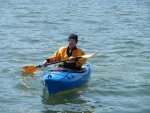
People cruise for weeks in a kayak alone. Perhaps you have too much kit? Perhaps you unfamiliar with the capabilities of kayaks. I can only say they are used a good deal here. I got the idea from others.

Calling me a poser... well, that's just plain funny. I'm quite OK with it.

fitting spray skirt fitting spray skirt. very seaworthy.jpg
 
Now now boys, keep it nice !

Minn.....I do have an Avon Redstart but stopped using it as it was a bit of a faff to inflate, the wash down, dry, deflate, and then put away in its ,(always too small), bag after use. You see we are not ‘allowed’ to keep inflatables in the dinghy rack, it attracts theft apparently as they are relatively easy to deflate and pack into a white van or pick up, if you get my drift ;0)

So I stopped using the Avon and got an 8ft grp ‘standard issue’ dinghy, which was fine but is getting a tad heavy, I do feel however that the 6ft will be too small esp as it doesn’t row very well, but I will try it with the electric motor first.

I may go back to the Avon......as I have more time on my hands these days maybe the ‘faff’ won’t seem so bad !

Cheers,

R
 
Kayaks tend to have different purposes to tenders. But when the wind is blowing too strong for rowing a tender or even flipping an inflatable I'd rather be on my sit on kayak. Less windage, easy to reboard. Lots of controllable power in the paddle and you can see where you are going. Wet but safe and easy enough to transfer up my stern ladder. I don't make a habit of it but reckon it is the safest. Nice option to have. Wish I could roll a proper kayak though.:)
 
This is a genuine question;

I have what I think - and I took 40 years finding - the ideal light but not too light round bilge 8'6" stem bowed tender, which I reckon optimum for getting self, a bit of kit - possibly involving taking out my rolled up 230 inflatable and a passenger, out to my mooring - 1/4 mile or less in usually downwind but none the less exposed water, to drop off the crew and kit then row back into it, quite easily with the strengthened rowlock mounts.

Could I do that with your kayak ?
 
No
I have a hard tender and an Avon redcrest too. But if I need to check the boat in less than ideal weather, or need to get up a shallow creek, it's horses for courses. If I want to pose I'll buy a SUP....:)
 
....

So I stopped using the Avon and got an 8ft grp ‘standard issue’ dinghy, which was fine but is getting a tad heavy, I do feel however that the 6ft will be too small .....

The problem is that GRP tenders are made much heavier than necessary.
There is a culture of expecting them to be indestructible.
They are made crudely, with cheap materials. We don't want to pay proper money for them. We expect to drag them over concrete etc.
It would be nice to get hold of a mould for a week and make my own tender in vinylester and kevlar or similar.
A nice 12ft tender weighing 25kg?
 
The problem is that GRP tenders are made much heavier than necessary.
There is a culture of expecting them to be indestructible.
They are made crudely, with cheap materials. We don't want to pay proper money for them. We expect to drag them over concrete etc.
It would be nice to get hold of a mould for a week and make my own tender in vinylester and kevlar or similar.
A nice 12ft tender weighing 25kg?
Working in grp boatbuilders I had access to a really nice dinghy mold.I did a deal with the manager to cleanup the mound in exchange I could use the left overs on Friday evening of the offcuts of CSM and resin which would be dumped.....unfortunatly everyone got wind of the plan and saved vast quantities of mat and resin .....nice dinghy,once in the waster but it weighed a ton!
 
No, they aren't the work of the devil, but 6 feet is a bit short. I built my Eastport Pram several years ago and it's been an excellent investment. I modified it slightly - raised the rowlocks on blocks which gives a better angle for rowing, fitted one of the gunwale strips as an inwale which makes lifting easier, and fitted nylon pads on the transom to take the wear from the outboard motor clamps. Rows better than any rubber dinghy (I also have a Redstart), isn't tippy (assuming nobody tries standing on the gunwale), has built in buoyancy tanks, and tows very well. It's light enough to be carried easily by two people.

http://www.fyneboatkits.co.uk/kits/rowing/eastport-pram/
 
The problem is that GRP tenders are made much heavier than necessary.
There is a culture of expecting them to be indestructible.
They are made crudely, with cheap materials. We don't want to pay proper money for them. We expect to drag them over concrete etc.
It would be nice to get hold of a mould for a week and make my own tender in vinylester and kevlar or similar.
A nice 12ft tender weighing 25kg?

Moulds crop up on eBay...
 
The problem is that GRP tenders are made much heavier than necessary.
There is a culture of expecting them to be indestructible.
They are made crudely, with cheap materials. We don't want to pay proper money for them. We expect to drag them over concrete etc.
It would be nice to get hold of a mould for a week and make my own tender in vinylester and kevlar or similar.
A nice 12ft tender weighing 25kg?

Not necessarily, but it takes a bit of effort to find the perfect tender, I had to drive to Kent and ' Bailey Boats ' ( who I don't think are still going ) to get the perfect stem dinghy, the ideal compromise between light but strong; no reason this shouldn't apply to the ideal pram bowed tender as well, just don't get the bow hooked under a stern ladder.
 
The problem is that GRP tenders are made much heavier than necessary.
There is a culture of expecting them to be indestructible.
They are made crudely, with cheap materials. We don't want to pay proper money for them. We expect to drag them over concrete etc.
It would be nice to get hold of a mould for a week and make my own tender in vinylester and kevlar or similar.
A nice 12ft tender weighing 25kg?

Rather than trying to find a suitable mould, how about building a multi-chine dinghy (if there is one that takes your fancy) - but instead of using 'conventional' plywood, laminate up fibreglass sheets instead?
These sheets could be simple CSM/WR/CSM and polyester, or stitchmat, or kevlar, with vinylester or epoxy..... there is a huge choice out there now.
And I am sure that these sheets could be made to be a fraction of the weight of their contemporary plywood sheets. Especially if the panels are not too wide (stressing the 'multi' chine aspect - ok, more work, but less weight).

Many moons ago I designed (and started to build) an 11' long two part nesting dinghy out of laid up fibreglass sheets (using a single layer of stitchmat and polyester resin), with two chines / three panels on each side.
I used a sheet of flat galvanised roofing sheet as a mould surface for laying up the sheets on.
I then stitched the panels together with cable ties and wire where needed.
Have started laminating the joints, and will complete it one day hopefully.....
It will weigh a fair bit more than 25 kg (I am guessing maybe 40 kg), but it could be much lighter if more advanced composite materials were used instead.
 
Not seen it mentioned yet but I use a Nautiraid 190. https://www.nautiraid.com/en/coracles.html

Downside is they aren't exactly cheap but, after that, for me at least its all good news.

As long as the side bladders are inflated properly they are really stable. On at least two occasions due to stupidity and/or carelessness transferring from it to the boat I've managed to dip the gunwales and, despite half filling with water, it never flipped and stayed buoyant enough to row it back to dry land, tip it out and start again.

It can get a bit splashy in a short chop when the breeze is up but always feels safe. Having a proper shape to it makes it very easy to row and its quick with a 2.5 hp outboard. It's also quick to erect and pack away. Takes me less than 5 minutes. And I can just chuck it in the back of a saloon car with the back seat down. No heavy lifting required.

I singlehanded mostly so the fact that its really tiny and light is a plus point for me. There's enough room for me and my kit. Although it claims to be a 2 person boat its a very tight fit and, in anything other than flat calm, doesn't feel safe if you have to go 2up any distance. If sailing with others I usually do the longer trip from slip to mooring on my own and then ferry the others from a nearby quay.

Probably not a good tender choice if you are self-conscious. Judging by some of the reactions I get as I go along, an average sized man in such a dinky boat must look pretty funny. But, being as it means I can arrive and be off the slip in the time it takes to inflate one chamber of the average RIB I'm ok with that.
 
We had a 6'6" simulated clinker the sort wih a snub nose. We called it the "tender of death". We never actually capsized it but it felt dangerously unstable even for short trips to boat or shore. It came loose from the boat once on a mooring and I swam after it. Then I was very strong and agile and no way could I get onbord and had to swam back to the boat back leg stroke holding the bows.
I had a tender capsize once, it was a double skin GRP tender that got water between the inner and outer skins and the water taken on slopped to one side and it suddenly turned over as I was sat in it.
The comparison with the stability and safety of an inflatable compared to a hard tender is immense. I know people say you cannot row an inflatable properly but longer than standard makes a big difference and I have never had any problems rowing up to 1/2 mile although generally I only row up to 400 yds each way.
 
There are some things you can do to improve stability of a (non-inflatable) tender. Loading it low with ballast will help. You might even consider adding permanent low down weight.

But while not the prettiest suggestion, a string of fenders each side - well secured between fenders to the gunwale will create the equivalent of a rib tube. It makes it hard to submerge the gunwale if you position them right (probably below the gunwale) and it means when you clunk alongside to get out there is less risk of damage. Something like this:
AlgaeAtJustRight.jpg
See http://janice142.com/Articles/StabilizeAHardDinghy.html for a cheezy american explanation of it being done. I think if you do it with tidy looking fenders it will look a lot better than that eyesore. It doesn't take up space in the boat and should provide floatation in the event of a swamping. You will need to think how you get back in over them if the need arose... a webbing ladder that you can reach and pull over them may be fine... it may also be a recovery aid if it did go over.
 
My dinghy is a 10' Minipram which I inherited with my first boat. It's got two sets of rowlocks, rows much better than the inflatable, built in buoyancy chambers and is reasonably stable provided you take the usual precautions. The only time it's capsized was when my wife 'over reached' towards our boat.
 
Top