
Are all screws made the same way or are some made from 2 parts

tudorsailor

Well-Known Member
Joined
12 Jun 2005
Messages
2,756
Location
London
zebahdy.blogspot.co.uk
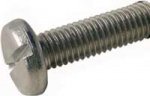
I have stainless steel M6 pan head machine screws holding the stanchion bases to the deck. There are washers and nuts on the underside. I found a head had come off a screw recently. Other owners with similar screws say that this has happened to them as well. Someone suggested that pan head screws are made in two parts with the flat head being welded onto the shaft. Is this the case for all pan head screws? If some are made from one piece, how do I find which are the better quality screws?
x3508.jpg

Thanks

TudorSailor
 
I have stainless steel M6 pan head machine screws holding the stanchion bases to the deck. There are washers and nuts on the underside. I found a head had come off a screw recently. Other owners with similar screws say that this has happened to them as well. Someone suggested that pan head screws are made in two parts with the flat head being welded onto the shaft. Is this the case for all pan head screws? If some are made from one piece, how do I find which are the better quality screws?

View attachment 71257

Thanks

TudorSailor

The process is called upset forming

https://www.youtube.com/watch?v=3kxcw08p_oY

The final diw is hex in this case but can be round in the case of pan head.

As can be seem the screw/bolt is made in one piece.
 
I have stainless steel M6 pan head machine screws holding the stanchion bases to the deck. There are washers and nuts on the underside. I found a head had come off a screw recently. Other owners with similar screws say that this has happened to them as well. Someone suggested that pan head screws are made in two parts with the flat head being welded onto the shaft. Is this the case for all pan head screws? If some are made from one piece, how do I find which are the better quality screws?

View attachment 71257

Thanks

TudorSailor

Its easy to over tighten 6mm machine screws as used in stanchion bases , then they go bang & fail
 
Are some screws more prone to crevice corrosion that others

Any suggestion as to a online supplier for small quantities of screws that does not charge a carriage charge that is more than the screws?

Thanks

TudorSailor
 
Just backing up what the other person said, the most likely cause of this failure in this application is crevice corrosion, even if the fastening is 316 stainless. The start of the crevice corrosion will be in the formed material at manufacture, even if the machine screw does meet specification and process capability requirements, crevices formed at this point of the fasteners life will be the basis of failure. Just add salty water.

And a great video that reminds me of working in those circumstances 20 or so years ago. I'm so pleased I don't work there any more :-)
 
So my questions are,
Are all screws of equal quality and susceptible to crevice corrosion? If some are better than others, how do I know what I am getting? Is ordering from Baseline marine any better than eBay - or do they come from the same Chinese factory?
Is there anything I can do to prevent crevice corrosion? Tefgel under the heads?

Thanks

TudorSailor
 
I have stainless steel M6 pan head machine screws holding the stanchion bases to the deck. There are washers and nuts on the underside. I found a head had come off a screw recently. Other owners with similar screws say that this has happened to them as well. Someone suggested that pan head screws are made in two parts with the flat head being welded onto the shaft. Is this the case for all pan head screws? If some are made from one piece, how do I find which are the better quality screws?

View attachment 71257

Thanks

TudorSailor

No they are all made from one piece. Problem is that to make the heads easier to cold form, we made the steel pretty soft which in turn makes for weaker fasteners. You cannto heat treat austenitic stainless steels like you can carbon steels so if its soft to allow easy forming, then it remains soft in use.
 
So my questions are,
Are all screws of equal quality and susceptible to crevice corrosion? If some are better than others, how do I know what I am getting? Is ordering from Baseline marine any better than eBay - or do they come from the same Chinese factory?
Is there anything I can do to prevent crevice corrosion? Tefgel under the heads? Thanks TudorSailor

Maybe this is a question Vyv is more qualified to answer but I suspect any type of sealant under the bolt head which keeps water out can only be good. As for quality, most chandlers/resellers buy on cost these days because most customers buy where cheapest.
 
Just backing up what the other person said, the most likely cause of this failure in this application is crevice corrosion, even if the fastening is 316 stainless. The start of the crevice corrosion will be in the formed material at manufacture, even if the machine screw does meet specification and process capability requirements, crevices formed at this point of the fasteners life will be the basis of failure. Just add salty water.

And a great video that reminds me of working in those circumstances 20 or so years ago. I'm so pleased I don't work there any more :-)
I had a series of failures of the bolt on which my alternator swings. The bolt simply sheared across the thread. After the second, I considered more carefully, and realized I had used a stainless (316) bolt - it was all the chandlery had in stock. I replaced it with a steel bolt, and the problem went away!
 
Maybe this is a question Vyv is more qualified to answer but I suspect any type of sealant under the bolt head which keeps water out can only be good. As for quality, most chandlers/resellers buy on cost these days because most customers buy where cheapest.

I would dispute that the cause is crevice corrosion in every case, as I have recent experience of many bolt failures due to stress corrosion cracking. Two of them are on the website in the rig section.
As Graham says the answer is to exclude water. In many of these cases the water pools on deck around the fitting, which suggests that bedding only the bolts is not sufficient to exclude the water. Bedding the whole fitting AND the bolts is a better idea.
 
I would dispute that the cause is crevice corrosion in every case, as I have recent experience of many bolt failures due to stress corrosion cracking. Two of them are on the website in the rig section.
As Graham says the answer is to exclude water. In many of these cases the water pools on deck around the fitting, which suggests that bedding only the bolts is not sufficient to exclude the water. Bedding the whole fitting AND the bolts is a better idea.

Sound advice. I have since found another couple of screws who's head came off with ease through corrosion. However I found one screw that had corroded through the shaft just at the point that it entered the deck. Although the builders had put sikaflex into the screw holes there is none under the foot of the stanchions. When I replace the screws I will not only put butyl tape around the screw, but I will put it under the foot of the stanchions too. I think I have 20+ fittings each with 3 screws. Can't take too long can it????

TS
 
Is butyl the correct material?. I believe that being non setting it will constantly extrude leaving a micro gap to allow water penetration. I am assuming you are proposing putting it under a staunchion base where rocking movement will occur thus squeezing any remaining filler
 
Last edited:
Top