Aqua Signal Masthead light

I've actually compared LED bulbs for cars with Nav light ones and so far most - I cannot find any difference. But I don't have test gear to check the light distribution, but the number + colour of LED's / amount of light given off appears same.

Maybe there is difference .... maybe not ??
 
True .... but don't forget that if a light and lense is in usable condition - you can get LED bulbs to fit in ... they have come a long way from the days of not providing the right light travel for nav lights ... now you can get nav light purposed LED bulbs ... the question is whether you are happy enough to step outside of Lamp specs and fit ... (some people seem to have a 'hissy fit' over this !!)

I doubt anyone has ever been caught out by this .. in incident or not ... I for one am happy enough to plug in an LED bulb and enjoy the reduction in amps draw ..
An LED in a fixture designed for incandescent ruins the optics. Because an LED is a surface emitter with quite a big area, the filament of an incandescent bulb is almost a point source.

This was a whole article on this in YBW some years ago. Really not recommended.

See: Warning not to use LED bulbs in filament bulb navigation lights - Practical Boat Owner

There's even an MCA Marine Guidance Note on this: https://assets.publishing.service.gov.uk/media/5a80e5e6ed915d74e33fd083/MGN_393.pdf
 
An LED in a fixture designed for incandescent ruins the optics. Because an LED is a surface emitter with quite a big area, the filament of an incandescent bulb is almost a point source.

This was a whole article on this in YBW some years ago. Really not recommended.

See: Warning not to use LED bulbs in filament bulb navigation lights - Practical Boat Owner

There's even an MCA Marine Guidance Note on this: https://assets.publishing.service.gov.uk/media/5a80e5e6ed915d74e33fd083/MGN_393.pdf
The ones i fitted (boatlamps) have different colour leds and seem to have a good sector cut off. More to the point they are bright enabling me to be seen from a greater distance.
 
Thinking about fresnel patterning is that a method of making the beam of light parallel as in a light house

The bean of light in a LED bulb can be setup as a parallel beam anyway so could not need a light parallel lens to any extant so could a plain flat lens be sufficient

Just thinking

I have LED bulbs in my aqua signal masthead light and in deck level lights and are so bright then can be seen for several miles
 
When my mast was down I fitted an aqua signal, cost over £300 at the time. I must have been flush then.
I fitted that because I did not like the idea of having to change bulbs like on the old type units.
4 years later it is still working great.
 
Thinking about fresnel patterning is that a method of making the beam of light parallel as in a light house

The bean of light in a LED bulb can be setup as a parallel beam anyway so could not need a light parallel lens to any extant so could a plain flat lens be sufficient

Just thinking

I have LED bulbs in my aqua signal masthead light and in deck level lights and are so bright then can be seen for several miles
Have you measured the light distribution and cutoff angles at the rated distance? Have you got a test certificate?

In that case, then by all means ignore the MCA.
 
MCA and guidance is all well and good .... but the main point is TO BE SEEN ......

Now I will ask ..... I am sure there are many here that spend greater hours on the water than I do ... greater reduced visibility hours etc.

Now please tell me have you noted any yacht with such poor cut-of / distribution of light that you are unaware of its heading etc ?

Its a joke really - sorry - but take my Sunrider 25 with pulpit mounted lights. They are fitted to stainless plates that are part of the pulpit each side. In terms of cu-off and vertical - they fail the guidance ... because they are angled in and canted out by the design of the pulpit. I have actually tried 3D printing wedges to correct ...
And I know of many other boats that have similar ........ so all this fuss about following MCa or not really is good for forums - but out there its not always the case.

Even big ships !! Aircraft Carriers ? Submarines on surface .... are two excellent examples of ships that even though their lights are designed correctly - their disposition and visually sightable by others is questionable.

Remember that word : Guidance. Not regulation.
 
When my mast was down I fitted an aqua signal, cost over £300 at the time. I must have been flush then.
I fitted that because I did not like the idea of having to change bulbs like on the old type units.
4 years later it is still working great.
I bet it's not still working in 40 odd years though or anywhere near.
 
MCA and guidance is all well and good .... but the main point is TO BE SEEN ......

Now I will ask ..... I am sure there are many here that spend greater hours on the water than I do ... greater reduced visibility hours etc.

Now please tell me have you noted any yacht with such poor cut-of / distribution of light that you are unaware of its heading etc ?

Its a joke really - sorry - but take my Sunrider 25 with pulpit mounted lights. They are fitted to stainless plates that are part of the pulpit each side. In terms of cu-off and vertical - they fail the guidance ... because they are angled in and canted out by the design of the pulpit. I have actually tried 3D printing wedges to correct ...
And I know of many other boats that have similar ........ so all this fuss about following MCa or not really is good for forums - but out there its not always the case.

Even big ships !! Aircraft Carriers ? Submarines on surface .... are two excellent examples of ships that even though their lights are designed correctly - their disposition and visually sightable by others is questionable.

Remember that word : Guidance. Not regulation.
Screenshot 2025-10-27 220000.png
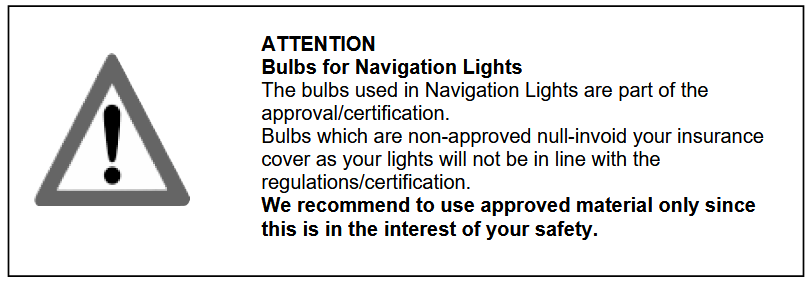
Aqua Signal Series 40 Manual.

A lot of collision cases have revolved around nav lights and visibility. For example, that case in California some years ago, where someone was killed.

Using LED bulbs in incandescent fixtures is a gift to your insurance company if you have a collision at night. And could be much worse than voided insurance, actually, if the other side's insurance company decides to take you to the cleaners.

Nav lights are critical safety devices and not the place for this kind of bodge, in my opinion.

And yes, I sail a lot at night, and do notice yachts with bodged nav lights, and steer a wide berth, as I know I can't be sure of the aspect.
 
View attachment 201268
Aqua Signal Series 40 Manual.

A lot of collision cases have revolved around nav lights and visibility. For example, that case in California some years ago, where someone was killed.

Using LED bulbs in incandescent fixtures is a gift to your insurance company if you have a collision at night. And could be much worse than voided insurance, actually, if the other side's insurance company decides to take you to the cleaners.

Nav lights are critical safety devices and not the place for this kind of bodge, in my opinion.

And yes, I sail a lot at night, and do notice yachts with bodged nav lights, and steer a wide berth, as I know I can't be sure of the aspect.

Regulation ? Depends on the area / country you are sailing in.
Certification - that's of course to be allowed to be sold legitimately in the area ... as in CE etc.

You bring up California Case .. I don't know that one - but maybe I'll have a Goggle on it ...
The one sad tale that usually gets quoted - is the case of the yacht lost south of Isle of Wight ... where a lot of investigation was made into lights - but particularly radar reflectors etc.

As to Aqua-Signal notice you show - that is Aqu-Signal using the strictest case situation where they are sold. They are playing on the Certification needed to be sold in markets where the bulb is part of the design specification to have the desired characteristics. Unfortunately producers of such lights have been slow to adapt or accept that LED's are now out there and superior to filament bulbs.

Next - not everyone actually goes out and buys Navigation Light spec filament bulbs ... many buy the bulb that looks liker it - such as car Festoon ... car single filament bayonet etc.

Sorry - but having been an OOW on ships for over 17yrs ... on boats / yachts since I was 5yrs old ... yours statement :

"do notice yachts with bodged nav lights, and steer a wide berth, as I know I can't be sure of the aspect"

I simply do not believe you are that good to determine such .. unless the bodge is seriously mounted wrong ... such as a mobo I saw in Roja ... where the side nav lights had been mounted turned 90 deg !! so they did not actually face fwd .. but upward .. seriously !
 
I managed to fit my tri light 90 degrees out. I didn't notice it for 2 years and no one told me / noticed either, and I was doing quite a bit of night sailing at the time. Just shows how much people actually look at the colours of nav lights.
 
The one sad tale that usually gets quoted - is the case of the yacht lost south of Isle of Wight ... where a lot of investigation was made into lights - but particularly radar reflectors etc. !
They also looked into the glasses used by the OW. They were the reactive type and even when clear they only let 80% of the light through. Believe that the report suggested reactive glasses aren't used during night hours, dusk to dawn inclusive.
 
I once saw a yacht with a bicolour mounted so that it showed green to port and red to starboard. I guess it must have been upside down.

It was the speculation about the possible condition of the Ouzo's lights that prompted me to replace my tri-colour. The original was the same as the one which is the subject of this topic. which nearly 20 years on must be long overdue for replacement.
 
Is that an AquaSignal? Maybe a Series 40? If so, the new LED one may fit the old base.

The old Series 40 tricolour often came with what they called the "Quick Fit Base", which also fits the newer Series 34 LED tricolour.

That's what I did with mine, 12 years ago! And is still going strong. It uses about 1/10 of the power, which is very welcome night sailing.

That’s good it’s still going strong after 12 years. Mine lasted 10 years before failure and our new boat has a non working one too, the previous owner handed me the replacement fitting he hadn’t got round to installing.

As much as I like LED there’s nothing like being able to just change a lamp rather than the whole unit.
 
They also looked into the glasses used by the OW. They were the reactive type and even when clear they only let 80% of the light through. Believe that the report suggested reactive glasses aren't used during night hours, dusk to dawn inclusive.

I know this will upset some and seems callous - but it is definitely not meant to be.

The problem there was that the Investigators had little to go on and they basically went 'fishing' for anything they could find to explain it .. and even then - it was only a 'most likely scenario' ... the actual cause was never proven beyond a doubt.
 
I know this will upset some and seems callous - but it is definitely not meant to be.

The problem there was that the Investigators had little to go on and they basically went 'fishing' for anything they could find to explain it .. and even then - it was only a 'most likely scenario' ... the actual cause was never proven beyond a doubt.
As you say nothing was proved, but it gave some interesting 'facts' that made me check and then change my masthead tri light plus bow light and also talk to others about reactive glasses. Luckily my radar reflector was one of the better types so I left that alone !
 
I have sailed at night in a harbour with tugboats traveling backwards with nav light stern forward and port and starboard lights reversed.

When I changed mt=y lights to LED it was the fact to be seen that was important to me so any ships bigger than me can see me.

It the times when in the middle of the night the OOW is asleep, and I had to wake him up with a call on VHF ch 16 that concerns me
 
I managed to fit my tri light 90 degrees out. I didn't notice it for 2 years and no one told me / noticed either, and I was doing quite a bit of night sailing at the time. Just shows how much people actually look at the colours of nav lights.
Oh, so it was you;)

More seriously, this thread seems to be really about money and finding more or less specious reasons not to do what one actually knows one really should do. Just go fit a good hermetically sealed LED masthead unit!

Hella is what I fitted when the mast was down for the 20 years rigging replacement, but I'm sure there are other brands just as good.

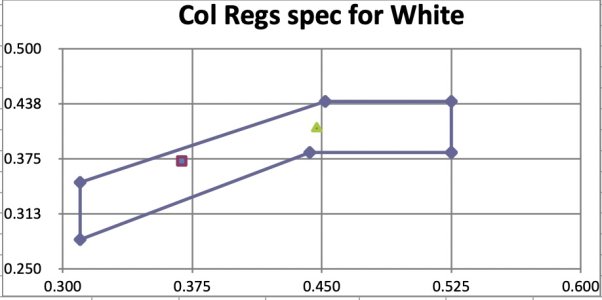
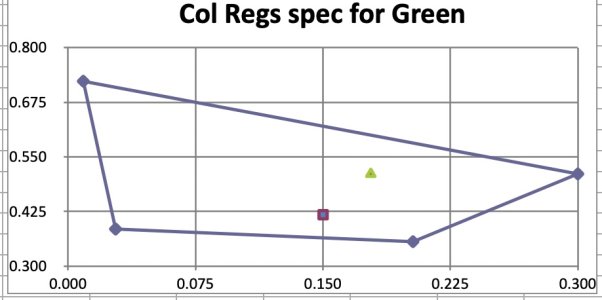
PS: I did the work referenced in the article by PBO on different white LEDs passing through coloured filters. Cold white was quite far off (too blue) but warm white was reasonable. That was in 2015, LEDs have a broader spectrum now so I'm sure the colours will be OK: the more relevant point is that any 20+ year old acrylic lens will have so much scatter and attenuation that it should be binned.

This was some of the original analysis:

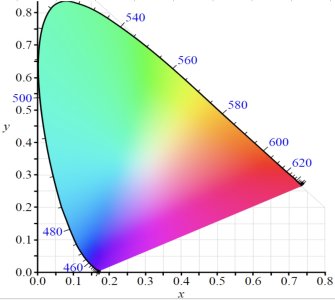
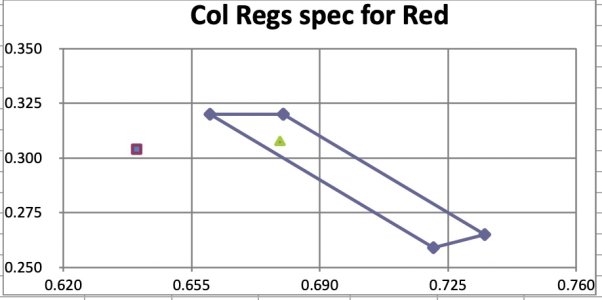
The colours specified in Col Regs are described as a region in x and y from the colour coordinate system shown here:

colours_x_y.jpg

The IMO defined x,y regions for white, red and green are shown below, together with the responses of an incandescent - the small green-ish triangle - and a warm white LED - the small red-ish square.

Coincidentally, an Aquasignal series 40 was what I had to hand, so the filters are for this very tricolour.

white.jpg
green.jpgred.jpg
 
I simply do not believe you are that good to determine such .. unless the bodge is seriously mounted wrong ... such as a mobo I saw in Roja ... where the side nav lights had been mounted turned 90 deg !! so they did not actually face fwd .. but upward .. seriously !
You don't have to be "good" to see the difference between bodged and proper nav lights. It's very obvious. With bad nav lights the sectors are not clearly separated; the light is dim because of cracked and cloudy lenses; the sectors are all off because the mounting geometry is off.

And you don't have to be good to see how much better the modern LED nav lights are.
 
Top