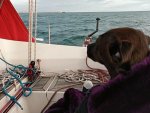
Kelpie
Well-Known Member
All this lifting of dogs. They have legs, make *them* do the work! If they don't get the message, sail off without them. It works with the car anyway.


All this lifting of dogs. They have legs, make *them* do the work! If they don't get the message, sail off without them. It works with the car anyway.

Jack spent a couple of weeks with a family with a much larger dog (a Labradoodle), while we were visiting relatives in Hong Kong. On return, we were surprised to discover that his ability to jump had greatly improved! Further, last week I was on Capricious and left him in the cabin, thinking he couldn't get up the companionway. Mistake! He now can, as I discovered when I realised he was in the cockpit while I was sorting out lines for a move to a new berth! Now, it takes a wash-board in place to keep him safely confined.When their legs are only about 6 inches long, they have to be lifted - even the car is a bit of a challenge! However, lifting a dog that only weighs about 5 kg isn't a big deal

Does your Moody have the transom scoop? which does make life a little easier. However, lifting 40kgs of Labradoodle from the wobbly dinghy into the boat is an interesting operation, one day it will end in tears and a big splash.

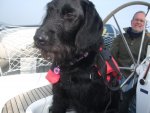
So that's what a Labradoodle looks like .... do they not molt? Used to be a labrador man years ago and the only thing that puts me off these days is memories of hair/fur everywhere ... if these mongrels don't molt they sound like the perfect dog!

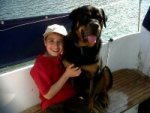
Our friend's has white fur with tight curls. Jack also has poodle in the mix. Poodle genes are supposed to mean that they are less likely to trigger allergic reactions in people susceptibel to dog hair. Jack certainly does shed some hair, but it is very fine, soft stuff.View attachment 62534
Some doodles look like that!
They come in all sizes from half that to even bigger, colours from pitch black to off white, and coats from short and straight via wavy to a tight curly fleece.
Ours, a bitch, weighs 34 kg, has a short straight black coat and moults for England. Tumbleweeds at home and on the boat. On the plus side she is great with the grandchildren and loves sailing and the dinghy (taxi to the pub!). A sugar scoop s good...