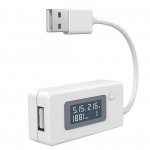
any idea of current draw when ipad & iphone are charging?

I reckon my IPad Pro draws 400ma when charged via a 12v USB socket charger. It is a slow charge though, I think I need a higher capacity USB charger to fast charge. I researched the size of the battery in the IPad and was surprised to find it is about 9,400mAh, so 9.4 Ah. Quite a lot. My solar produces about 9A on a sunny day - so one hour’s worth of solar energy to charge from flat to fully charged.
 
simultaneously, through a unit like this?

https://www.aliexpress.com/item/12V...-Panel-Mount-Boat-Truck-Auto/32825268977.html

Is it as simple as 1a and 2.1 amps per hr?

Ta
Yes. Simple.

I had three and binned them all as they can cause rf interference. Also the led light is bright and a pain. I just installed the basic 12v socket and used a good quality flush usb socket adapter like this...

https://www.amazon.co.uk/RAVPower-C...8018&s=gateway&sprefix=USB+12,aps,147&sr=8-46
 
Last edited:
I reckon my IPad Pro draws 400ma when charged via a 12v USB socket charger. It is a slow charge though, I think I need a higher capacity USB charger to fast charge. I researched the size of the battery in the IPad and was surprised to find it is about 9,400mAh, so 9.4 Ah. Quite a lot. My solar produces about 9A on a sunny day - so one hour’s worth of solar energy to charge from flat to fully charged.

Surely if it is drawing 400ma and its 9400mahr battery, it will take 20odd hours from flat to full??

Anyway, thats bye the bye, it's the actual current draw that I need to mitigate that I'm looking for. 400ma, anyone reckon thats what their phones and ipads are drawing when plugged in aboard?
 
Surely if it is drawing 400ma and its 9400mahr battery, it will take 20odd hours from flat to full??

Anyway, thats bye the bye, it's the actual current draw that I need to mitigate that I'm looking for. 400ma, anyone reckon thats what their phones and ipads are drawing when plugged in aboard?

Yes, perhaps I badly worded that. What I was trying to express was the considerable amount of power that an IPad Pro consumes - one hours worth of all my solar production - not that I could charge the iPad at 9A! That would probably cause it to melt, as you say it would drip feed in over a much longer time period.
 
A lot of modern kit will only charge from a high current USB adaptor. at least 1.3 A at 5V.

So assuming it's a reasonably efficeint switcher, something like 0.6A will be drawn from the 12V.
Some USB charger sockets are rated at 2A now. My phone's adaptor is 2A @5v and it won't charge at all from an old skool 500mA USB adaptor. That's a Nokia not I-aanything.
 
My iPad Pro draws about 0.7amp when over 50% charged but when less can draw 1.5 amps, my laptop port at 5his will not charge it, my iPhone is a little more friendly and seems to draw a max of 1,1 amp when low battery. On the boat both plug into 2x 2.1 amp usb power socket

Both draw enough to kick my battery charger out of standby straight away
 
"amps per hr" is meaningless, despite how often it is written in YM.

I used to work with large superconducting magnets which had to be tamed up and down slowly to avoid accidental "quenches" ( field increases to quickly, windings move, friction heats up windings, superconductivity goes, stored magnetic energy dumped as heat, liquid helium boils off, everybody talks with squeaky voices). The power supplies therefore had labels on them specifying the maximum permissible amps per hour.

This may not, of course, be the sense in which YM (mis)uses the term.
 
I used to work with large superconducting magnets which had to be tamed up and down slowly to avoid accidental "quenches" ( field increases to quickly, windings move, friction heats up windings, superconductivity goes, stored magnetic energy dumped as heat, liquid helium boils off, everybody talks with squeaky voices). The power supplies therefore had labels on them specifying the maximum permissible amps per hour.

This may not, of course, be the sense in which YM (mis)uses the term.

Very good! Co-incidentally, I used to work with liquid helium and a large conventional magnet. And demonstrated (on college open days) breathing from a helium dewar with a squeaky voice. Being careful not to get frost-bite of the tongue!

Mike.
 

A lot of these seem to spec 2.1A total - ie. if you have 2 devices plugged in you won't get 2.1 + 1 A out of it. Might be better to get 2 devices rather than one with 2 outputs. Possibly even look for 3A output.

Despite doing the above charging seems a art rather than a science, and sometimes it seems to draw at a decent rate, and other times trickles in, or refuses completely.

Also take care with P=VI when converting 12v v's 5v on either side of the converter. ie 2.1A at 5v is not the same as 2.1A at 12v.
 
A lot of these seem to spec 2.1A total - ie. if you have 2 devices plugged in you won't get 2.1 + 1 A out of it. Might be better to get 2 devices rather than one with 2 outputs. Possibly even look for 3A output.

I have a BlueSea fast charge socket which will do 2 x 2.4A or (I think) 1 x 4.8A. It works quite well, but both my tablet and my phone think they are charging more than they are on it - the phone will say 100% after half an hour then very quickly drop to a more plausible 40%.
 
Its not just a case of the current drawn, its also the state of your batteries. If they are at 12v and your iPad is at 12 v it won't fully charge, if, say, 12.5v is taken as fully charged. I find this on my motorhome when I'm wild camping, the iPad never fully charges unless I'm in the brightest sunlight and the 200W of solar panel on the roof is doing its thing and the battery terminal voltage rises to nearer 14.5V. Its also noticeable when the fridge kicks in, sometimes the iPad stops charging and starts again when the fridge goes off.

I've never noticed the same effect on the boat, probably because I'm not hanging around watching it as much, but it will happen.

To do a true calculation you need to know the internal resistance of your batteries and the potential difference between the batteries..

Also, ampere hour rating is an indication of total capacity and charge and discharge rates. If something is rated at, say, 10 AH then in theory you could draw 10 amps for 1 hour or 1 amp for 10 hours or other combinations. The reverse for charging, if you shove 10 amps in then it will take 1 hour and 10 hours at 1 amp.

Obviously that's reductio ad absurdum to make a point and you need to know the maximum charge and discharge rates so as not to damage the batteries, good kit will have protection.
 
Its not just a case of the current drawn, its also the state of your batteries. If they are at 12v and your iPad is at 12 v it won't fully charge ...

That sounds like very poor charger design. iPads charge at 5.1V, 2.1A (iPhones at 5.0V, 1.) and any half-decent DC-to-DC charger ought to be able to supply that whether your batteries are at 12V or 14V.
 
I have had to throw away all my old chargers, left me by a friend. My phone would charge in car or in boat with engine on, the Navigators would not except intermittently and they did not charge the ipad. The chargers said 2.1A and 1A but only worked on Navigators phone if engine flat out giving 14.5V.

Bought decent Belkin chargers or Apple branded Belkins as used on boat for ipad and now no issues. Old chargers were clearly incapable of giving output unless input high enough voltage and probably fairly smooth. On boat our combo would beep and charge then shut down restart and repeat.

I also suspect instantaneous draw might have been enough to overload the charger or cause blip on the input supply voltage such that it dropped momentarily below the allowable minimum. There is after all resistance between battery and charger so they are not at same voltage. On the railways we once discovered that our 15A 120V point machine actually tried to draw about 10,000A on startup. Not long enough to even be noticed by the fuse or our digital meters but enough of a spike to upset our delicate pc controlled circuit controller before we had it hardened. However the cost of a fast capture oscilloscope that could record such transients and set up costs would rival the boat costs never mind a new charger.

Modern phones and ipad can take more power and need decent chargers, but the steady current of the phone is as others have said about 0.5A.
 
But if the charger cannot supply the 2amps at the start the iPad or iPhone may not continue to charge and report incompatible device
 
I have a pair of dual USB sockets in the cockpit. Both dual sockets were rated equally a 2.1 amps each - so 4.2 amps per outlet.

However, we had 2 iPads on the go and both plugged in to one dual outlet. The charging became intermittent - cutting in and out.

We then split the iPads between 2 outlets and they charged quite happily.

So, my dual 2.1 amp sockets can't handle the load - despite what the little Chinaman claims on eBay :) .
 
Top