Any harm in oversized trim tabs ?

gyislander

Active Member
Joined
25 Jun 2021
Messages
49
Visit site
I've been looking a while for trim tabs for my fairline weekender 21 and just bought a full Lenco kit at a bargain price. The tabs are 18" wide by 12 deep. From what I can see the recommended tab sizes for the boat are either 12x12 or 18x9. I planned to cut the tabs down to 12x12 but wonder if there's any harm or indeed benefits of sticking with oversized?
 
You will notice a bit more drag and thus parasitic speed loss when down compared to what the naval architect prescribed .
Try and make sure when mounted there are some minus positions , ie when up they are not just flat parallel with the hull but actually stick up ,Negative positions .
Depends on the ram on hull positions.
You need from dead flush in line a range of minus 3 up and plus 5 down . Ratio similar . Not 8 all positions down .

The “up “ is important as the hull attitude changes when running compared to sat on its berth .It goes bow up so effectively to still allow that tilt you need them up if you see what I mean .This is important running down waves , down wind keeping the bow up .

There is a risk of oversized , the disadvantage you are asking about is that the bow can’t rise as much as you might like in a following sea when planning . As well a unnecessary extra parasitic drag which you might be able to live with .
It is a planning boat after all .

The tabs should ideally in a well balanced hull should just be there to only change the AoA , lower the bow in a big head sea or lift it in a big following sea , Definition of a “ well balanced hull “in a planning boat ( this is lost on many on here ) is one whereby the AoA reduces as speed increases and it settles at planning speeds of under 4 degrees when running with tabs set at zero .
Zero is neither up or down .The helm is free to trim the bow as required depending on the sea conditions .


A lot of smaller Fly bridge boats are unbalanced, poorly balanced and require permanent tab down .Equally I see a lot of sports boats too running waaaaay bow high or there owners running tabs down all the time to improve forward visibility.
Some boats ( go dock walking in the Med ) have a permanent central bolted on fixed flap in between the two movables at the sides .Theses tend to have semi tunnels .Semi tunnels kill off stern lift .A better more accurate wording would be they ADD excessive stern suction , sinking .

As I say and more than happy to repeat until the cows come home ….,try before you buy .Have a run out in it , see how she runs before signing the cheque.
 
I've been looking a while for trim tabs for my fairline weekender 21 and just bought a full Lenco kit at a bargain price. The tabs are 18" wide by 12 deep. From what I can see the recommended tab sizes for the boat are either 12x12 or 18x9. I planned to cut the tabs down to 12x12 but wonder if there's any harm or indeed benefits of sticking with oversized?
Will give you more planing surface useful at lower speeds, Follow manufacturers installation instructions.
 
You will notice a bit more drag and thus parasitic speed loss when down compared to what the naval architect prescribed .
Try and make sure when mounted there are some minus positions , ie when up they are not just flat parallel with the hull but actually stick up ,Negative positions .
Depends on the ram on hull positions.
You need from dead flush in line a range of minus 3 up and plus 5 down . Ratio similar . Not 8 all positions down .

The “up “ is important as the hull attitude changes when running compared to sat on its berth .It goes bow up so effectively to still allow that tilt you need them up if you see what I mean .This is important running down waves , down wind keeping the bow up .

There is a risk of oversized , the disadvantage you are asking about is that the bow can’t rise as much as you might like in a following sea when planning . As well a unnecessary extra parasitic drag which you might be able to live with .
It is a planning boat after all .

The tabs should ideally in a well balanced hull should just be there to only change the AoA , lower the bow in a big head sea or lift it in a big following sea , Definition of a “ well balanced hull “in a planning boat ( this is lost on many on here ) is one whereby the AoA reduces as speed increases and it settles at planning speeds of under 4 degrees when running with tabs set at zero .
Zero is neither up or down .The helm is free to trim the bow as required depending on the sea conditions .


A lot of smaller Fly bridge boats are unbalanced, poorly balanced and require permanent tab down .Equally I see a lot of sports boats too running waaaaay bow high or there owners running tabs down all the time to improve forward visibility.
Some boats ( go dock walking in the Med ) have a permanent central bolted on fixed flap in between the two movables at the sides .Theses tend to have semi tunnels .Semi tunnels kill off stern lift .A better more accurate wording would be they ADD excessive stern suction , sinking .

As I say and more than happy to repeat until the cows come home ….,try before you buy .Have a run out in it , see how she runs before signing the cheque.
Thanks for a great explanation I hadn't considered the minus required, I'd assume the fitting instructions would allow for that but I'll make sure when I fit them. Would simple adjustment when in use not negate the parasitic drag though ?
 
Would simple adjustment when in use not negate the parasitic drag though ?
Your recommended tabs are 12 x 12 , you have 18 x 12. So an excess wetted area of 6 X 12 square inches per side. Which is 1 square foot. Your boat is about 16 feet by 8 feet in the water when it is planning, roughly 128 square feet not allowing for the V shape. In relation to the total wetted (underwater) area of your boat it is nothing at all. Forget it.
 
Thanks for a great explanation I hadn't considered the minus required, I'd assume the fitting instructions would allow for that but I'll make sure when I fit them. Would simple adjustment when in use not negate the parasitic drag though ?
Racing and fast boats have longer thin flaps rather than extra width for a given surface areas .This cuts down the frontal edge , but retains sufficient area to press down and Newton’s first law take over …..stern rises .

Yes adjustment might help in terms of how far off / apart the centre of lift ( CoL ) and centre of gravity (CoG ) are in the hull .
Obviously as the speed alters so does the CoL , The attitude the AoA , angle of attack also changes and it’s this the flaps should be able to effect .
Ideal hulls the CoF and CoG are close .
Those with rearward weight bias the CoG is too far back , so much so they are pretty unresponsive attitude -AoA - wise to flap .
Those boats run very bow high or stern low .A lot of flap down just increases drag and fuel burn and never gets the AoA under the magic 4 degrees .

If the weight at the back ie the CoG has moved behind the CoL say after a refuel and the boats runs without flap down at say 6/7 degrees then a bit of flap say postion 1 or 2 out of 5 might actually increase the speed by a knot or so as the running attitude drops , the AoA down to around or below the magic 4 degrees .
Although the flaps are down the AoA is lower and the net drag of the whole thing lower so it’s speed picks up a bit .

As said if the CoG and CoL are close and the hull balanced the tabs will tilt it either way , you will notice it .

Also not mentioned yet is cross winds .
Adding tabs will enable the hull run flat in cross winds instead of leaning .Leaning is inefficient and adds extra drag .So one tab down to level it off = less drag more speed for a given throttle position.


If the boats CoG and CoL are miles out , tabs will just create more drag , ie the amount of tab down , it barely lifts the weighty stern and just acts as a glorified water break .This is more a fly bridge 20/22 knot slug .There is not enough hull lift generally due to the slug speed .

The faster you go the less tab down is needed ( if it’s a balanced hull ) as the lift naturally lifts the whole boat up nice and level under the 4 degree angle .
Again a lot of lardy boats never go N of 26 knots they can’t not enough grunt .They just sit there pointing towards the moon mimicking a airplane attempt taking off 1/2 way down a run way .
 
Sounds like the tabs should be fine
Racing and fast boats have longer thin flaps rather than extra width for a given surface areas .This cuts down the frontal edge , but retains sufficient area to press down and Newton’s first law take over …..stern rises .

Yes adjustment might help in terms of how far off / apart the centre of lift ( CoL ) and centre of gravity (CoG ) are in the hull .
Obviously as the speed alters so does the CoL , The attitude the AoA , angle of attack also changes and it’s this the flaps should be able to effect .
Ideal hulls the CoF and CoG are close .
Those with rearward weight bias the CoG is too far back , so much so they are pretty unresponsive attitude -AoA - wise to flap .
Those boats run very bow high or stern low .A lot of flap down just increases drag and fuel burn and never gets the AoA under the magic 4 degrees .

If the weight at the back ie the CoG has moved behind the CoL say after a refuel and the boats runs without flap down at say 6/7 degrees then a bit of flap say postion 1 or 2 out of 5 might actually increase the speed by a knot or so as the running attitude drops , the AoA down to around or below the magic 4 degrees .
Although the flaps are down the AoA is lower and the net drag of the whole thing lower so it’s speed picks up a bit .

As said if the CoG and CoL are close and the hull balanced the tabs will tilt it either way , you will notice it .

Also not mentioned yet is cross winds .
Adding tabs will enable the hull run flat in cross winds instead of leaning .Leaning is inefficient and adds extra drag .So one tab down to level it off = less drag more speed for a given throttle position.


If the boats CoG and CoL are miles out , tabs will just create more drag , ie the amount of tab down , it barely lifts the weighty stern and just acts as a glorified water break .This is more a fly bridge 20/22 knot slug .There is not enough hull lift generally due to the slug speed .

The faster you go the less tab down is needed ( if it’s a balanced hull ) as the lift naturally lifts the whole boat up nice and level under the 4 degree angle .
Again a lot of lardy boats never go N of 26 knots they can’t not enough grunt .They just sit there pointing towards the moon mimicking a airplane attempt taking off 1/2 way down a run way .
Sounds like the tabs should be fine then as the boat feels pretty balanced to me, gets quickly on the plane already and reacts well to engine trimming. It's a little slower to plane 4 up and it's for that reason and handling in awkward seas that I've invested in fully adjustable tabs rather than the smart tabs I had on my last boat.
 
Sounds like the tabs should be fine

Sounds like the tabs should be fine then as the boat feels pretty balanced to me, gets quickly on the plane already and reacts well to engine trimming. It's a little slower to plane 4 up and it's for that reason and handling in awkward seas that I've invested in fully adjustable tabs rather than the smart tabs I had on my last boat.
Agree sounds good .
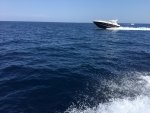
Here are some shockers .

FA1F27B9-43C3-4C1E-B6EB-2C025ECA6ECE.jpeg
It’s a S/Skr Porto 47 , but the 48 and San Remo hulls are the same .This ones rearwards IPS no Jack shaft .Owner told me tab hardly made a difference.

FF66FFE7-8BFE-418B-BE86-2CA0BB68A4A0.jpeg
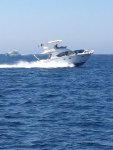
This what I referring to with FB s “ pointing to the moon”: They are typically sub 45 ftrs and the CoL and CoG are miles apart .No amount of tab can defy the laws of physics.

As the hull L lengthens things get better the massive engines placed more central kinda help close down the CoL / CoG .But semi tunnels just add more suction negative pressure .
.5595A0C1-5495-469F-BECC-701D2D930EEF.jpeg
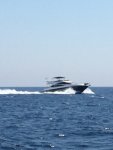
Sterns sinking and see the commotion of wake behind .Greta Thunburg won’t be happy with that fuel burn . :D
1E4E03EF-CD86-41D9-8CA6-CA195A495944.jpeg
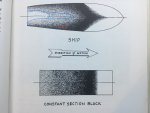
Black is positive pressure or LIFT and white is negative pressure or suction down .Note the blue areas highlighted.
The max lift is the few Ms that the waves smack into , impact into .The faster the impact ie faster you go ( if you can ) the greater the lift area .
AAECBD9F-9F8F-417A-A756-BBC261776484.jpeg
Your stern area what’s happening lift wise .^^


DB654959-5C79-43A5-B4A1-FA79D90EAD23.jpeg
^^ stern s sinking m needs to increase speed or move weight forwards ? Has to stand to see out , it’s all wrong ?.


FE766EAA-465E-448A-A071-4D6515A4C194.jpeg
^^^ Here we are ……who ever penned this knows his onions .
Must have read this book below ….the holy grail of fast planning boat design.
78F74A90-6E81-40A2-9744-4D1786B8164B.jpeg

Finally let’s not forget prop lift , big pitch + loadsa Hp below ?
014B85C8-A269-4B6B-B0C0-B30151C9DEE2.jpeg
:D:D:D
 
If I get this right then if the boat runs bows up without flaps the COG is to far aft of the COL.
Perhaps better to add weight forward than run with flaps fully down all the time which is what mine seems to need.
 
If I get this right then if the boat runs bows up without flaps the COG is to far aft of the COL.
Perhaps better to add weight forward than run with flaps fully down all the time which is what mine seems to need.
Depends ?
To the letter depends on if you make the distinction from fully planing hulls and semi planing .
If you have the Broom 33 ( as per your info “about you “) then go to semi planing mind set , because that’s what it is .
You will see because it’s semi ing it’s not getting enough lift it’s just pushing water in front aside more than its lifting over water .
If so - it follows it then creates a bigger hole aft the faster it goes = stern starts to sink more and more into the bigger hole the bow areas creating .Plus not enough lift area at the stern sections , more suction areas.
Unkess as you say you tab it , drop the tabs .Thing is thats hugely drag inducing .


Planning is not a on / off switch it happens gradually to various degrees at various speeds .

The common consensus amongst naval architects re definition is along theses lines ………..
Planing starts when further increases in speed results in the lowering of the AoA , the bow angle drops as you go faster .

If your hull just digs in at the stern and the bow risers as you pin the throttles then arguably it’s not pure planing .It’s semi planing .
There‘ s not enough lift being created , throwing hp at it just makes a bigger wake and uses more fuel .
It needs the shape to get up over the water .
Stuff like sharper chines , bigger chime flats , lifting strips carefully placed + sized .
The deeper the deadrise ie the greater the shape moves away from a flat surf board the greater ot more pronounced it needs the above features . Dead-rise is a function of seakeeping cutting through waves not planing .
A flat piece of plywood planes better than anything, but is no good in real life seas .

Back ground history to see how all this came about ……hope it’s interesting to busty folks ?

Adding Hp to increase speed only works once you start planing properly.
If you can get the CoL over ( actually a fraction in front in minimise porpoising ) the CoG in the middle of the wetted area then every added Hp with a low as possible shaft angle = more knots .
It you can add those knots in a deep dead rise whereby “ deep “ is considered above 20 degree then you can keep your speed up in every day waves .
This is what Lindsay Lord figured out scientifically/ mathematically between the wars to design his rum runners .

During prohibition officialdom s boats were basically the equivalent say Brooms back in the day could not catch get anywhere near Lindsays boats in Caribbean. Up to then boat design was a family affair “ it’s how grandpa did it “
When WW2 broke out Lindsay was basically under investigation from the feds re his assistance designing the mobs boats .

Rather than jail him he was pragmatically drafted into the navy and he was in Pearl harbour when that kicked off , and tasked after that of coming up with a motor torpedo boat , because they were going after the Japanese now realised they would need a small 70-90 ft high speed craft .

Well no surprises the final boats were deep V for rough seas high Hp , and fast = manoeuvrable and very effective in the battles of the Pacific ….there‘s an historical semi argument they couldn’t have done it ( used theses boats ) won that war without them .
Un sung hero’s .

Back across in Europe typical stuffy Admiralty did not throw much into MTBs and were blinded with all this planing stuff science .The U.K. version around 70;ft was dreadful it has basically a flat bottom hardly any deadrise . Couldn’t go out and fire torpedo s in a chop / rough seas .
The Germans kinda 1/2 way were better there E boats had deadrise and Hp so could operate in rough seas ….capture of the Channel Islands etc .But they were just lucky they did not know exactly why there boats were better than the English .
 
Last edited:
I used to have a small Hardy which was semi displacement and weight distribution was absolutely critical. I had my batteries in the bow but many owners use weights or sandbags to get the balance right.
 
So were the rum runners early cigarette boats?
Basically yes . Lord started it .
After the war with increased recreational boating and surfing Lord went on to assist designing fast planing civi boats and surf boards .In fact arguably revolutionised surf board design in the day .Held a chair as the worlds first naval architecture school / uni with MIT .
Also had his own side job as a independent consultant .

All the fast boat makers used him or were influenced by his writings and publications .

.By the 60 s the likes of Dick Bertram Jim Wynn, Sonny Levi. Don Shead and many others followed .By the 70 s the likes of Don Aronow et al established thunderbolt alley In Miami to make race boats .
Ironically getting drawn into the mob .This time for drug running .
Aronow raced in Europe and his boats did not go unnoticed. In the early 70 s
Amarti and Theodali + a few other Italians basically copied . The designs of Itama , Magnums , and many others like Tornadoes and Rizzardis etc . From then onwards its hard to untangle who copied who , who did this that or the other first .
Don Shead deserves a mention for the mid 80 s and early 90 s Sunsseker s .

Of course todaythe market has moved away from hull shape , sea performance of hulls shaped like the super hawks etc .
Its swung heavily towards floating apartments/ second holiday homes with all of life’s accoutrements and the interior volumes to suit .Not being critical or judgmental just factual btw before anyone flames me .

You still can find a few remnants at some shows like obviously Itama , Baia , Magnums , Otam which are as close to the Lindsay Lord rum runners shape as you can get with deep dead risers and loadsa Hp .Well everything in his book inc central engine location which knackers interior volume but achieved the holy grail of the CoL and CoG being in the centre of the wetted area when running ….hence zero tab needed as they run true under 4 degrees planing .
Its a niche market a tiny market theses days .

Very satisfying boats to drive.

Note the flap indicator = zero . ^^^^

Below the dogs water bowl levels @27 knots economy cruise .


Now re visit post #10: and reflect for a mo if any water would be spilt from there dog bowls on the cockpit floors ?
 
Yep , theses two used to do the rounds on the CdA .Up to fifty these days .
Lifted and trucked away once at La Rague I was there .
Anyhow in the season they live on the Villanova bros jetties in St Trop doing tricks taking out punters .

 
Thanks for your observations on the Broom 33. It explains its unexciting performance. An ex-Broom man said it was always regarded as slow. Broom never claimed it was a planing boat, this came from a brief description of it on the BOC website.
A description of the hull from a magazine review is:-
“ it is medium-to-deep-vee in form, with a deadrise amidshipsof 21-", decreasing to 17'at the transom. Three sprayrails run
from the stem to between half and three-quartersthe length ofthe boat, and these, togetherwith a chine flat, provide extra planing lift and a dry ride. A shallow keel runs three-quarter length, provid i ng directional stability at sea”
I assume the skeg keel will cause drag and the trim tabs are always down however it runs pretty level.
If you still think it is a semi planing hull I shall ask the BOC to change their description
 
Nice to see your are curious of what’s going on under the water , the hull form .The floating apartments guys more interested in fridge size , bed headroom ,prawn grills , joysticks …….stop reading now and skip the rest ! ;)

Planing

A planing hull is simply one so shaped that a degree of dynamic lift is added to its natural buoyancy during the time when its speed of advance exceeds that rate at which solid water can close in abaft of it .


I think we all first need to agree that there is no one binary point of planing. It is not either on or off. It is a transitional regime, and therefore, any attempt to define a point of planing is somewhat nonsensical.


What actually defines planing using the most widely accepted definition is —-

The fact that if the speed increases the trim angle will decrease. I did say this earlier ^^^ .

If you aren't planing, increasing speed in the sub planing regime results in an increase in trim angle, for a planing hull. Again, for a semi-planing hull that might not happen at all, but for a true planing hull, the speed where it attains planing status is the point where the trim angle decreases as the speed increases.


Think about an airplane wing. To supply a given amount of lift at a given speed you need a specific angle of attack. If the speed increases you have to decrease the angle of attack or you will get an increase in lift. As you approach planing speed the trim angle doesn't decrease and indeed, the lift is increasing since you are supporting an ever increasing portion of the hull with hydrodynamic lift.
But once you are on the plane, even though the hull may be heavy and still have a significant portion of displacement lift, if &the trim angle drops as speed increases, it has attained planing status.

This is why using arbitrary measures like % of weight or amount of lift, are not appropriate, a heavy hull might have a different lifted height when compared to the same hull when lightly loaded. But in both cases, when the trim angle decreases, planing has been realized.

How much of the displacement volumn must be above the surface to be "on plane"? all of it, most of it, half of it, any of it? What % if any ?
Since planing begins to occur when hydraulic forces lift the hull, how much until it is actualy "planing"? Any lift replaces displacement forces with dynamic ones, so some say the begining of planing occures when there is any lift not associated with displacement.

Therefore to some they see no reason for any of the qualifiers at all. Many shapes can plane to one degree or another, no reason to put those conditions on it. I also do not see why 50 percent is the magic number either, if any portion of the weight is lifted out of the water by hydrodynamic lift you will reduce the drag and increse speed.

Some say that planing occures if any of the weight is suppored by the dynamic forces on the hull from the water. A little or a lot of the weight being supported is illrelevant, the fact that the hull is not fully in displacement mode means that lift forces on the hull are partially supporting the weight of the boat.

I think the real problem is the word "planing" itself is obsolete and based on archaic ideas about fluid mechanics. The origin of the word assumes it is even possible to be above or "on" the plane of the surface. We know a lot more about the process and forces involved but are stuck with these obsolete terms.


Getting back to the topic some suggest taking into account the “subjective feeling “ of the persons on board, I believe that anyone who has been on board a planing vessel can witness that it's movements became "stiffer" and more jerky when encountering waves at high speeds than it was during low-speed navigation. A mathematical explanation for this behavior is that the perturbation of hydrostatic lift component is in linear relationship to the vertical speed of the incoming wave disturbance, while the dynamic lift component increases as a square function of the vertical speed of the perturbation. Hence, the vertical accelerations become much more severe in high-speed regime.
It makes me think that perhaps it can lead us to a completely different criterion for the definition (by convention) of the planing, based on the vertical acceleration response of the vessel to incoming waves, or to a single standardized perturbation which could be reproduced in towing tanks. The planing regime would then be indicated during sea trials by the on-board accelerometers, rather than through the GPS readout .

Just some food for the few creative minds on here . :D .
clear.png

I think that at the end, it is a matter of semantics and not physics or engineering. It would be better to say, for example, "this vessel at a speed of 54 knots has 93% dynamic lift to displacement ratio", rather than argue whether it is planing or not

I think we can all agree that, when looking trim angle it becomes pretty clear where planing starts.

The more you think about it one soon realises this becomes different for every hull, and for every load condition, every thrust angle, and for every offset of the thrust vector from the line of the planing surface, as well as things like prop rake. It's possible to significantly change the onset of planing by modifying those variables.

When all things are considered, it is far more complex than a simple % of lift. For lightly loaded short, wide hulls, the change in trim angle happens much more quickly with increasing speed. For much larger hulls with heavier bottom loading, the curve will likely be more of a gentle hump, but the reality is, when you are past the peak of the trim angle curve the hull is now in the planing regime. Since there a any number of variables that can push the actual speed at which the trim angle starts to decrease - that's not a bad thing to use for a rule of thumb .

Maybe planing is like time: we all know what it is, until we think about it :unsure:
clear.png
 
Top