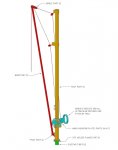
Any crane experts on here?

If I understand you correctly your approach is quite wrong. A simple derrick such as you seem to be proposing is barically a strut in compression . Its likely failure mode will be buckling. It should not have bending loads applied to it such as your pulley at mid-point, this will increase the chance of failure.
If your strut is sagging under its own weight, as you seem to suggest, it must be woefully inadequate.
I wouldn't look to fishing boats for examples of good practice.
 
  • Like
Reactions: DJE
Even with the load perfectly central a slender strut will buckle if you exceed the critical load. Well designed stays and spreaders will reduce the effective length and increase the critical load. This is difficult to arrange in practical structures and usually only done where weight is critical in structures like yacht masts and tall radio masts.
Euler's critical load - Wikipedia
 
Last edited:
I don't think that you'll find much black and white regulation to specifically help. LOLER is fairly general and applies mainly to workplaces. If you wish to use your club insurance or, worse, satisfy an accident investigator, you will probably have to show evidence such as the equipmnt being competently designed with appropriate calculations and load testing. Not easy for a club.
Actual lifting also needs to be properly planned and supervised, even at club level. There's plenty of scope for trouble in this whole area.
The inspector working on behalf of the sailing club insurance company asked for a certificate to say that the crane we had was suitable.
I undertook a load test, in the company of our sailing secretary. I tested the crane with known weights (checked prior) at various radii & whilst lifting & lowering. I then rotated the weights at an observed radius circle to imitate a mast falling at an angle as if something went wrong during operations. It is surprising how much this adds to the load on the crane. I put the jib at maximum out reach. I put the load just above the ground. Then I moved the load in a circular motion so it reached out further than the jib.
At each stage I recorded the maximum weight that the crane would lift, before the wheels on the opposite side lifted off the ground indicating tipping over.
I noted the ground conditions & the fact that the gantry was on firm level ground. I noted tyre pressures & checked & noted condition of rigging & running tackle , along with advice for maintenance.

I then wrote a report of my findings & made a recomendation of the maximum load that I felt the crane should lift.
I made a brass plate with crane No & SWL which is prominently placed by the loading handle
The insurance surveyor accepted this- Along with my MRICS & MCIOB qualifications- Which are construction industry ones . Nothing to do with cranes & I pointed that out in the report.
My professional indemnity insurance policy does not cover such work, so I made that clear & pointed out, disclaimer etc etc

I have asked the club to write a risk assessment/method statement a number of times with no response.
 
I don't think that you'll find much black and white regulation to specifically help. LOLER is fairly general and applies mainly to workplaces. If you wish to use your club insurance or, worse, satisfy an accident investigator, you will probably have to show evidence such as the equipmnt being competently designed with appropriate calculations and load testing. Not easy for a club.
Actual lifting also needs to be properly planned and supervised, even at club level. There's plenty of scope for trouble in this whole area.


As a LOLER inspector, specialising in boat yard operations and equipment..............

In short, if it hasn't got appropriate paperwork which confirms it is properly designed, calculated, tested etc according to legislation, then I would not pass/ certify it for lifting use. Plus appropriate markings on the equipment. In fact I might not even examine it, Can of worms.

BUT....LOLER is an enabling act/ approved code of practice under the Health and Safety at Work Act. Volunteer and private 'setups' are different, although many insurance companies in this field require full LOLER certification regardless. It shows that the end users have thought about what they are doing, and is a step towards safe operations.

We also provide proper accredited training for 'official' boat yard plant, to clubs as well and one key point we emphasise is this;
'If something was to go wrong and someone was hurt/ killed, and a judge ultimately asked you the question 'did you do all that was reasonably practical/ achievable to try and prevent this from happening in the first place' (or words to that effect) - what would you say? In a world where it is quite easy and not overly expensive to hire a guy with a HIAB on the back of his truck for an hour, I think many people might struggle with that one.

It never ceases to amaze me to see some of the things that go on around lifting operations and equipment (even in commercial operations in some cases). Even just a few hundred kg could kill someone if it fell on them..........

If you are going to do it, do it alone where there is no chance of anyone else getting hurt if it goes wrong.
 
Would it help to ballast the lower end of the mast? That would mean you wouldn't need to have your lifting point as high up.
You are right. With the bottom end of the mast weighted with whatever kind of ballast is convenient, the lifting point can be just a little above the ballast. It could be sandbags, chain, or whatever.
 
Last edited:
Not withstanding Ribdriver is correct about legislation and obligation. Me being no expert..... here are some thoughts
I think the picture of the trawler crane is horrible. As said the load on the boom is compression. This is dealt with by large dimension boom. Typically using a lattice structure or if using a tube a fat tube or spreaders stay arrangement as used in our sail boats. Naturally the boom on the trawler will sag in the middle by gravity on the tube and this will instigate compression buckling. So lifting in the middle may have helped a bit. But I think another consideration is that the boom has to be controlled in height. This tackle to the middle may have been for that reason. ie without it and the hoisting wire going over a sheave at the end (top) the boom could just drop down to the load.
I would have the boom height controlled by another winch and wire to the centre or to the end (top). Of course the other real problem with a crane is to counteract the loads out on the boom against toppling over. Most crane accidents seem to be in this way.
Anyway back to the original problem. Lakesailer advocated self mast raising on a smaller boat using a very tall A frame. The mast is laid (stored) on the deck. Perhaps a problem for you to get to that point. The A frame poles are sat on the deck near the gunwhale going up to join together. They are braced forward and aft by stays. The lifting tackle is attached to the top of the A frame. Typically the mast will be lifted from a point above centre of gravity. often by a sling under spreaders. Perhaps with a lashing around the mast further up and held up in place by a halyard. the mast is lifted by the tackle and the base guided toward the mast base.
Obviously the A frame must be much higher than this CofG point and another 2 metres higher if it is a keel stepped mast.
I am not advocating this method for a boat as big as yours as I think the design of the A frame would be too difficult. Poles in compression and very long.
Just a few thoughts and do be carefull. ol'will
 
Your spar is far too small in diameter; reduce the wall thickness and go up to at least 100mm, 150mm would be better but difficult to get in thin enough wall. You will not have any appreciable bending with a larger diameter tube.
 
  • Like
Reactions: DJE
Weld 4 No 5mm * 150 fins to the tube for the middle third, spaced at 90 degrees
This provides vertical & horizontal stiffness plus holes can be drilled easily for taking additional support lines
Get them laser cut to taper them each end to reduce weight
Things like lattice or wire structures are open to damage if the boom is dropped accidently
 
  • Like
Reactions: DJE
Ring Seldon for an estimated cost for a new mast then decide if its worth the risk of dropping it, that doesnt factor in any personal injury to you or others or damaging your neighbours boats in the yard

Or you could just get a chap with a lorry with a hiab.
 
Not at all. How do you intend to stop interaction at the boom end between the two wires? Get a lifting engineer involved to help you. I think you're treading on dangerous ground by self designing and building / testing / using unless you involve professional help. Your choice though.
Its one wire! Bad drawing I know. The wire from the winch pulls with force F. The force at the end of the boom is 2 F. The vertically resolved force needs to be sufficient to lift the boom. As the boom rises, that force required deceases. The vertically resolved force at the centre of the boom depends on the trigonometry of the angles. In relation to F, it is relatively small.
I am asking for professional help.
The finished product will be tested professionally, approved by the insurance company and operated only by those trained to do so.

Now;- technical help please!
 
If your strut is sagging under its own weight, as you seem to suggest, it must be woefully inadequate.

No- all sections sag under their own weight. (See Hollow Rectangular Beam Deflection Calculator)
The trick is to ensure that the section is adequately massive so that the sag is insufficient to move the compression line outside the section OR to counter it as I have suggested.
 
The inspector working on behalf of the sailing club insurance company asked for a certificate to say that the crane we had was suitable.
I undertook a load test, in the company of our sailing secretary. I tested the crane with known weights (checked prior) at various radii & whilst lifting & lowering. I then rotated the weights at an observed radius circle to imitate a mast falling at an angle as if something went wrong during operations. It is surprising how much this adds to the load on the crane. I put the jib at maximum out reach. I put the load just above the ground. Then I moved the load in a circular motion so it reached out further than the jib.
At each stage I recorded the maximum weight that the crane would lift, before the wheels on the opposite side lifted off the ground indicating tipping over.
I noted the ground conditions & the fact that the gantry was on firm level ground. I noted tyre pressures & checked & noted condition of rigging & running tackle , along with advice for maintenance.

I then wrote a report of my findings & made a recomendation of the maximum load that I felt the crane should lift.
I made a brass plate with crane No & SWL which is prominently placed by the loading handle
The insurance surveyor accepted this- Along with my MRICS & MCIOB qualifications- Which are construction industry ones . Nothing to do with cranes & I pointed that out in the report.
My professional indemnity insurance policy does not cover such work, so I made that clear & pointed out, disclaimer etc etc

I have asked the club to write a risk assessment/method statement a number of times with no response.

I find myself in total agreement with what you have stated (especially the last sentence!).

As my proposed crane can rotate about a vertical axis, the risk of the mast falling at an angle is diminished.

The tests we performed with the original boom were with ~300kg. That was with the boom horizontal which is a worst case. With the boom near vertical, the test is less onerous.

Useful input.
 
As a LOLER inspector, specialising in boat yard operations and equipment..............

In short, if it hasn't got appropriate paperwork which confirms it is properly designed, calculated, tested etc according to legislation, then I would not pass/ certify it for lifting use. Plus appropriate markings on the equipment. In fact I might not even examine it, Can of worms.

BUT....LOLER is an enabling act/ approved code of practice under the Health and Safety at Work Act. Volunteer and private 'setups' are different, although many insurance companies in this field require full LOLER certification regardless. It shows that the end users have thought about what they are doing, and is a step towards safe operations.

We also provide proper accredited training for 'official' boat yard plant, to clubs as well and one key point we emphasise is this;
'If something was to go wrong and someone was hurt/ killed, and a judge ultimately asked you the question 'did you do all that was reasonably practical/ achievable to try and prevent this from happening in the first place' (or words to that effect) - what would you say? In a world where it is quite easy and not overly expensive to hire a guy with a HIAB on the back of his truck for an hour, I think many people might struggle with that one.

It never ceases to amaze me to see some of the things that go on around lifting operations and equipment (even in commercial operations in some cases). Even just a few hundred kg could kill someone if it fell on them..........

If you are going to do it, do it alone where there is no chance of anyone else getting hurt if it goes wrong.
Good advice and useful.

I am well acquainted with risk assessment. You will notice from my signature that I manufacture (used to - no more orders please - I've retired!) and demonstrations at marine exhibitions, notably Southampton have caused a huge amount of unintelligent criticism namely from one so called H&S officer.
There are many risks in climbing a mast and my risk assessment studied and countered them all. I was forced to employ a "Safety at Height" inspector to approve my analysis.

Rest assured, risk analysis will be undertaken. The crane is radio controlled thus allowing any personnel to be outside any fall zones and any operators will need training. There are safety switches to avoid limit problems and load sensors to avoid nag induced over tensioning.

You have no reason to know my/our interest in safe operation but rest assured it is foremost.

BUT - I asked for technical advice!

Perhaps I might approach you to perform the safety analysis and testing if you are not too far away as you are properly qualified.
 
Not withstanding Ribdriver is correct about legislation and obligation. Me being no expert..... here are some thoughts
I think the picture of the trawler crane is horrible. As said the load on the boom is compression. This is dealt with by large dimension boom. Typically using a lattice structure or if using a tube a fat tube or spreaders stay arrangement as used in our sail boats. Naturally the boom on the trawler will sag in the middle by gravity on the tube and this will instigate compression buckling. So lifting in the middle may have helped a bit. But I think another consideration is that the boom has to be controlled in height. This tackle to the middle may have been for that reason. ie without it and the hoisting wire going over a sheave at the end (top) the boom could just drop down to the load.
I would have the boom height controlled by another winch and wire to the centre or to the end (top). Of course the other real problem with a crane is to counteract the loads out on the boom against toppling over. Most crane accidents seem to be in this way.
Anyway back to the original problem. Lakesailer advocated self mast raising on a smaller boat using a very tall A frame. The mast is laid (stored) on the deck. Perhaps a problem for you to get to that point. The A frame poles are sat on the deck near the gunwhale going up to join together. They are braced forward and aft by stays. The lifting tackle is attached to the top of the A frame. Typically the mast will be lifted from a point above centre of gravity. often by a sling under spreaders. Perhaps with a lashing around the mast further up and held up in place by a halyard. the mast is lifted by the tackle and the base guided toward the mast base.
Obviously the A frame must be much higher than this CofG point and another 2 metres higher if it is a keel stepped mast.
I am not advocating this method for a boat as big as yours as I think the design of the A frame would be too difficult. Poles in compression and very long.
Just a few thoughts and do be carefull. ol'will

It is. not obvious from the photo but there is only a single continuous boom lifting wire on the fishing boat derrick. It passes from the mast round to a sheave at the end of the boom, back to a sheave on the mast and down to the centre point. The force at the centre of the boom is the winch force. That at the end of the boom is double winch force (In consequence of the sheave). I found 7 other trawlers with the same arrangement. All were plated so presumably insurance approved. The boom diameter in the photo was around four inches. It was not possible to see the wall thickness as the ends were capped. However, I could bend it sideways significantly. The lifting wire for the baskets lies under the boom and is completely separate.

In my design, as noted elsewhere, toppling is countered by the whole crane being free to rotate about the vertical.

I have in the past lowered my mast on a 22 footer using a spinnaker pole supporting a line from the masthead to the foredeck and adjustable tension on the shrouds. It worked well. I used the same arrangement to lower the mast on my current boat. The difference was due to size. The mast is 14metres in length, weighs 140 kg and the boat deck is three metres off the ground. The mast foot needed to be restrained from kicking back which was achieved by a bunch of ropes. As the mast approached the horizontal, it was laid to rest in the hoist slings. The trickiest part was avoiding the mast toppling sideways by continuous adjustment of the shrouds.
The evolution was safely performed.

I am not prepared to reverse the evolution to reset the mast!
 
Your spar is far too small in diameter; reduce the wall thickness and go up to at least 100mm, 150mm would be better but difficult to get in thin enough wall. You will not have any appreciable bending with a larger diameter tube.
Yes, I agree.
I find it difficult to reconcile the difference between boat masts and derrick jibs. The boat mast is restrained from bending by bits of "string". Why not for derrick booms?
 
Weld 4 No 5mm * 150 fins to the tube for the middle third, spaced at 90 degrees
This provides vertical & horizontal stiffness plus holes can be drilled easily for taking additional support lines
Get them laser cut to taper them each end to reduce weight
Things like lattice or wire structures are open to damage if the boom is dropped accidently
The only problem with welding on attachments is the resultant distortion. If the weld is on top (which it probably is) the weld shrinkage will cause a bend downwards (which it did) which is counter to what is desired.

However, the photo does show that arrangement.
 
The only problem with welding on attachments is the resultant distortion. If the weld is on top (which it probably is) the weld shrinkage will cause a bend downwards (which it did) which is counter to what is desired.

However, the photo does show that arrangement.
I suggested 4 welded pieces placed radially around the tube & any sensible welder could spot weld them in place first to prevent distortion. That would solve your issue - would it not?
 
Its one wire! Bad drawing I know. The wire from the winch pulls with force F. The force at the end of the boom is 2 F. The vertically resolved force needs to be sufficient to lift the boom. As the boom rises, that force required deceases. The vertically resolved force at the centre of the boom depends on the trigonometry of the angles. In relation to F, it is relatively small.
I am asking for professional help.
The finished product will be tested professionally, approved by the insurance company and operated only by those trained to do so.

Now;- technical help please!
L003_001A.jpg
I designed this for our sailing club. I am a chartered civil engineer with a lot of experience of steel structures. We had it tested by a reputable crane testing company; they did all the legally required overload tests and gave us a certificate for a SWL of 300kg.
The boom (part 03) is 7. 8m long 100m diameter and 6mm wall thickness. In the horizontal position the boom has an unfactored compressive capacity of 27kN. If it was 60mm diameter with 6mm wall thickness the compressive capacity would be zero at that length due to self weight bending. At 6m long the capacity of the 60mm diameter tube would be 8kN and at 5m long it would be 13kN. One important point is that the end fittings are carefully detailed to ensure that the forces are applied along the centreline of the tube. Your sketch seems to indicate that the loads may be applied eccentrically which will reduce the compressive capacity.

- Technical enough?
 
Yes, I agree.
I find it difficult to reconcile the difference between boat masts and derrick jibs. The boat mast is restrained from bending by bits of "string". Why not for derrick booms?
You can do that but unless the spreader is huge the angles and resultant mechanical advantage mean the loads are disproportionately high; KISS says get a larger tube.
 
Top