Antifouling time soon

The new one on the block, Silic One.

Two good reports so far . Fouling seems to come off fairly well as long as you move now and then.

Quite a performance to apply though.
 
So the long and short of it is , it is basically down to individual preference with no real advantage using one brand over another or the colour unless you go belly up in the ocean when RED may have an advantage.... I think I will go for a mid blue mid priced AF then :) Thanks for all the views now the next question is how many coats and thickness do you allow to build up before you say, thats it its time to strip back to the bare hull ?
 
The new one on the block, Silic One.

Two good reports so far . Fouling seems to come off fairly well as long as you move now and then.

Quite a performance to apply though.

For it to work properly, the boat speed needs to be about 14kts, which doesn't make it suitable for many cruising yachts.
 
So the long and short of it is , it is basically down to individual preference with no real advantage using one brand over another or the colour unless you go belly up in the ocean when RED may have an advantage.... I think I will go for a mid blue mid priced AF then :) Thanks for all the views now the next question is how many coats and thickness do you allow to build up before you say, thats it its time to strip back to the bare hull ?

If you use a hard anti foul the build up will be much quicker than if you use an ablative anti foul.

I would suggest that you get what you pay for - if you buy a cheap anti foul then it will, generally, perform less well than a more expensive anti foul. The cheaper AF will need more frequent wipe down and only last 12 months you should get 2 years from a 'top of the range' AF. I personally don't mind applying AF - but I object to the simple cost of slipping - we use a top of the range AF.

Jonathan

If you apply a silicone AF and you change your mind and want to revert to a conventional AF it is devil to remove the silicone coating such that a conventional AF will adhere. Many commercial vessel that have tried silicone based AF are not totally impressed, if the coating is damaged - hitting things in the sea - it is difficult to repair. I think it is the way forward but ......
 
So the long and short of it is , it is basically down to individual preference with no real advantage using one brand over another or the colour unless you go belly up in the ocean when RED may have an advantage.... I think I will go for a mid blue mid priced AF then :) Thanks for all the views now the next question is how many coats and thickness do you allow to build up before you say, thats it its time to strip back to the bare hull ?

If you're going to lift the boat out every winter, you can probably get away with a mid-priced antifoul. If you want it to stay in the water for 2 years, you need better antifoul, generously applied.

If you use ablating antifoul, pressure washing it on liftout will remove quite a lot of the remaining antifoul layer. I then wash my hull with a Scotch-Brite pad and a running hosepipe, this gets a lot more off, so build-up is minimal. I've never had a boat stripped back to a bare hull, and I kept my last boat for nearly 20 years.
 
For it to work properly, the boat speed needs to be about 14kts, which doesn't make it suitable for many cruising yachts.
I used it on my prop a couple of years ago. In spite of carefully following instructions there was virtually none still adherent by the next year and I wasn't over-impressed during the season. It seemed like a good idea at the time.
 
We used Speaker Coastal hard a/f on our hull and Hempel Cruising Performer on our keel for the last two seasons.

The logic being that we can scrub most of the hull with a brush from the dinghy so we can scrub away as much as we like without removing the hull af. But since we can't reach the keel we use an ablative paint there so it 'should' clean itself.

I've got photos that show the results but are too big to post at the moment. However it can clearly be seen where the limit of our reach with the brush amidships near the keel and towards the tip of the rudder was as there's more slime. Otherwise, both the hull and keel are pretty clean, I think the Hempel paint on the keel did a good job.

We had very few barnacles last season which are normally more of a problem, especially on the prop which previously we've covered in a good coat of marine grease. Last season we painted it with white Hempel Hard Racing af over Hammerite Special Metals primer, both of which did well. We didn't need to clean it at all and the paint adhered well.

We have a deep water mooring on the Medway near buoy 26, launched early June and hauled out early December. We come out every winter.

The last time we scrubbed would have been early October and our last sail early November, the last month in the water was spent in Gillingham Marina.

We noticed one of our club mates' boat was remarkably clean at haul out with a thin coat of slime. He used International Cruiser 250 and is moored in a marina, we may be trying this paint next season.
 
The Medway is quite a muddy river and this assists in allowing marine growth. As PVB has said apply the most expensive antifouling and applied as recommended by the manufacturer. Using a boat frequently to sail/motor also helps to keep the hull clean.

I should mention that the colour can make a difference. A previous yard manager at Chatham Marina commented some years ago that white antifouling seemed to remain the cleanest. When I used to have a river mooring I found that it was necessary to scrub every few months, but now I am in Chatham Marina it is totally different. There is very little mud in the water, being very deep the water stays cooler in the summer and there is also a natural spring flowing into the basin reduces the salinity, these combined mean I can have a faily clean bottom after 2 years in the water as shown in this photo, Dover White International Micron had been applied.

View attachment 106043
I would report that I have heard that darker antifouling colours are more effective that lighter colours.
Racing boats preferring white so that the amount of fouling is obvious therfore indicative of time for a scrub.
From your picture if that is 'Dover White' I'm possibly looking at a negative ?
Ink
 
I would report that I have heard that darker antifouling colours are more effective that lighter colours.
Racing boats preferring white so that the amount of fouling is obvious therfore indicative of time for a scrub.
From your picture if that is 'Dover White' I'm possibly looking at a negative ?
Ink
Love to see your boat after 2 years in the water without scrubbing.
 
We have black anti foul. Usually seems quite clean on annual lift out but maybe in the Solent the fouling is less than in Medway. Can you rotate photos when attached ?
 

Attachments

  • AC742C6C-41F6-4776-A140-F2AE8FCBB61A.jpeg
    AC742C6C-41F6-4776-A140-F2AE8FCBB61A.jpeg
    32.3 KB · Views: 14
I used it on my prop a couple of years ago. In spite of carefully following instructions there was virtually none still adherent by the next year and I wasn't over-impressed during the season. It seemed like a good idea at the time.
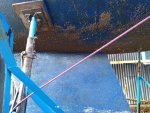
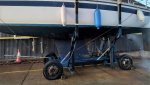
I used Silic One on my hull nearly 2 years ago and I'll be lifting the boat in March to service the outboard.

After the first year I was impressed with the lack of growth, just a light covering of slime which rubbed off with a cloth.

I don't think the prop treatment is any good however. Glad I have an outboard that tilts the prop clear of the water.....

I'll be posting photos of the year 2 condition when I can.
 
Right, I've made my photos of hull fouling a more sensible size to illustrate my post above.

And 'speaker coastal' should have been 'Seajet Coastal' above. Flippin' auto correct!

keel root.jpghull.jpg
 
Last edited:
Yes, I have photos. The photo below is from July 2019, when the boat was lifted after 2 years in the water. This was before any jetwashing, obviously.

Good grief ?

What do you use on your saildrive ?
 
Not sure whether "Good grief" is encouraging or discouraging! I use Trilux 33 for the saildrive and the area around the rudder shaft.

Encouraging (and depressing ?) at the same time.

Portsmouth Harbour, every saildrive product known to man ... my prop and leg are approaching furball status mid-season.

After two years I'd expect them to have their own seahorse colony well established ?
 
Top
