Antifouling over Coppercoat

Euphonyx

Well-Known Member
Joined
29 May 2010
Messages
3,529
Location
Dublin
Visit site
Yes. I have searched and no.. I haven't found the answer!!

I'm at a crossroads. The coppercoat has become thin in patches and is at the end of it's working life after 10 years. Do I re-coppercoat or antifoul in the usual way? Wasn't overly impressed with the coppercoat when I compared to boats around me who use normal anti fouling but it did its job to a decent degree I suppose. Decision time now. Can i simply apply antifouling over the worn out coppercoat? Anyone done this without any adventures ensuing? Thanks
 
I did this job (in disgust with Coppercoat performance) on a previous boat. Abraded with 180 grit on sander, applied a single, light coat of Primocon, as advised by boatyard, then antifouled.
I sold the boat a couple of years later (after 1 re-antifoul) & saw no signs of problems.
 
I have used an International antifoul (micron 350) directly onto the abraded copper coat for three years now with no problem.
I tried an experimental coat on the rudder for one year prior to completely going over to ablative anti foul.
My copper coat was 12 years old and had ceased to be effective but was a sound base coating.
 
Interesting to hear people are moving away from Coppercoat when the all the prep for it has already been done and the option is there to have simply more applied when it's exhausted.

On my radar to Coppercoat my own boat next winter as I'm bored with the annual antifoul aggravation. Owners not happy with it?
 
On my radar to Coppercoat my own boat next winter as I'm bored with the annual antifoul aggravation. Owners not happy with it?
I am more than delighted with Coppercoat - my boat hardly moved over COVID and there was a thin film of slime that jet washed off. I had mine done professionally as applying the stuff is not in my skill set. I would do it in summer due to a higher ambient temperatures and less likelihood of rain.

If I was in the same position as the OP I'd be overcoating with Coppercoat. I hate antifouling.
 
Interesting to hear people are moving away from Coppercoat when the all the prep for it has already been done and the option is there to have simply more applied when it's exhausted.

On my radar to Coppercoat my own boat next winter as I'm bored with the annual antifoul aggravation. Owners not happy with it?

If you buy top end AF and do not skimp with its application you should be looking at a 2 years life. Top end? - best that International make, Hempel's Globic or Jotun Sea Quantum Ultra. The latter 2 are commercial application only and are listed for supply to 'qualified' applicators - but you can usually find someone who will stretch the rules. I don't know what top of the range International is now called - they keep changing the names but one of the Micron range. I have used all three for a complete hull coating, Ultra over 4 years (2 applications), Globic over 2 years and International Micron for 2 years and half way through the second of 2 years. I've also compared with the cheap offerings. If you eke out the expensive paint, thinking you will save money - you are wasting your time and money - slipping to apply costs! Follow the instructions and be generous. Ask the paint maker for a coating thickness gauge - they are cheap.

You can usually tell a good AF, its the most expensive product stocked and it is the most dense, it has more copper compound in it. But AF is not only the amount of copper but the formulation of the resin and the biocides. Its not quite as simple as looking at the one with the most copper.

CC requires rubbing down to expose new copper - adding a new coat of AF is not much different in effort (I don't know the cost equations)

All AF including CC depends on the environment in which they are used - 2 marinas side by side will produce different results - simply because the water is different. But most depend on the vessel moving - leave it stationary - it will foul. In the Jotun range of Sea Quantum they actually produce a product for vessels that are laid up, the others in the range (of 4 total) are have slightly different resin systems for vessels that travel fast or slow. Ultra is about right for us - but if you sail at 30 knots they have a product.

AF, not CC?, will have a short life if thinly applied (unsurprisingly). By the sound of it a thicker coating of CC would last longer than 10 years....??

Be careful buying 'commercial' AF. It can come in drums that are so heavy you cannot lift them - and you need to be able to stir the AF and then decant into a tray. Stirring 50kg of AF with a little battery drill is difficult. Check drum weight!


If I were buying a new yacht I would have it coated with CC from the outset. Much of the cost of applying CC as a retro coat is preparation of the hull and finding a weather window to apply the CC. If you apply CC from new - the boat builder might do it in a shed - ideal. If I found that the CC was inadequate the additional costs incurred in having it done during commissioning would not be that significant and as mentioned the CC coat would do no harm under a conventional AF - its just copper and epoxy.

I had a look at the Clipper fleet on their last iteration when they stopped over in Sydney for Xmas. The hulls were totally clean and it was just 'green' CC. Normally when they get to Sydney they would lift each yacht and apply a new coat of AF. They did not even lift the yachts. One of the rudders had suffered some form of mishap and was removed - not a trace of weed. I took images of some of the other hulls underwater - not a trace of weed or shell - but then the hulls are worked hard - but I was convinced. I was not sufficiently convinced that I would have our cat soda blasted and made fair - that's too much of a wallet shrinker and I would not strip the old AF off myself - life is too short - but new - different story.

Jonathan
 
Last edited:
the option is there to have simply more applied when it's exhausted.
Copper coat works great for some and not for others, so the others antifoul over the top.
From asking many who have copper coat I got the opinion is was around 50/50 for and against but some of the against put up with it because it's already there.
 
Yes. I have searched and no.. I haven't found the answer!!

I'm at a crossroads. The coppercoat has become thin in patches and is at the end of it's working life after 10 years. Do I re-coppercoat or antifoul in the usual way? Wasn't overly impressed with the coppercoat when I compared to boats around me who use normal anti fouling but it did its job to a decent degree I suppose. Decision time now. Can i simply apply antifouling over the worn out coppercoat? Anyone done this without any adventures ensuing? Thanks

You can re Coppercoat - 100 grit hard sand then apply the new Coppercoat.
Or just sand and antifoul. I’d use primocon but others have applied without and it’s been ok.
As the prep is the same for either I’d say if you’re keeping the boat for more than 2 years then Coppercoat is the best value.
 
My boat was Coppercoated , now underneath several layers of A/F, appears to provide a good surface for hard and soft antifoul to adhere to.
Aware of two other mobos where Coppercoat was put on and then over coated a season or two later with ordinary A/F.
We also have a couple of boats Coppercoated by previous owners, the present owners seem happy enough with the stuff to leave it alone.
 
Last edited:
I just scrubbed off and slapped on the AF. It stuck fine, but worked about as well as the Coppercoat on my drying mooring so, after a couple of tries, I gave up and just scrubbed off once or twice in the season. This was made easier by having a bilge keeler and a club with scrubbing grids.

I've just antifouled my new boat, but this had more to do with management really not liking the tatty red boot top and blue antifoul than any expectation of keeping the barnacles at bay. (I pick my battles ;) )
 
Copper coat works great for some and not for others, so the others antifoul over the top.
From asking many who have copper coat I got the opinion is was around 50/50 for and against but some of the against put up with it because it's already there.
I think that those for are, like me, emotionally compromised after the massive cost of applying it for the first time around!
 
9 year old CC'd Boat launched end April - Hauled October.
Neptune marina Ipswich. Static for this period ( used as a 'houseboat').
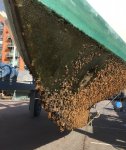
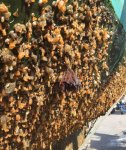
Hull cleaned and abraded, 2 coats SML Cu-pro applied - Boat moved to Levington - just slime despite lack of use.
Yard staff at Neptune reckoned CC didn't work there (I'm using polite language here!). Needless to say, I'm not a fan. This is it after hauling out that October. P.S. it was professionally applied (apparently)
neptune-1.jpg

Neptune-2.jpg
Edit. CC was 9 years old and passed by the surveyor as being in good condition.
 
Interesting to hear people are moving away from Coppercoat when the all the prep for it has already been done and the option is there to have simply more applied when it's exhausted.

On my radar to Coppercoat my own boat next winter as I'm bored with the annual antifoul aggravation. Owners not happy with it?

Had Coppercoat on my previous boat.
Sold her about 10 years after I applied it and you could see it was coming to the end of its useful life. On the keel in particular.


Had my 'new' boat Coppercoated when I bought her.
Was a bit disappointed with its performance after one year. Pressure washed her and abraded the entire hull in the hope to expose more copper.
Hauled out last week, and I was quite pleased with the result. A few barnacles where the skeg joins the hull and some slime on the keel.

Even though the boat might still need an annual pressure-wash, it's nothing compared to having to anti-foul every year.
A job I loath.
 
I think that those for are, like me, emotionally compromised after the massive cost of applying it for the first time around!
I think this is very true. I had Coppercoat for 11 years, and it was fine for the first 5 years or so. Then, despite still being a nice sound surface, it seemed to lose it toxicity. In spite of careful abrading over the last few winters, I found that it slimed up quite quickly and definitely needed a mid season scrub before any decent passage (a loss of 1 knot boat speed puts 2 hours on a trip to Cherbourg for me). And the guys at the boatyard where I haul out each winter will testify that the slime was getting more and more sticky to get off. So this winter have bitten the bullet and gone back to conventional antifouling. I agree that there is a 50/50 split about Coppercoat performance - those who have spent a lot of money on it tend to rate it highly for a few years - the other 50 per cent are like me and get somewhat disillusioned as time goes on.
 
I was strongly considering CC'ing my boat, but as I had plans to sell her in few years, didn't went that way.
On my research, I noticed that a minority of CC jobs are not done exactly as the producer specifies- which compromises the quality of the job. It has to be applied exactly as per (simple) instructions - and looks like some people are not following them, but just do as standard antifouling. Also, some are missing sanding with proper paper few days after. I will definetely redo CC on my current boat. Even if is not working properly, removing slime mid-season is much easier as power wash or abrasive wont remove the paint.
 
I was strongly considering CC'ing my boat, but as I had plans to sell her in few years, didn't went that way.
On my research, I noticed that a minority of CC jobs are not done exactly as the producer specifies- which compromises the quality of the job. It has to be applied exactly as per (simple) instructions - and looks like some people are not following them, but just do as standard antifouling. Also, some are missing sanding with proper paper few days after. I will definetely redo CC on my current boat. Even if is not working properly, removing slime mid-season is much easier as power wash or abrasive wont remove the paint.
Interesting, I was advised not to sand the CC until it stopped working. No sign of it stopping working anytime soon.

Totally, agree about the preparation and following the instructions to get the job done correctly. My boat's bottom looked like the surface of the moon as I don't believe it had ever been taken back to GRP in the 35 years before my ownership. The change in her speed was phenomenal, I have gone from an 'on passage' average speed of 4 kts to 6 kts, meaning passages are faster and more time in the club bar.
 
Interesting, I was advised not to sand the CC until it stopped working. No sign of it stopping working anytime soon.

Here under brushing: https://coppercoat.com/wp-content/u...ttom-Paint-Application-Instructions-NOV18.pdf
There is very good youtube story about CC from disaster to happy user:

CopperCoat support advised me to sand with something around 500.

Some people has issues with CC on steel keels, but I think its because they wait too long for priming - rust activates within 2-3 hours.
 
I think that those for are, like me, emotionally compromised after the massive cost of applying it for the first time around!
Perhaps for some. I regard it as money very well spent. No lift out costs for ten years to start with.

2009 I applied DIY over high build epoxy after buying my current boat on the hard in Plymouth. 2019 lifted out for first time to touch up coppercoat. Boat had been pressure washed once or twice a year between tides up to 2014 when I sailed to the Azores. Main problem in 2019 was loss of coppercoat for about 50cm around sintered bronze cooling plate for fridge and small blistering between coats of high build epoxy applied under the coppercoat.
Boat has not been lifted or cleaned since launch in 2020, currently there is a slight slime coating.
Up to 2014 boat spent winters in Orkney; growth on hull was rapid and far greater in Kirkwall marina than in Stromness marina, regardless of choice of AF. Some visitors had long strings of growth after a week or so in Kirkwall, but not so bad on my boat and easily washed off the coppercoat with pressure washer between tides.
 
Top