
You are using an out of date browser. It may not display this or other websites correctly.
You should upgrade or use an alternative browser.
You should upgrade or use an alternative browser.
Antifoul preparation
- Thread starter wingcommander
- Start date

Momac
Well-Known Member
I noticed a lot of people dry sanding and tried it for only a couple of minutes before realising it is hazardous
Wet sanding is messy but less likely to result in health issues.
Since its winter read the paint manufacturer's instructions regarding temperatures before applying paint.
Wet sanding is messy but less likely to result in health issues.
Since its winter read the paint manufacturer's instructions regarding temperatures before applying paint.
MikeCC
Well-Known Member
Use the mesh type abrasive on a roll. Mirka is premium brand but generic ones available. Use on a pole with a swivel sanding pad. Rinse frequently in bucket of water.

johnalison
Well-Known Member
It doesn’t look perfect but if you just want to get sailing it won’t do any harm to give a wet rub to remove anything loose and then prime and paint.

awol
Well-Known Member
Washing the hull with oxalic acid would be a good idea.

Graham376
Well-Known Member
Don't dry sand without using shop vac, preferably with HEPA filter.
William_H
Well-Known Member
You might want some primer on those areas with what looks like bare GRP. In practice I (you) just do what you can (or have the patience to do) before applying anti foul paint and get it back in and sailing. You might want to improve the rub down next year. Don't stres about getting it perfect. Sailing is more fun than rubbing down. ol'will
Neeves
Well-Known Member
Use an ablative paint and then if you power wash, or scrub with water - simply apply the ablative AF on top of the old.
AF paints work by deterring the ability of fouling organisms to stick to your hull. Ablative paints do this 2 ways - they include a chemical that deters fouling and the paint wears and anything that has resisted the chemicals washes off as you use your boat - or that is the theory. In practice the paint is not a perfect deterrent and your boat does not 'self wash' (because you do not use it frequently and maybe move too slowly). But paint left on your hull, if you used ablative in the past, still contains the magic chemicals - abrading the paint simply throws some of you money straight down the drain.
Just give you hull a decent power wash, and see your paint going down the drain anyway , leave to dry and then apply more ablative paint. be generous - more paint the longer the coating will last.
If you want to know how well your new paint is performing as an ablative coating, change the colour - when the old colours starts to show through - you need to schedule another time on the slips.
For choice of paint - make casual visits to local boat yards and see what they apply. Ask your neighbours what they use and what they think of that prduct. Assess your little survey and make your own decisions. But fouling is location specific and varies over the years. It also varies by how much is applied (most people skimp, and then complain) and many don't use their yachts with sufficient frequency. In general the more expensive AF last longer than the cheaper offerings.
I quite enjoy AF - when you finish - the yacht looks like new - having looked old a tired 2 or 3 days earlier.
Good luck
Jonathan
Edit - if you use a high speed craft (and annoy every one in sight) then the ablative paint will wear off quickly and. hard AF, or even CopperCoat would (might) be better. For the owners of Hi-Speed MoBos - if there is no-one in sight - go for it!
AF paints work by deterring the ability of fouling organisms to stick to your hull. Ablative paints do this 2 ways - they include a chemical that deters fouling and the paint wears and anything that has resisted the chemicals washes off as you use your boat - or that is the theory. In practice the paint is not a perfect deterrent and your boat does not 'self wash' (because you do not use it frequently and maybe move too slowly). But paint left on your hull, if you used ablative in the past, still contains the magic chemicals - abrading the paint simply throws some of you money straight down the drain.
Just give you hull a decent power wash, and see your paint going down the drain anyway
, leave to dry and then apply more ablative paint. be generous - more paint the longer the coating will last.If you want to know how well your new paint is performing as an ablative coating, change the colour - when the old colours starts to show through - you need to schedule another time on the slips.
For choice of paint - make casual visits to local boat yards and see what they apply. Ask your neighbours what they use and what they think of that prduct. Assess your little survey and make your own decisions. But fouling is location specific and varies over the years. It also varies by how much is applied (most people skimp, and then complain) and many don't use their yachts with sufficient frequency. In general the more expensive AF last longer than the cheaper offerings.
I quite enjoy AF - when you finish - the yacht looks like new - having looked old a tired 2 or 3 days earlier.
Good luck
Jonathan
Edit - if you use a high speed craft (and annoy every one in sight) then the ablative paint will wear off quickly and. hard AF, or even CopperCoat would (might) be better. For the owners of Hi-Speed MoBos - if there is no-one in sight - go for it!
wingcommander
Well-Known Member
Definitely will be wet wet sanding . On a damp day which shouldn't be difficult to arrange lolDon't dry sand without using shop vac, preferably with HEPA filter.
Yes it presume you refer to the staining, a result of the surveyor testing the bilge pump..also need to find the source of the discolouration.Washing the hull with oxalic acid would be a good idea.
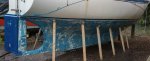
Thanks for the replies, picture is after scrape but before sanding. Is it worth applying a thickened epoxy to any deep scratches prior to a primer, or is this considered OTT. Very pleased to have discovered a blister free hull anyhow.
