Anti Siphon

ip485

Well-Known Member
Joined
13 Feb 2013
Messages
1,614
Visit site
I seem to have a fuel blockage somewhere between my Racor and the fuel tank. The pickup has an anti siphon valve at the top. Am I right in thinking that if I were to blow some air back through the fuel pipe the anti siphon valve would restrict it blowing down the pickup pipe?
 
Depends on what this device is. Is it actually a valve or just some sort of obstruction to prevent fuel theft? Otherwise, I've never heard of an anti-syphon valve in a fuel line.
 
I seem to have a fuel blockage somewhere between my Racor and the fuel tank. The pickup has an anti siphon valve at the top. Am I right in thinking that if I were to blow some air back through the fuel pipe the anti siphon valve would restrict it blowing down the pickup pipe?
A picture of what you call an "anti siphon valve" would help us to understand what it is.

www.solocoastalsailing.co.uk
 
I seem to have a fuel blockage somewhere between my Racor and the fuel tank. The pickup has an anti siphon valve at the top. Am I right in thinking that if I were to blow some air back through the fuel pipe the anti siphon valve would restrict it blowing down the pickup pipe?
As plum says a photo would help understand what you have. You definitely do not want an anti-siphon valve that admits air into your fuel system.

Maybe a check/ non return valve to prevent fuel draining back into the tank when the filter is changed ??? If so it would prevent you blowing air back through the pipework.
 
Last edited:
Maybe a check/ non return valve to prevent fuel draining back into the tank when the filter is changed ??? If so it would prevent you blowing air back through the pipework.
If that is the case then presumably the OP could just break the line at the upstream connection to the non-return valve and blow into the tank and then blow into the Racor from there. That would identify/clear any blockage, temporarily at least.

I've never seen an NRV on a fuel line but my multiple experiences with NRVs on older car screen wash systems is that they always block with crud and quickest solution is to remove them completely.

Richard
 
I've never seen an NRV on a fuel line but my multiple experiences with NRVs on older car screen wash systems is that they always block with crud and quickest solution is to remove them completely.
Richard
Thread drift but ... add some Patio Magic or equivalent to the screen wash.
 
Thank you so far. I may be wrong and I have asked on the IP forum. Something at the back of my mind suggests American vessels that are coded require this, but perhaps I am dreaming. I dont have a photo to hand but intend to remove the pickup at the weekend so perhaps all will be revealed. I hate this type of job because you just know the pickup will not unscrew in a friendly sort of way! Anyway fingers crossed, I havent done it before so need to know how to do it.

It will be interesting to see what I find. There is a right angle elbow on top of the pickup on the top of the tank, then the fuel line to the Racor. The breather line to the fuel tank is fine (checked that), and there is considerable vac. in the Racor when the engine looses power, so it is inevitably the ball in the Racor sticking, something in the fuel line, or something in the pickup.

The odd thing is it runs fine for maybe an hour with no vac. and then the vac. rises in the Racor as the fuel flow is starved. It is not the filter which I have changed, and also the engine filter and the fuel is star bright clean.

Anyone care to have a bet where to start? My inclindation was the pickup and now it is tending towards a sticking ball in the Racor as I cant see why a blockage would cause an intemittent fault.

Oh and the Genset runs absoultely fine so the fuel is good and further proof it is not a vac. forming in the tank.
 
Thank you so far. I may be wrong and I have asked on the IP forum. Something at the back of my mind suggests American vessels that are coded require this, but perhaps I am dreaming.

They may be required to have something, but it can’t be an anti-siphon valve like in a toilet system. Those allow air in at the top of the loop, so that the liquid can drop back down both legs and break the siphon over the top. They only work in a pressure line - if you put one in a suction line like the one from the tank to the lift pump, then the pump will just suck air in through the valve.

Pete
 
As for the problem, I’d suspect crud floating around in the tank that’s intermittently getting sucked onto the end of the pickup tube.

I’m not sure what the “ball” is that you’re referring to? My Racor filters don’t have any balls in them, but obviously the company do make a range of different types.

Pete
 
Thank you so far. I may be wrong and I have asked on the IP forum. Something at the back of my mind suggests American vessels that are coded require this, but perhaps I am dreaming. I dont have a photo to hand but intend to remove the pickup at the weekend so perhaps all will be revealed. I hate this type of job because you just know the pickup will not unscrew in a friendly sort of way! Anyway fingers crossed, I havent done it before so need to know how to do it.

No not dreaming

Google Fuel system antisiphon valve and youll find loadsa info.... maybe something which will help

Anti-Siphon Valve
  • The Anti-Siphon Valve is typically located on top of your fuel tank where your fuel feed hose connects. This is a USCG required part that prevents fuel from leaking into the bilge should a fuel line fail, or gets cut below the tank level.
  • Common symptoms of an anti-siphon valve going bad is lower than normal top end or loss of RPM's at the upper range caused by the anti-siphon valve not opening up all the way from internal corrosion. (very common problem on 10+ year old boats.

I believe the USCG requirement may only apply to gasoline fuel systems
 
Last edited:
As for the problem, I’d suspect crud floating around in the tank that’s intermittently getting sucked onto the end of the pickup tube.

I’m not sure what the “ball” is that you’re referring to? My Racor filters don’t have any balls in them, but obviously the company do make a range of different types.

Pete
Are you sure Pete?

My Racor 500FGs have a NRV ball in the middle of them. Both of mine had been serviced by the previous owner and the valve seat had been installed upside down. Apparently, this is very common because the wrong way looks right but isn't, if you get my drift. :)

Richard
 
No not dreaming
Google Fuel system antisiphon valve and youll find loadsa info.... maybe something which will help
I believe the USCG requirement may only apply to gasoline fuel systems
P'raps I'm even slower than normal this-morning, but can't see how a valve can allow fuel feed to the engine but stop fuel flow if the fuel-line fails
 
P'raps I'm even slower than normal this-morning, but can't see how a valve can allow fuel feed to the engine but stop fuel flow if the fuel-line fails
The Racor 500fg filter has a one way ball valve and in thd Racor service instructions it says "
The hollow aluminum checkball floats up against the seal when fuel is stopped thus preventing fuel bleed-back".

www.solocoastalsailing.co.uk
 
The Racor 500fg filter has a one way ball valve and in thd Racor service instructions it says "
The hollow aluminum checkball floats up against the seal when fuel is stopped thus preventing fuel bleed-back".

www.solocoastalsailing.co.uk
See post #12. :)

However, that is for a different purpose than the "fuel line failure" situation as mentioned by Earlybird. A fractured fuel line will still allow the tank to empty itself into the bilges, depending upon relative heights, even with the Racor fitted.

Richard
 
The Racor 500fg filter has a one way ball valve and in thd Racor service instructions it says "
The hollow aluminum checkball floats up against the seal when fuel is stopped thus preventing fuel bleed-back".

www.solocoastalsailing.co.uk
That's surely a check valve to stop fuel returning to the tank, maybe similar to the OP's system. The USCG appear to require a valve that will allow fuel-flow to the engine but not through a leak in the fuel pipe.
I know welding kit etc. has failure valves for pressurised hoses, but I find such a device hard to imagine for fuel suction pipes.
Edit, beaten to it by RichardS
 
That's surely a check valve to stop fuel returning to the tank, maybe similar to the OP's system. The USCG appear to require a valve that will allow fuel-flow to the engine but not through a leak in the fuel pipe.
I know welding kit etc. has failure valves for pressurised hoses, but I find such a device hard to imagine for fuel suction pipes.
Edit, beaten to it by RichardS

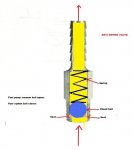
Here's one
evmas160b516_sm.jpg

And here's what's inside

Anti siphon valve.jpg
 
Top