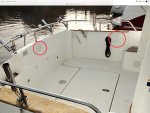
Antarès 8 Spring Cleat

Radio Tanganyika

New Member
Joined
10 Jul 2021
Messages
5
Visit site
Hi Folks
Has anyone managed to fit a spring cleat onto the gunnel of an Antarès 8 [2011]? I have thought of having a cleat welded onto a hollow U section then glueing the cleat onto the gunnel. The place I want to fasten the cleat seems hollow but the gunnel is intrinsically strong. Also I'm a bit flakey on which glue I could use.
 
Hi Folks
Has anyone managed to fit a spring cleat onto the gunnel of an Antarès 8 [2011]? I have thought of having a cleat welded onto a hollow U section then glueing the cleat onto the gunnel. The place I want to fasten the cleat seems hollow but the gunnel is intrinsically strong. Also I'm a bit flakey on which glue I could use.
I would not trust an adhesive for a cleat that one day may be subject to an excessive load when using it to, for example, stop your boat when comming alongside in adverse weather. Why not bolt through into a 6mm stainless plate, which is what I have done on my Antares 760, although you will have to get creative to reach the underside of the gunwale.

Www.solocoastalsailing.co.uk
 
Thank you for that; so, how did you access the inside of the gunwale?
First, I drilled and tapped two M10 threads into two strips of stainless steel 6mm x 30mm x 120mm. Holes spaced to suit your cleats. This avoids the problem of holding plates and nuts in difficult to reach places and no need to hold nuts underneath when tightening screws from above.

Access under the gunwale will depend on the design of the interior moulding of your boat. On my 760 on the port side is a plywood panel under/behind the table and on the starboard side is a plywood panel in the back of the galley cupboard. Although you may not be able to reach, after removing the access panels, where you need to hold the stainless strips, you may be able to do the following.

From the outside, after drilling the two 11mm holes in the gunwale, lower a piece of string down each hole until the ends can be reached from the access panels. Pass the ends of the string through the two tapped holes then tie, say a washer, to the end of each string. Now, from the outside you can pull the two strings to raise the stainless strip up into the inaccessible part of the gunwale. Once the stainless strip is in place, hold it tight with one of the strings, cut the other and insert one of the M10 screws, then once that screw is holding the plate in place cut the other string and screw in the second screw. Now unscrew both screws a little (not too far) so you can squeeze some sealant under the cleat to bed it down on, tighten screws just a little so the sealant is 1mm thick, leave for a few days for the sealant to go off then tighten screws. Hope that makes sense.

www.solocoastalsailing.co.uk
 
First, I drilled and tapped two M10 threads into two strips of stainless steel 6mm x 30mm x 120mm. Holes spaced to suit your cleats. This avoids the problem of holding plates and nuts in difficult to reach places and no need to hold nuts underneath when tightening screws from above.

Access under the gunwale will depend on the design of the interior moulding of your boat. On my 760 on the port side is a plywood panel under/behind the table and on the starboard side is a plywood panel in the back of the galley cupboard. Although you may not be able to reach, after removing the access panels, where you need to hold the stainless strips, you may be able to do the following.

From the outside, after drilling the two 11mm holes in the gunwale, lower a piece of string down each hole until the ends can be reached from the access panels. Pass the ends of the string through the two tapped holes then tie, say a washer, to the end of each string. Now, from the outside you can pull the two strings to raise the stainless strip up into the inaccessible part of the gunwale. Once the stainless strip is in place, hold it tight with one of the strings, cut the other and insert one of the M10 screws, then once that screw is holding the plate in place cut the other string and screw in the second screw. Now unscrew both screws a little (not too far) so you can squeeze some sealant under the cleat to bed it down on, tighten screws just a little so the sealant is 1mm thick, leave for a few days for the sealant to go off then tighten screws. Hope that makes sense.

www.solocoastalsailing.co.uk
I don't know whether or not the deck in question is of sandwich construction or not, but however it's constructed, I would consider it advisable to liberally coat the bores of the holes with epoxy, so as to prevent any ingress of water into the layup, in the event of your sealant failing due to unexpected stresses.
 
I don't know whether or not the deck in question is of sandwich construction or not, but however it's constructed, I would consider it advisable to liberally coat the bores of the holes with epoxy, so as to prevent any ingress of water into the layup, in the event of your sealant failing due to unexpected stresses.
The area in question is not sandwich construction.
 
Top