Another battery question!

LeonF

Well-Known Member
Joined
25 Jun 2001
Messages
1,217
Location
South London
Visit site
I've searched but cannot find an answer. My 26ft double ender has two batteries, one starter , one domestic. No fridge or heater but chart plotter, VHF with AIS, autohelm when motoring etc. 20w solar panel with a non MPPT controller. 1,2,Both selector switch. I need to replace the domestic battery. No management system. Boxes are built in so I'm stuck with a size of around 80/85 ah. Engine start battery is a Yuasa from Halfords HBS 096. I've seen a M28-AGM Yuasa Active Marine Dual AGM Battery 12V 70Ah 760A, or a similar size EFB battery also from Yuasa.

M26-EFB Yuasa Active Marine Battery 12V 80Ah​

Can I use either of these ? On my previous boat I replaced my batteries with AGMs and had an Adverc, but they kept charging to 16.5/17v and I couldn't get an answer from Adverc or the supplier and searches threw up a risk of them cooking so I returned them. This was over 20 years ago. My engine is a Beta 16 with a 40 amp hour alternator.
 
Last edited:
That will be fine. You just have to remember to keep 1 just for starting rather than using it for service as well. much better to have split banks and a VSR though.
Which do you think, the EFB or the AGM ? I always keep Battery 1 for starting, both if motoring, and Battery 2 when sailing.
 
Which do you think, the EFB or the AGM ? I always keep Battery 1 for starting, both if motoring, and Battery 2 when sailing.
Yes that is a good policy except that it is desirable to use no 2 alone for starting occasionally to ensure it will do the job. Because one day no 1 will not crank the engine and you will need no 2 to assist or be the alternative. ol'will
 
Which do you think, the EFB or the AGM ? I always keep Battery 1 for starting, both if motoring, and Battery 2 when sailing.
As Tranona says, better to have separate batteries and switches. It is not a good idea to have the switch on "both" at any time, other than for emergency starting, if something goes wrong with one battery you could lose both. If you don't want to change the switch, at least fit the VSR and only use one battery at a time, that way, both batteries get charged whenever there is a charging source (engine or solar) with no risk to one battery if the other fails.
 
As Tranona says, better to have separate batteries and switches. It is not a good idea to have the switch on "both" at any time, other than for emergency starting, if something goes wrong with one battery you could lose both. If you don't want to change the switch, at least fit the VSR and only use one battery at a time, that way, both batteries get charged whenever there is a charging source (engine or solar) with no risk to one battery if the other fails.
Hi Paul. Sorry I'm not that electrically competent and am now a bit confused. I had a Volvo split diode device between the alternator and the battery switch when I had the Volvo MD2010, which I understand senses which battery is most in need when charging from the engine, but can cause a voltage drop from the alternator. When I had the Beta 16 fitted they ignored the diode and connected the alternator directly to the selector switch, I was told it was less complicated. Is a VSR the same as the diode I had previously ? It's still in place but unused. I would never sail with the selector switch on BOTH, only when motoring.
 
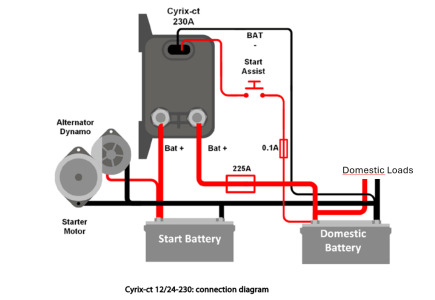
A Voltage Sensitive Relay will effectively connect both the batteries whilst charging but not discharging and do it without any of the voltage loss like a diode splitter would give you. Its the best automatic solution, same as you using the switch but you don't have to be there!
 
Hi Paul. Sorry I'm not that electrically competent and am now a bit confused. I had a Volvo split diode device between the alternator and the battery switch when I had the Volvo MD2010, which I understand senses which battery is most in need when charging from the engine, but can cause a voltage drop from the alternator. When I had the Beta 16 fitted they ignored the diode and connected the alternator directly to the selector switch, I was told it was less complicated. Is a VSR the same as the diode I had previously ? It's still in place but unused. I would never sail with the selector switch on BOTH, only when motoring.
Yes, there would be a voltage drop from the diode, but it would have charged both batteries no matter which was selected. Whoever told you it is less complicated to do without it is retarded, now you have to fiddle with the switch or run on both to be sure both batteries get charged.

I would completely remove the diode and any wiring that goes to it, leaving redundant parts in place is a bad practice. With the alternator connected to the common terminal of the switch it is important to remember to never turn the switch off, or the alternator will be damaged. If you fit a VSR between the two batteries (or the two battery terminals of the switch) both batteries get charged by the alternator, mains or solar. There is no voltage drop.

Having the switch on both is a bad idea at any time, one battery fails and you can lose both.
 
I've searched but cannot find an answer. My 26ft double ender has two batteries, one starter , one domestic. No fridge or heater but chart plotter, VHF with AIS, autohelm when motoring etc. 20w solar panel with a non MPPT controller. 1,2,Both selector switch. I need to replace the domestic battery. No management system. Boxes are built in so I'm stuck with a size of around 80/85 ah. Engine start battery is a Yuasa from Halfords HBS 096. I've seen a M28-AGM Yuasa Active Marine Dual AGM Battery 12V 70Ah 760A, or a similar size EFB battery also from Yuasa.

M26-EFB Yuasa Active Marine Battery 12V 80Ah​

Can I use either of these ? On my previous boat I replaced my batteries with AGMs and had an Adverc, but they kept charging to 16.5/17v and I couldn't get an answer from Adverc or the supplier and searches threw up a risk of them cooking so I returned them. This was over 20 years ago. My engine is a Beta 16 with a 40 amp hour alternator.
Are you happy with only 20 w solar. It has been some years, but solar was cheap about8 years ago and Inused as much as I could fit - (swinging mooring)
 
Are you happy with only 20 w solar. It has been some years, but solar was cheap about8 years ago and Inused as much as I could fit - (swinging mooring)
"as much as can fit" depends on two things... the design of the boat... and how much deck area the owner is willing to give up (or tolerate windage aloft). A 26ft double ender is going to be very sailorly and not have a lot of holiday-caravan spare roof to panel over. And it's probably a bit gorgeous.

A small panel just to keep batteries topped up when not there seems to fill a particular use case really well. Actually generating a meaningful % of your power needs is a different kettle of fish.
 
I used an arangement of a small solar PV panel with bungees attached sitting on top of the boom sail cover. Flying leads to socket inside the cabin. Easy mount but perhaps limited to 20 w. Need to put it away before sailing. ol'will
 
Are you happy with only 20 w solar. It has been some years, but solar was cheap about8 years ago and Inused as much as I could fit - (swinging mooring)
OCuea as William mentions, my needs are modest and the 20w solar, I bought it from 20W Flexi Solar Panel Kit - PV Logic | Solar Technology ,fit's neatly on my push pit on a steel plate wired into boat permanently. If close manoeuvring in a marina I can hinge it down out of the way if I need to. Interestingly they advised me against the more expensive version with bluetooth etc as they said if we had a run of grey weeks in winter the bluetooth element using a tiny bit of juice could run my batteries down.
"as much as can fit" depends on two things... the design of the boat... and how much deck area the owner is willing to give up (or tolerate windage aloft). A 26ft double ender is going to be very sailorly and not have a lot of holiday-caravan spare roof to panel over. And it's probably a bit gorgeous.

A small panel just to keep batteries topped up when not there seems to fill a particular use case really well. Actually generating a meaningful % of your power needs is a different kettle of fish.
Well I get a lot of compliments, well at least the boat does, so maybe it is just a little bit gorgeous !
 
Very interested in this thread. I suspect the OP (like me) doesn't feel comfortable/competent to remove or mess around with the 121Both switch.

However in a 2018 thread I saw that Paul R did say that in such a situation it was ok to leave the switch in place and just put a VSR between the two batteries (which for me is a fairly short cable run) Old thread words copied below. Is this still good as if so I would definitely feel Ok doing this:


"If the domestic bank is suitable for engine starting all you need to do is leave the switch set to that bank and know that the "engine" battery is there should you need to start the engine in the event of a discharged domestic bank. I'm sure Calder mentions this system, as it's a common US method. I'd still favour having separate switches, but having the VSR would be better than not having it.

Installation is pretty simple, it will come with instructions, basically connect it to the two battery bank positives, either at the batteries or the switch (whichever is more convenient) and a light gauge negative wire to the negative bus or a battery. Fit a fuse in one or both positive connections."
 
Very interested in this thread. I suspect the OP (like me) doesn't feel comfortable/competent to remove or mess around with the 121Both switch.

However in a 2018 thread I saw that Paul R did say that in such a situation it was ok to leave the switch in place and just put a VSR between the two batteries (which for me is a fairly short cable run) Old thread words copied below. Is this still good as if so I would definitely feel Ok doing this:


"If the domestic bank is suitable for engine starting all you need to do is leave the switch set to that bank and know that the "engine" battery is there should you need to start the engine in the event of a discharged domestic bank. I'm sure Calder mentions this system, as it's a common US method. I'd still favour having separate switches, but having the VSR would be better than not having it.

Installation is pretty simple, it will come with instructions, basically connect it to the two battery bank positives, either at the batteries or the switch (whichever is more convenient) and a light gauge negative wire to the negative bus or a battery. Fit a fuse in one or both positive connections."
See post #8, still a better option than leaving the switch on both.
 
Top