anchors ready! what happens to my anchor when tide switches?, and is too much chain ever a bad thing (space permitting!)

Clyde Cruising Club has had two anchoring Zoom sessions recently that I think are now available on their website. Both presented by experienced sailors; Yacht master instructor and anchor supplier. Sum up was: old style anchors need min scope of 5, NG are better. Use mixed chain and nylon rode, or a snubber at least length of boat to reduce snatch and drag. Worth a watch with a beer in hand.
 
Distillation of all anchor threads:

People with new generation anchors buy one size bigger than the manufacturers recommend, use at least 5x depth of chain, dig them in with full reverse engine, set at least two GPS anchor alarms and keep an anchor watch in anything over Force 2.

People with older anchors buy the recommended size, lob 'em over the side with 3x depth of chain, have a beer and go to sleep.

There is no observable difference in performance.

I'm with you here JD. A while back I carefully anchored in a lonely remote bay up in the NW, using my (somewhat oversize) NG anchor, with a generous scope of (somewhat oversize) chain, well dug in with engine in full revs astern.

A tatty prawn boat came in later, skipper tossed a tiny Fisherman anchor overboard, attached to a short length of well worn rope. Kettle on. Ends.

Although, he wasn't there when I woke up next morning....................
 
See my post#10, actually a Manson but almost identical. I have owned my Rocna for more than 10 years, it is one of the first to reach UK, before there was an importer here. I don't know how many times we have been at anchor when the tide or the wind has turned more than about 120 degrees but it must be hundreds. The Rocna has never failed to reset.

The information I refer to can be be read on www.morganscloud.com aka Attainable Adventure Cruising. The author quotes a number of other reports to collaborate the data and reach a conclusion. The basis of the conclusion not to support Rocna, in the context of remote adventure cruising, is that this is a risk not worth happening, in these scenarios. IIRC he states that it is a good anchor but if this weakness can be exploited, when on other NGA it does not exist, then he does not support it.
 
The information I refer to can be be read on www.morganscloud.com aka Attainable Adventure Cruising. The author quotes a number of other reports to collaborate the data and reach a conclusion. The basis of the conclusion not to support Rocna, in the context of remote adventure cruising, is that this is a risk not worth happening, in these scenarios. IIRC he states that it is a good anchor but if this weakness can be exploited, when on other NGA it does not exist, then he does not support it.
Based on 'a number' of incidents you can count on one hand though... and not limited to rocna, sticky mud can affect any roll bar anchor in similar way.
 
Based on 'a number' of incidents you can count on one hand though... and not limited to rocna, sticky mud can affect any roll bar anchor in similar way.

Indeed, that is also discussed in the link I gave.
 
I wish people who have shelled out good money for their choice of the latest fashionable new new new generation anchor, would speak more quietly. I don't want my (used to be fashionable) anchor hearing them, and going into the huff, and no longer functioning perfectly. (Which it does).
 
behind a paywall so few can see it, not the greatest link,,, , i read it back when paying for it

It is an excellent link for so many reasons such that paying to access it at least once, is almost irrelevant. The information and data used is well researched and very relevant and could form a serious piece of focused research for anyone planning long distance cruising, especially in remote areas. It's hardly expensive and could really help a person save a small fortune using the information that has been presented.

In the context of this thread, it had relevant information, which I thought would have been of interest to the OP to counter the usual NGA are excellent arguments.

I have no association with the website except as a subscriber.
 
I wish people who have shelled out good money for their choice of the latest fashionable new new new generation anchor, would speak more quietly. I don't want my (used to be fashionable) anchor hearing them, and going into the huff, and no longer functioning perfectly. (Which it does).

I am sure your anchor will continue to hold fast in stubborn defiance of other peoples opinions no matter the volume or veracity of their claims; they all tend to do that, as JD very eloquently suggests. :-)
 
It is an excellent link for so many reasons such that paying to access it at least once, is almost irrelevant. The information and data used is well researched and very relevant and could form a serious piece of focused research for anyone planning long distance cruising, especially in remote areas. It's hardly expensive and could really help a person save a small fortune using the information that has been presented.

In the context of this thread, it had relevant information, which I thought would have been of interest to the OP to counter the usual NGA are excellent arguments.

I have no association with the website except as a subscriber.
Agree it's well worth the cash for a year, but you said 'look at this!!!' and posted a pay to see link. At least go .... oooops.....just a little ..... ;)
 
BlowingOldBoots (aka BOB) - I'm with you - the link I provided earlier, from Practical Sailor, underlines the comments from AAC or Morgan's Cloud. AAC made those comments some years ago and with time have not chosen to amend their comments. The removal of support for Rocna (and other roll bar anchors) by AAC might (then) have been due to a few cases - but at least 2 of the cases related in very expensive consequences (large yachts on beaches with significant damage). The idea that with a change of tension from 0 degrees to 180 degrees allows an anchor to 'shuffle' round is ludicrous. The shuffle round angles and somersault angles are clearly defined in the PS article.

It is a pity that this specific article is behind the paywall (as are many articles on Practical Sailor) but development of good advice costs money and there has to be some way to support the work - or we are left with advice from forums such as this - and some advice is, well, questionable. What is interesting is that a number of people will commend subscribing to AAC - and then ignore the advice :) . Equally interesting is the simple fact that owners of Rocna (and other concave roll bar anchors) see evidence of the problem every time they retrieve their anchor in mud. It is heavily clogged and takes considerable time and effort to clean - even with a powerful deck wash. The ability to connect these 2 issues, clogged on retrieval, and a tripped anchor and its inability to re-set - never seems to cross consciousness.

Much better to be in denial.

BOB - good try, but it is an impossible hill to climb - as Morgan's Cloud found after they removed their recommendation and received an avalanche of vitriolic mail. Don't expect any thanks - you need a tough hide.

Jonathan
 
Last edited:
The somersault will only happen if the pull is changed quickly 180 deg ... which usually does not happen unless in a narrow channel. Most times even then - there is a transition period of tide that causes boat to SWING round an arc to take up new lie.

But if WIND overcomes tide - that could do it ... but it needs to be strong and definite.

The usual action of a rode and anchor is as I showed in my Priory bay photo ... the boat swings and the chain follows an arc as boat moves ... if the pull continues - then the ARC causes the anchor to slew round until it resets in new orientation.

This above of course is for an all or predominantly chain rode.

For a rope rode or one that has only a short minimum chain at anchor - then its all bets are off what happens as the rope has no weight, no catenary effect, in fact could quite easily cause a somersault of the anchor ...
 
An armchair admiral writes...

Pretty much any anchor will hold in most conditions. Pretty much any anchor will fail in rare conditions, when another design would do better. Pretty much any "expert" will use those rare conditions to rubbish the other boat's anchor, while maintaining that his rare condition is so exceptional that no reasonable person would expect it to hold.

Untie anchor - pull out rode & make off - splash - chug astern - ball - chug beer.
 
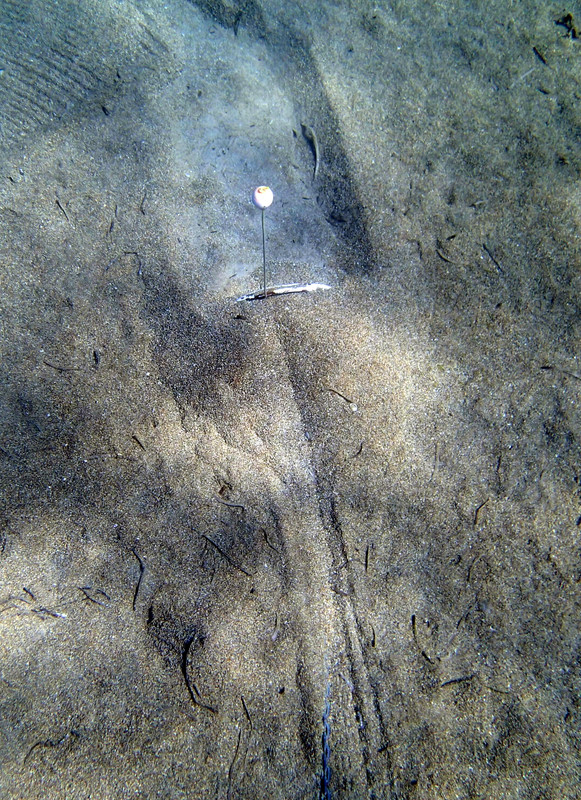
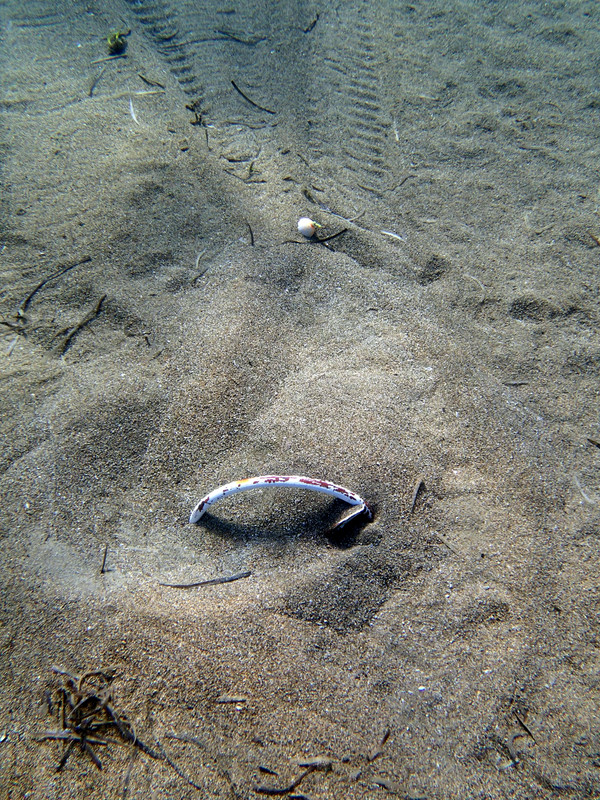
Here's another photo of my Rocna failing to reset when the wind turned;). We anchored in a SE-facing beach on the island of Patmos in a light south-easterly wind, knowing that it was forecast to veer to the NW and increase overnight. I photographed the anchor to check that it was well set.


As predicted, the wind picked up to about force 5 and veered to NW, from which we were well sheltered. I photographed the anchor next morning. The odd thing to see here is that the float that is attached to the crown of the anchor is only a couple of inches above the seabed and placed somewhere near the end of the shank. I assume this means that the chain dragged right across the shank and hoop, taking the metre-long line with it. the anchor has turned and is still holding well.
 
Here's another photo of my Rocna failing to reset when the wind turned;). We anchored in a SE-facing beach on the island of Patmos in a light south-easterly wind, knowing that it was forecast to veer to the NW and increase overnight. I photographed the anchor to check that it was well set.

I don't think anyone has said a Rocna will fail to re-set in sand - its mud that is the issue,

Jonathan
 
Maybe the mud experienced in the Morgan's Cloud incidents had a specific consistency? Our Rocna does sometimes come up with a clod of mud attached to the flukes but I am sure it would set again, simply pushing the mud through the hoop.
 
Maybe the mud experienced in the Morgan's Cloud incidents had a specific consistency? Our Rocna does sometimes come up with a clod of mud attached to the flukes but I am sure it would set again, simply pushing the mud through the hoop.


That's the problem ... what is the bed used to anchor in ...

But I have never had any problem resetting an anchor that even has dried mud on the flukes .............

I have 4 types of anchor (ignoring the bricks used in the river !) ...

1. Proper 5kg Fishermans I use as my kedge / lunch stop on a 4 ton 25ft Bilge keeler (3m chain, rest rope).
2. 10kg (?) Holdfast plough as main bow anchor same boat. All chain rode... 30m
3. Home made fisherman style 1kg for fishing from my smaller 4 - 5m boats in river ... all rope.
4. Dinky small 2kg Admiralty pattern anchor with a 20m Anchor reel of woven rode .. its holding is amazing !! (It came with one of the Soviet MoBo's I rescued).

In the river where I live - its typical glacial job with a hard bottom covered by thin mud layer. They all need a lot of scope out to be reliable hold ... which to be honest would be for ANY design and is why most people here tie a lump of concrete or brick to a rope and use that !!
The plough fairs best from its weight PoV combined with the chain. But I am seriously thinking to swap the fishermans kedge for that Admiralty Pattern job ...
 
In the river where I live - its typical glacial job with a hard bottom covered by thin mud layer. They all need a lot of scope out to be reliable hold ... which to be honest would be for ANY design and is why most people here tie a lump of concrete or brick to a rope and use that !!

I regularly anchor the Drascombe in the River Ken, which is much like that. I have a knock-off Bruce copy, two metres of 6mm chain and 20m of rope and it sets and holds very well indeed, as long as it has a lot of scope.
 
Top