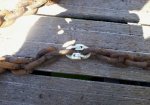
Anchoring - Hammerlocks instead of shackles, corrosion

Neeves

Well-Known Member
Joined
20 Nov 2011
Messages
14,060
Location
Sydney, Australia.
Visit site
I've been using hammerlocks instead of shackles to attach anchor to chain. Hammerlocks don't have protruding shackle pins, are more streamlined and don't seem to 'lock up' in the shank slot - BUT - are difficult to source galvanised. I've been having mine galvanised, but that's an inconvenience for me and it will be doubly so for most. Its very subjective but I've been finding them 'better' than shackles (mainly because they don't lock up).

But I recall - 'someone' - Geem?, an ocean girdler of some repute, mentioning he had used, ungalvanised, hammerlocks instead of shackles 'as they were so cheap, when they started looking manky he (they) simply threw them out and used a new one'.

Hammerlocks are common in the lifting industry, usually painted in primary colours and come as G80 or G100 strength (most chain is G30)

as an example:

Hammerlock Shackles | ARK

They seem to be gaining popularity for use with safety chains on caravans.

I have seen them used in marine applications (galvanised) but only in really large sizes - but I have never seen galvanised versions for sale.

Any input from anyone who has used them.

Jonathan
 
Never used one, but it looks like a good idea. As for shackle pin heads, I screw in the pin with a squirt of Loctite, then slice off the head, which is even cheaper.
 
It was probably me, never saw or heard anyone else using them. This is after a few hundred anchoring nights; in total been using them for 6-7years.


DLink%2Banchor-2.JPG
 
Been using Hammerlocks for Shanty's anchor & mooring bridle for years. As the OP says, cheap enough that when they get too rusty, they can be cut off & replaced - usually after several seasons use.

As the OP says, they are used for lifting equipment. They are also used by commercial fishermen, so can be obtained from stores supplying the fishing industry (e.g. Gael Force)
 
There is another version, whose wire sizing is a little deformed (meaning not shaped circular rod like the above, but sort of contorted ellipse) to give a shape very similar to one chain link, which will go through the windlass without problems. Breaking strength just a touch below chain, I used to connect two lengths of my used chain (after having removed a central section). I bought the Crosby as well but this is a lot easier to mount :)
I could only find a couple of them though, a lot more expensive than the above, it has a stamping on the body with a code, I could source the producer but now I forgot who it was.


dlink.jpg
 
I've been using hammerlocks instead of shackles to attach anchor to chain. Hammerlocks don't have protruding shackle pins, are more streamlined and don't seem to 'lock up' in the shank slot - BUT - are difficult to source galvanised. I've been having mine galvanised, but that's an inconvenience for me and it will be doubly so for most. Its very subjective but I've been finding them 'better' than shackles (mainly because they don't lock up).

But I recall - 'someone' - Geem?, an ocean girdler of some repute, mentioning he had used, ungalvanised, hammerlocks instead of shackles 'as they were so cheap, when they started looking manky he (they) simply threw them out and used a new one'.

Hammerlocks are common in the lifting industry, usually painted in primary colours and come as G80 or G100 strength (most chain is G30)

as an example:

Hammerlock Shackles | ARK

They seem to be gaining popularity for use with safety chains on caravans.

I have seen them used in marine applications (galvanised) but only in really large sizes - but I have never seen galvanised versions for sale.

Any input from anyone who has used them.

Jonathan


Not used then on anchor chain but are quite common on multi leg sling chains.

pewag_grade12_2leg11072017164646_lrg.jpg


The slot in an anchor stock is designed IMHO for the bow of a shackle to be located in the slot and not the pin.

The slot allows the bulbus pin thread to pass through the slot so the bow is in the slot. This was its less likely to jam
 
It was probably me, never saw or heard anyone else using them. This is after a few hundred anchoring nights; in total been using them for 6-7years.


DLink%2Banchor-2.JPG

Roberto - it could have been you, and apologies to Geem for misrepresentation (but you Geem, should try them :) )

And apologies Roberto for not remembering it was you!

That one looks a bit ordinary but will last a bit longer (as long as not is not staining the deck).

Answering Rogers comment - The bow of the hammerlock is not dissimilar to the bow of a shackle, but the opposite bow is a better interface with the chain (than a shackle pin).

As I have been typing Shanty and Roger have posted - I confess apart from Roberto's post some months ago I thought I was the only one using them.

The problems with shackles are they have a 'flat' end that even when the shackle pin end is cut off they can catch on the sides of the bow roller. The hammerlock has a more kindly end that more easily slips round the front of a bow roller. The down side is that they are devil to cut off or you need a punch to Hammer out the pin.

I cannot suggest that a hammerlock is perfect - but they do provide an option to the conventional shackle that may overcome some issues resulting from shackles. Hammerlocks come in a whole host of designs. As far as I am aware all hammerlocks come with the Grade, G70, G80 or G100 embossed onto them, have the WLL defined and the better ones will have the manufacturer's name and a batch code.

I started using them as finding decent shackles to fit 6mm high tensile chain was not easy - but G80 and G100 hammerlocks in 6mm sizes was easy. The hammerlocks are marketed as the same strength as the chain, but in testing are, much, stronger.

Jonathan
 
I'm testing these:

YOKE

This elongated half of a hammerlock fits into the shank slot

which is one half of a hammerlock, the other half is as shown above (and fits the chain)

Contradictorily they only supply sizes 7/8mm and larger and are actually too big for our chain - so I use a 6mm Omega as well.

I was intrigued by the length of this specific component - I'll report back.

Jonathan
 
I've always known these as 'Trawlex' shackles.It turns out that Trawlex is a trade name (just done a quick google).One result from the googleing is a firm Crooks in NZ.They advertise a galvanised and 'passivated' hammerlock shackle.
Hope this is of some use.
Cheers
 
The V shape of the bow roller on my boat prevents the shackle catching on the stemmed cheeks. Another way of looking at it the shackle has two parts to fail, the Hammerlock 4 parts. I do like the slimmer dimensions of the Hammerlock but as I have wide cheeks on the stem head fitting it offers no advantage over a shackle.
 
Shackles seldom fail because they break. Most failures occur when the pin has been incorrectly moused (or not moused at all). Hammerlocks over come operator assembly error - you cannot go far wrong in hammering in a clevis pin. However I am aware of one shackle failure occurred when the shackle appears to have been side loaded and the shackle deformed and the pin pulled out. Another failed when the bow of the shackle failed, it snapped. Both of these failures should have been picked up during testing - which underlines - buy rated shackle. Good shackles are batch tested to 2 times WLL, which for most shackles taking a 3/8th" size would be to 2t or in the case of Crosby G209a shackles 4t. 2t is well beyond anything you will ever experience on a yacht that would use a 3/8th" shackle.

What is interesting about the lifting industry - they appear to use Hammerlocks and Omega links in preference to shackles - I don't know why.

Jonathan
 
Top