Anchor shackles

lustyd

Well-Known Member
Joined
27 Jul 2010
Messages
14,941
Visit site
Following on from my other thread about rode, I bought a metal thimble and then wondered whether current shackle would fit. While looking at shackle dimensions I saw the ones with the coloured pins (which are new to me). These had a test strength of 6000kg or so but since they were making a fuss I thought to check standard shackles and it turns out they are around 600kg or 1/10 of the chain strength.

So, walking back to the boat after lunch I checked and not a single boat has a high strength shackle. A couple have swivels instead (direct to anchor on all, naughty!) but the vast majority have standard galvanised or stainless shackles.

This seems worrying. Firstly that I didn't know, and secondly that nobody else seems to know. Hence the thread here. Check your shackle if you plan to anchor!
 
Following on from my other thread about rode, I bought a metal thimble and then wondered whether current shackle would fit. While looking at shackle dimensions I saw the ones with the coloured pins (which are new to me). These had a test strength of 6000kg or so but since they were making a fuss I thought to check standard shackles and it turns out they are around 600kg or 1/10 of the chain strength.

So, walking back to the boat after lunch I checked and not a single boat has a high strength shackle. A couple have swivels instead (direct to anchor on all, naughty!) but the vast majority have standard galvanised or stainless shackles.

This seems worrying. Firstly that I didn't know, and secondly that nobody else seems to know. Hence the thread here. Check your shackle if you plan to anchor!
Neeves is your man on shackles. Hee has posted many times on the subject for similar reasons to you encouraging people to make sure all the links in the anchor system match.

The reason people get away with using undersize shackles is because they never anchor in situations when the loads would exceed the shackle. Chains and shackles are way overspecified for the loads that a boat can apply until you get to extreme conditions. Again Neeves and Vyv Cox have posted plenty showing what the real loads are and why you almost never here of anchor chains or shackles breaking.
 
When I got my boat it had a flush (allen key) stainless steel shackle on the anchor. And quite a lot of rust on the chain nearby. I too noticed the variation in breaking and SWL and went with a galvanised green pin shackle. Survived Floris. I don't bother with or need a swivel. Perhaps if I spent a week spinning at anchor I might wish for one. Simple wins out for me.
 
Last edited:
I would not use stainless shackles in a galvanised rode, the galvanised shackles are better.


All shackles good or bad, for the same sized pin, have a similar design and dimensions. You cannot tell the difference by quickly looking - they all look the same. So your local DIY store will sell a 3/8th" shackles, which will be good to secure your dog (as long as the dog is not very big) and maybe have never been tested. Shackles should be embossed with the WLL, size and a code that refers to a batch number.

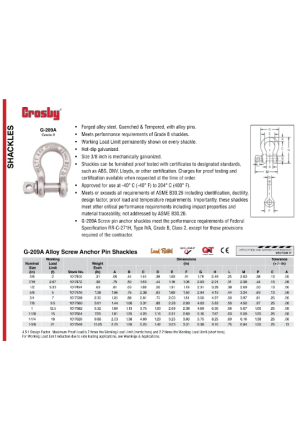
Coloured pins are common place. They are often part of branding Peerlift refer to their blue pin and or their G80 shackles, Crosby (https://kitocrosby.com/product/crosby-g-209a-alloy-screw-anchor-pin-shackles/_ have their painted silver and are called their Platinum range, Campbell refer to their Orange pin shackles (I've only seen them for sale in N Am). Confusingly in Australia colour is part of quality
identification, I think yellow is G60 quality and many G60 components, say lifting straps, are also yellow

The best shackles available are described as being Grade B or G80. Grade A aka G6 or G60 shackles are weaker.

3/8th" grade B shackles, supplied by Peerless (Google Peerlift Blue Pin shackles or Peerless | Peer-Lift® Screw Pin Anchor Shackles ), Campbell, Crosby and Yoke have a WLL of 2,000kg the identically sized Grade A shackles have a WLL of 1t. Be care
full when you buy as they all make Grade A aka G6, or G60, shackles. You want G80 or Grade B shackles

Whereas a 3/8th" shackle might be paired with 8mm chain the WLL of 1,000kg seems well over strength for the shackle (8mm G30 chain has a WLL of 750kg). If your shackle locks up in the slot in the anchor and is side loaded at 45 degrees - the WLL falls to 500kg. So focus on Grade B. You can buy Crosby shackles from Tecni, I think they are Bristol based, You might be able to buy Crosby or Peerless shackles from Gunnebo who are all part of the same company now. Yoke products, (I don't know if they carry shackles in the UK), are sold in the UK by:

Tiger Lifting UK Limited

Leanne Reynolds leanne.reynolds@tigerlifting.com

Tiger Lifting Information info@tigerlifting.com


If you check Peerless Blue Pin G80 anchor/aka bow shackles you will find they make quite small shackles to a grade B specification (but you have to read the small print). What, I think we call 'D' shackles, the lifting industry call chain shackles.

A few years ago Kito (a Japanese crane builder) merged with Crosby to form Kito Crosby. The then went on a buying spree and bought Peerless, America's biggest chain maker, PWB an Oz chain maker, Weisenfalls (renamed Kito Italy) and Gunnebo, to name a few. They have all since been bought by Columbus McKinnon. They have been updating their websites and it can be difficult to find minor items like ....shackles. I've tried to provide some of the relevant links.

You need to read the small print, G8 or G80 and Grade B are hidden in the small print.

All the shackles to which I refer have a screw pin, which can be secured by mousing or use Loctite (it sets in the wet). All of these companies also make with a shackle pin secured with a nut and split pin - but to the same G80/Grade B spec.
Tecni. Crosby G209A Full Alloy Steel Anchor Bow Shackle Screw Pin


I have sourced and tested all of these 'anchor' shackles in a 3/8th" size with a screw in pin. Blindfold they are all the same, just different colour pins :). I buy direct from Tecni, there are various sources of Campbell shackles (check companies that sell chain). I have bought direct from Yoke - but you need to be persuasive.
You only need buy once, but buy 2 shackles. They should last a long time.

I do not recommend CMP's Titan Black Pin shackles, easily available in many chandlers - they don't meet the G80 nor Grade B spec and as you need to have no second thoughts over your choice - don't let your shackle be the weak link.

There are some Chinese suppliers of shackles ostensibly G80, Grade B. I have not tested them. When I tested CMP's Black Pin shackles they were marketing them as Grade B. When they saw my test results they removed the Grade B claim and reduced the WLL from 2,000kg to (I think its 2 short tons). This led me to wonder about their QC and testing regime (which now may be superb, or not).


If you have downsized your chain you really need a Grade B shackle - but you could equally consider an Omega link or a Hammer Lock, which you can source at G10 or G100 quality (from any lifting component distributor (but they will not be galvanised). They are not expensive - use until the paint wears off and they start to get unsightly and buy a new one.

When I have tested shackles with screw in pins the shackle invariably fails at the thread 'inside' the bow. The pin is slightly thinner at that point as the thread of the pin extends outside the threaded hole. On bow shackles with a nut the thread is exterior to the shackles - possibly making it easier to achieve Grade B G80 strength.


Thread drift

In the Panope Odin (from Viking) video Steve Godwin comments on the poor shackle slot in the shank. He suggests, I think, that the shackle might lock up. He does not mention the shackle size he used but being in Washington State he has easy access to all of the Peerless, Crosby range and I know my Odin 40, the model he tests accepts Peerless, Crosby, Yoke, Campbell 3/8th" Grade B shackles - so I'm a bit confused what his beef is about. I do use an Omega link, that I have galvanised, as an enlarged link on my high tensile 6mm chain paired with a 3/8th" bow (anchor) shackle (bow through the slot, shackle pin through the Omega and the pin of the G100 omega fits the hole in the 6mm chain....perfectly (that's how the all the lifting components are designed.


Personally I prefer to deal with Yoke. They have some innovative products, their marking (on their shackles )is crisp and legible and the they have some excellent height safety kit (think mast climbing). But all the companies I list, Peerless, Yoke, Crosby, Campbell and Tecni are highly reputable and for mail order from N Am maybe try Fishery Supply

Jonathan
 
Last edited:
....Or just hammer a tapered drift into the end link of the chain, so that you can use a bigger shackle than the chain would normally accept. (Standing by for abuse).
 
....Or just hammer a tapered drift into the end link of the chain, so that you can use a bigger shackle than the chain would normally accept. (Standing by for abuse).
Why are you expecting abuse?

I might not recommend it for high tensile chain, though if its been galvanised it will have reduced hardness, but for G30 or G40 - all you need is somewhere to do the hammering, not the deck and probably not the pontoon.

Jonathan
 
Another vote for the Crosby 209A, but whatever shackle you choose, make sure it cannot bind and lock in an unfair position on your particular anchor. This involves pulling the chain from all directions and making sure the shackle remains free. If it can bind, a slightly different model or size of shackle usually solves the problem and will be a much better choice.

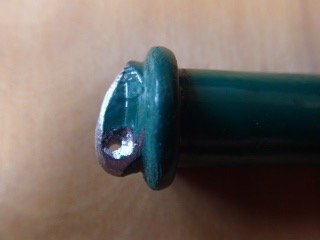
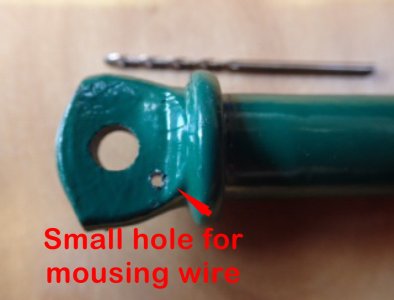
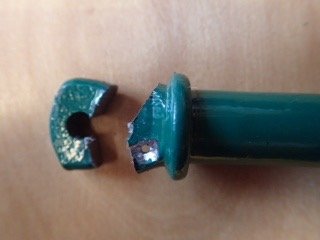
It is also worthwhile streamlining the head of the shackle. This will not reduce the chance of the shackle binding on the anchor , but it reduces its chance of catching on the bowsprit, forestay, etc., as the anchor is retrieved. Rather than removing the head off pin completely, I leave a small protrusion that can be drilled to accept a mousing wire. The photos below show what I am trying to achieve.


You_Doodle_2023-03-10T16_05_53Z.jpeg
IMG_6775~photo.jpeg
IMG_6774~photo.jpeg
 
Last edited:
We only ever used bolt type bow shackles in the diving industry. The split pin discarded and giant nappy pins made and used to secure the nut. Generally these were used for single lifts to make it easier for the divers to remove/install the shackles. I’ve also seen cotter pins used for permanent applications. Could also use R clips and linch pins (perhaps only in larger shackles) but I wonder if key rings of appropriate material would be a good solution. Certainly easier than mousing and less likely to catch on the bow roller, although I accept the bolt type shackles are always going to struggle at that point.
 
This is link to the Peerlift G80 anchor (aka Bow)(blue pin) shackles

Peerless | Peer-Lift® Screw Pin Anchor Shackles

Important if you don't need a 3/8th" shackle and want something smaller and robust

Most manufacturers of bow shackles also have a complimentary range of bolt type bow (anchor) shackles, see Bens post No 16

and a link to Campbells 3/8th" G80, Grade B anchor/bow shackles

5410695

I could not find a spreadsheet covering the complete range of Campbell's sizes. You need to link to the specific size you need.

Jonathan
 
Last edited:
I detect a trend in the Lifting industry toward nut shackles. I cannot say its away from shackle pins as shackles with pins never received much mention (there are better devices for the lifting industry). But there has been recent mention of bolted shackles as being better.

I look at the drawings of bolted shackles and wonder if you took a grinding wheel to the bolt's head and rounded it, enough to leave something to get a spanner on, did the same for the nut and cut off the end of the shank (removing the hole for the split pin) but secured with Loctite. The nut and bolt would then be no wider than the bow of the shackle - the nut and bolt head, now being rounded, would be better accepted by a narrow bow roller. Security would rely on Loctite - which many would not trust.

I might be inclined to use a stronger nut and bolt (the supplied nut and bolt are only need to be G80 and you can source much stronger.

This would work less well if you swap your anchors frequently - but who takes their anchor of the bow roller anyway?


The industry says shackles pins are for temporary installation and that bolts are safer especially in application where there is vibration. Bolts are for long term fixed installations, (like most anchors on a rode :) ). This suggests the industry has not heard of mousing wire - or does not like it. Because I did swap anchors frequently, to test anchors not shackles. I used zip/cable ties not as long lasting and better on hands than mousing wire. For long term installation I used blue Loctite and cable ties or mousing wire.

If you Google there are a number of vids on comparing bolted pin and shackle pins

Jonathan
 
Last edited:
For those who are of a cautious nature I did some tests with Loctite under water.

Adhesives Test - Practical Sailor

I think Vyv Cox also did some work underwater with Loctite - his report maybe on his website.

I also was a bit overly generous on a different occasion with a red Loctite to secure an inter screw. I might have, out of character, been overly generous. It was impossible to break the seal, even using a 2' long adjustable spanner - the success was to use a blow torch.

Jonathan
 
Because my captive bow roller i have found that Allen key head stops it jamming as it's nice and flush. The anchor locker is the only downside of a Finnish motor sailer
 
Top