Anchor question,

doug748

Well-Known Member
Joined
1 Oct 2002
Messages
14,100
Location
UK. South West.
Visit site
I know we all love an anchor wrangle. But here is a real, proper question. I have a 4ton 32 foot boat and am considering a new anchor. I have a choice of two:

10kg genuine spade S60
10kg genuine Rocna.

Both are about £280. They are for general sheltered anchoring in Northern Europe, not survival conditions.

I have narrowed it down to these two, so won't be considering any alternatives.

The question is which one would you pick? The Rocna or the Spade?
 
Last edited:
Neither. Even though you PLAN to anchor in sheltered conditions if it does blow up you would then be thankful that you had gone up a size say to 14kg.
 
It may well depend on what your bow roller can accommodate.

Can you please give me some advice on how the rest of us can avoid occasional "survival conditions" when at anchor?
 
It may come down to which fits your bow roller. Some people have difficulty fitting the roll bar of the Rocna, whereas the Spade doesn't have one. Spade comes out top in the majority of anchor tests, which usually only compare ultimate holding, but I don't think there is much difference between them in reality. Either of them is fine for your boat, the holding of new generation anchors is remarkable. The Rocna sizing chart recommends a 10 kg for your boat and their philosophy is that this chart covers all conceivable conditions, 50 knots of wind, surge and a dodgy bottom.
 
That's three "don't knows" so far then.

By the way, I forgot to say, am not fussed if people express their preferences through experience or by a detailed knowledge of test results.
 
Last edited:
That's three "don't knows" so far then.

By the way, I forgot to say, am not fussed if people express their preferences through experience or by a detailed knowledge of test results.

Well, thanks for that. Some of us are trying to help by suggesting that your deck / bow roller layout may well be the deciding factor, but if your attitude is so disparaging, I'm out!
 
OK, then, a comparison question for you: what's the melting point of zinc compared to lead?

Good question! :encouragement:

Purely from memory having melted a lot of lead in my youth Lead 800 C, Zinc 1000 C

And relevant because I'm thinking of making a plaster cast of the new saildrive anodes I have just bought and then melting down the old ones and using the cast to make new ones. Has anyone else tried it?

Richard
 
Good question! :encouragement:

Purely from memory having melted a lot of lead in my youth Lead 800 C, Zinc 1000 C

And relevant because I'm thinking of making a plaster cast of the new saildrive anodes I have just bought and then melting down the old ones and using the cast to make new ones. Has anyone else tried it?

Richard

Must have had a good blowlamp! :) Lead M.Pt 327C, Zn M.Pt 415C

Casting your own anodes can work but you must take steps to ensure that there is not even the faintest trace of iron/steel in there. Iron inhibits the anodic reaction of zinc in microscopic levels, should be less than .0014% to comply with the Mil Spec A-18001A.
 
Must have had a good blowlamp! :) Lead M.Pt 327C, Zn M.Pt 415C

Casting your own anodes can work but you must take steps to ensure that there is not even the faintest trace of iron/steel in there. Iron inhibits the anodic reaction of zinc in microscopic levels, should be less than .0014% to comply with the Mil Spec A-18001A.

I make my own for my Autoprop, and they work fine. They don't have any iron or steel attachments, but my (bought) pear-shaped hull anode has a steel strap embedded in it for its fixings.
 
I suppose that the iron strap doesn't have any effect on the overall performance of the anode. Most decent shaft anodes also have steel straps in them. The info on iron content is here http://www.boatzincs.com/use_milspec_a18001k.html. MGDuff sell zinc anodes to Mil Spec 18001K and limit iron content to .005% max.

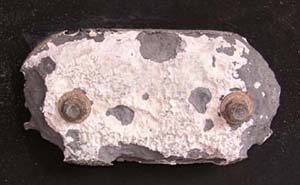
This anode pictured in your link says the crust is due to metal oxide I was under the impression that this kind of crust is when a zinc anode is used in brackish/fresh water.

passivated-hull-anode.jpg


My boat is moored in a tidel lagoon feed by fresh water rivers so the water would tend to be brackish.
 
Top