Anchor light position

There are a few statements above as to what the Regs require and allow that I'd quibble with (Paul beat me to it!). In particular, there is no requirement for the light to be in the foretriangle (unless you own a superyacht), you may also have a light at the stern, and you may also illuminate the deck by whatever means

Anchoring lights ColRegs quoted below (emphasis added) for info/clarification.

"Rule 30 Anchored vessels and vessels aground

(a) A vessel at anchor shall exhibit where it can best be seen:

- - - - (i) in the fore part, an all-round white light or one ball;

- - - - (ii) at or near the stern and at a lower level than the light prescribed in sub-paragraph (i), an

all-round white light.

(b) A vessel of less than 50 metres in length may exhibit an all-round white light where it can best be

seen
instead of the lights prescribed in paragraph (a) of this Rule.

(c) A vessel at anchor may, and a vessel of 100 metres and more in length shall, also use the available

working or equivalent lights to illuminate her decks.


(d) A vessel aground shall exhibit the lights prescribed in paragraph (a) or (b) of this Rule and in

addition, where they can best be seen:

- - - - (i) two all-round red lights in a vertical line;

- - - - (ii) three balls in a vertical line.


(e) A vessel of less than 7 metres in length, when at anchor, not in or near a narrow channel, fairway

or anchorage, or where other vessels normally navigate, shall not be required to exhibit the lights

or shape prescribed in paragraphs (a) and (b) of this Rule.


(f) A vessel of less than 12 metres in length, when aground, shall not be required to exhibit the lights

or shapes prescribed in sub-paragraphs (d) (i) and (ii) of this Rule.
 
Does anyone put one up when moored? We do display an anchor light* when actually anchored but those will usually be very quiet, out of the way places. When we leave the boat on its own mooring we don't. That seems to be accepted practice even though its much busier.

*to answer the OP - I either use a specific anchor light with dawn/dusk sensor on the spinaker halyard, or the all round white at the top of the mast - the factor which determines that is the weather... not because of visibility - but because if I've settled down below and its now raining I'll flick a switch at the chart table, if we are coming back to the boat in the dark my preference is the light to be lower so easier to ID from the dinghy.
We have an LED “garden light” attached to the push pit which stays on the boat from April to October. It generally stays lit all night, unless very gloomy weather at the end of the season.
Hence this is on whether at anchor, on a mooring or indeed in a marina. It gets augmented by a proper anchor light when on anchor - and occasionally if on a particularly exposed mooring (eg the sole mooring just off the entrance to busy Pierowall Harbour on Westray).
 
You, and a few others in this thread, are mistaken
While true, I’d argue it’s not sensible to do so if the two light could be seen at the same time. The provision is aimed at scenarios where the forward light is blocked by the boat. Otherwise you’ll look like a ship underway, which will be confusing to other vessels.
I’m sure you’ll argue that that’s not an issue in an anchorage, but we’ve stayed at plenty of anchorages where it would be a problem, the most recent being Carlingford Lough.
 
Most concern re not being run into by another boat when anchored is related to other small boats. ie the viewer is near water level. This means that any mast head light can easily be confused with a star. So then light needs to be low enough to be clearly on a boat. However this does not always ensure that light will be seen from all quarters. So maybe 2 lights one near bow one near stern. If you really are concerned in an anchorage.
Of interest perhaps was a tragedy in Port Hedland (north of Perth) where 2 guys in a run about going fishing early in the morning ran in to a large barge which was anchored. The 2 guys died. Should never have been going so fast in the dark. However it was also shown that anchor lights were in adequate for the size of the barge. Several lights would have been appropriate. On the other hand I moor my boat among many others and when I have anchored it was among many others and have not ever used an anchor light. Being hit being the least of my worries. But other situations would call for a light. ol'will

The problem then is that you’re not within the regs so would be liable for any issues.
You’re permitted a single light either in the fore triangle or top of mast and you’re also permitted normal deck lighting such as downlights to aid seeing on deck.
Two white lights means something else entirely.
Rule 30(a) requires two lights. One forward and a lower one aft

Rule 30(b) allows vessels under 50m to show only one light where it can best be seen instead of the lights prescribed in 30 (a)

.
 
I have done so where I felt I was 'exposed', eg as a visitor at the end of a line of moorings.

Obviously I wouldn't, and couldn't, leave a light on if it was my own mooring and I was not on board.

Being run into when there's nobody on board would be bad, but being run into when one is asleep could be catastrophic.
That is no longer true, with self charging LED lights like we use for that purpose (in addition to full spec anchor light when relevant)
 
e) A vessel of less than 7 metres in length, when at anchor, not in or near a narrow channel, fairway.....
(b) A vessel of less than 50 metres in length may exhibit an all-round white light where it can best be

seen
instead of the lights prescribed in paragraph (a) of this Rule.

I must have read those regulations at some time in the past, but admit they didn't come to mind when I hang my electric anchor light about half mast height on the starboard spreader flag halyard on my 20 foot boat.
Like Dunedin above, I also have a garden solar lamp which hangs on the Boom end.

I anchor in a River quite a lot, and an anchor light in spite of what any regulations state is just common sense.
 
That is no longer true, with self charging LED lights like we use for that purpose (in addition to full spec anchor light when relevant)

We use a Dusk to Dawn led lamp in fore triangle on anchor and by the shrouds (boarding point) on the mooring whether on board or not as local traffic passes between moorings day and night.
Dusk to Dawn Anchor / Utility LED Light
 
While true, I’d argue it’s not sensible to do so if the two light could be seen at the same time. The provision is aimed at scenarios where the forward light is blocked by the boat. Otherwise you’ll look like a ship underway, which will be confusing to other vessels.
If the ship is underway her aft most light will be higher than the forward light, at anchor those positions are the reverse.
I’m sure you’ll argue that that’s not an issue in an anchorage, but we’ve stayed at plenty of anchorages where it would be a problem, the most recent being Carlingford Lough.
For vessels under 50m may have a single all round light, where it can best be seen.
 
We use a Dusk to Dawn led lamp in fore triangle on anchor and by the shrouds (boarding point) on the mooring whether on board or not as local traffic passes between moorings day and night.
Dusk to Dawn Anchor / Utility LED Light
We use the same Dawn to Dusk light from Boatlamps as our main anchor light.
Almost never switch on the masthead one as too high up.
 
If the ship is underway her aft most light will be higher than the forward light, at anchor those positions are the reverse.

For vessels under 50m may have a single all round light, where it can best be seen.
But at night time those look identical because you can’t necessarily see the vessel or gauge distance.
 
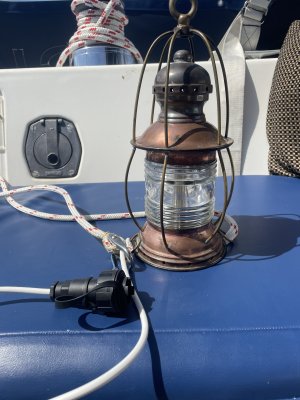
This is mine;

IMG_9971.jpeg

Hung from the anchor ball from the spinnaker halyard up forward . A bright LED lamp replaces the oil wick which compliments the fresnel lens. A wire ran down the inside of a bit of double braid rope. Plugged into a circuit by the mast so I can turn the light off when I’m making coffee in the morning before I get dressed.

A lovely thing to use.
 
We find that masthead anchor lights are nearly universal. And many people seem to leave them on automatic so display the wrong colours when underway, naughty naughty. As has been said, they're not ideal when buzzing around in a dinghy, especially some of the very directional LED ones which will become invisible from below when you get too close.

We've never had a (working) masthead anchor light so generally resort to some cobbled together contraption. We've had plug in lights hoisted in the fore triangle but for whatever reason these have all failed.

The current setup is a bunch of solar driveway lights cable tied together to make a sort of ball, and suspended between the babystay and the mast. I'm not very proud of it but it does work. Visibility from astern is poor so I really ought to replace it with something better.

Strings of LED lights are stupidly cheap and it would be easy to make your boat look fairly distinctive, a big advantage in a crowded anchorage.

It seems that a lot of the rules and common practice around anchor lights is outdated, from a time when running a light was quite a drain on either your paraffin or electricity supply. These days, the more the merrier, so long as you're not going to be mistaken for e.g. a navigation buoy or a vessel underway.
 
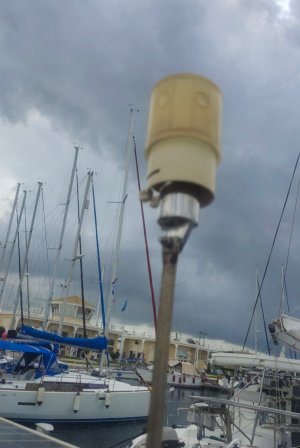
I have posted another pic of my superb anchor light before. The light is 10+ years old now which is why the lens looks a bit yellow. Its original purpose was to top scaffold poles but they are sold by the Pavlou Brothers' chandlery at Poros in Greece. It is totally self contained, daylight switching and solar charging. Invariably when we are ashore it is the brightest light in the anchorage. We turn it on in April and off in October.

It is mounted on my stern arch. The biggest risk in Greek anchorages is collision by fishing boats where the pilot is sitting in a wheelhouse or at a tiller with an awning above. A masthead light would be almost impossible to view from these positions, even if he bothered to look.
Screenshot_20250610_175215.jpg
 
We find that masthead anchor lights are nearly universal. And many people seem to leave them on automatic so display the wrong colours when underway, naughty naughty. As has been said, they're not ideal when buzzing around in a dinghy, especially some of the very directional LED ones which will become invisible from below when you get too close.

We've never had a (working) masthead anchor light so generally resort to some cobbled together contraption. We've had plug in lights hoisted in the fore triangle but for whatever reason these have all failed.

The current setup is a bunch of solar driveway lights cable tied together to make a sort of ball, and suspended between the babystay and the mast. I'm not very proud of it but it does work. Visibility from astern is poor so I really ought to replace it with something better.

Strings of LED lights are stupidly cheap and it would be easy to make your boat look fairly distinctive, a big advantage in a crowded anchorage.

It seems that a lot of the rules and common practice around anchor lights is outdated, from a time when running a light was quite a drain on either your paraffin or electricity supply. These days, the more the merrier, so long as you're not going to be mistaken for e.g. a navigation buoy or a vessel underway.
We have seen several catamarans with normal anchor lights plus led garden lights positioned in each corner. That works very well, with all of them being seen when approaching from the bow.
I think the best possible illumination in a busy anchorage is spreader mounted deck lights left on all night, if you can afford the power
 
Some of those garden lights look like a sodium street light a few miles away, I posses 3 paraffin oil lamps, one of which must have come off a ship as its so large. The electric one is a Bebi, unfortunately no longer made, which I hang off the lazyjack lines.
 
Top