
Anchor for a Dubois Westerly

laika

Well-Known Member
Joined
6 Apr 2011
Messages
8,307
Location
London / Gosport
Visit site
Never mind what's best, what other than another CQR will fit on the bow roller of my Oceanlord? On the westerly owners' forum I got the advice that the bow rollers of all the 35'+ dubois westerlies were pretty similar but no-one volunteered a suggestion of anything that would fit. From the cardboard model I don't think a spade will fit (entirely the wrong shape). Manson supreme maybe but they don't have a cardboard template. Has anyone got some practical experience?

It's not often people's anchors fall apart giving them the opportunity to buy a fancy one...
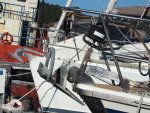
 
Thanks both. john_morris_uk: what size spade do you have?

And how do you both secure the shank at the inboard end? They don’t seem like they’ll sit flat under the pin like the old cqr.
 
In day to day running I take a lashing back from that little shackle to the windlass.....

For offshore and on passage I drilled a hole in the shank just behind and below ( in the pic ) that shackle.... I stick a bit of threaded rod through it. Rod has lock nut(?) on one end ( visible in pic) .... butterfly nut and spring washer on other end....

Every year or so threaded rod gets bent after she has stuck her nose into a few too many big seas.... simply cut it out and replace with another bit of threaded rod.... is cheap... is good...
 
Last edited:
Totally different yacht, so apologies if irrelevant. We have done 'something' like Frank - but cannot stomach the idea of drilling the shank. The shanks are hopefully designed to be strong enough, drilling a hole seems to negate that?

We have run a threaded, stainless, rod through the bow roller sides (which had holes to start with) and through the chain - its a long bow roller. Loctite secured nut on one end, nyloc nut on the other. The size of rod being dictated by the size of chain. It was a bit of a fiddle, we now have a simple claw that drops onto one of the first links of chain. Attach claw to windlass or nearby strong point. We use the same claw as the back-up in case the snubber fails, so the tension will never be on the windlass. So retrieve anchor, fit rod or hook, release tension on windlass. For long ocean passages we attach claw and also simply lash the anchor (they wobble on the bow roller as you go over swells and I assumed this would wear the roller). To lash we have used the tripping or tandems holes, already in the shank, at the crown - these holes are common on most anchors (except Spade). Spade have a rather small hole in the aft part, or heel, of the fluke it would take a small shackle and as its 'very', small you could lash to the shackle - leaving the shackle there permanently.
 
Last edited:
Thanks both. john_morris_uk: what size spade do you have?

And how do you both secure the shank at the inboard end? They don’t seem like they’ll sit flat under the pin like the old cqr.

I consulted with the designer/manufacturer and drilled a hole in the shank. The shank lies in the ‘U’ on the deck and a drop nose pin goes through the hole.

I put a lashing on the roller end but one day will get round to designing a clamp. (One that folds to one side when not in use. )
 
@john_morris_uk: Just to get a little more info on that spade if I may...is it the S100?

...and I realise I haven't asked about securing the bow-roller end. I'm trying to visualise where Neeves has lashed the tripping hole to. Have people also drilled holes towards the crown for the bow roller pin or are they simply pulled tight? The latter would be fine for day to day use but a problem with the oceanlord/sealord not having a deck-accessible anchor locker is not being able to easily stow it offshore.
 
I would not recommend drilling a hole in the shank (although it is done very commonly).
If you do drill, at least make sure it is the right place :).

QHZ01KV.jpg
 
I consulted with the designer/manufacturer and drilled a hole in the shank. The shank lies in the ‘U’ on the deck and a drop nose pin goes through the hole.

I put a lashing on the roller end but one day will get round to designing a clamp. (One that folds to one side when not in use. )

You must have a very, very old Spade if you consulted the designer. Having bent the shank of a steel Spade I would not, ever, consider drilling a hole in the shank. There are much better ways to secure a shank of a Spade, a simple clove hitch round the shank would suffice - with the 2 tails attached - somewhere.

You lash a shackle inserted into the hole in the rear of the fluke - to whatever is convenient. Its not taking any load, simply stopping the anchor wobbling from side to side
 
I don't lose sleep over having drilled a hole where I did.... its not really in the shank but where there is a lot more meat.

What I would lose sleep over is not having the anchor restrained at that point......

Before I did this I once had the Rocna lifted clean off the roller when she stuck her nose into a sea... despite being quite well secured otherwise... or so I thought..

Anchor ended up 'upside down' over the side... hard to describe but definitely 'not good'.

Had the same thing happen years earlier with the CQR when I had failed to put the pin over the top of the shank.... maybe I should just stop sailing to windward.....
 
I

Had the same thing happen years earlier with the CQR when I had failed to put the pin over the top of the shank.... maybe I should just stop sailing to windward.....

You are obviously think you are far too young - though as you frequent this august group of individuals possibly you are on the verge of maturity :)

On a more serious note - it can be a worry when you see how an unrestrained anchor can act if left to its own devices - it does not matter, well almost does not matter, how it is achieved - but they do need to be restrained (I am told - anchors are a bit like husbands - acquired for the good but superficial impression, and then nurtured in the hope their performance improves - or something like that!)

Jonathan
 
I would not recommend drilling a hole in the shank (although it is done very commonly).
If you do drill, at least make sure it is the right place :).

QHZ01KV.jpg

If that is yours I suggest you put a good quality bow shackle between the swivel and the anchor as sideways pull is bad for a swivel like that which is only rated at about half its straight pull strength if pulled sideways. Some people recommend a bow shackle on the anchor and three links of big chain connecting the shackle to the swivel.
 
Good point about the swivel.

Most swivels I see are attached this way, and it is not ideal. This is not something I would recommend.

However, problems related to the anchors holding ability are much more common than strength issues, so this should always be the primary concern.

The steel Spade is a good anchor, so the basics are correct.

This is not my anchor.
 
Do you think hole might be a little large?

img_2368699_0_9e2286fd38f4d8121c285cd4d7671c6b.jpg


img_2368699_1_b9c0a0fbd419a055a5dab1bd9fa34853.jpg

But this image 'looks' to be a Kobra where strength is an issue, as reported within this forum. Hold does not seem to be the issue -as a number of members, people who actually use the anchor, seem more than happy. I note this anchor also has the swivel incorrectly attached - it seems an excellent example of 'what not to do'!

The chain look good - apart from that one length that has gone rusty - where the rest looks almost new. Any comment on the chain - or is it the end and its been swapped end for end - difficult to tell where it is from the image - but you must have looked, and puzzled. The end attached to the swivel looks slightly rusty, compared to the bulk - but not as bad as that one length.
 
Last edited:
But this image 'looks' to be a Kobra

The anchor that Norman commented on was a Spade. The anchor with the very large hole in the shank that you show from post #13is a Kobra.

Interesting, the Kobra was reasonably old and looked well used judging from the wear around the toe area of the fluke, but despite the large hole the shank was straight.

Drilling holes in anchor shanks is not uncommon and as the photos show, sometimes these are large holes, holes with notches, or multiple holes. Some of these must considerably weaken the shank, but it is not unusual to see anchors like this that appear to have been used a lot and have not bent.

I still don’t think drilling holes in the shank is a good idea, but it is obviously done by many owners. The other consideration that has not been mentioned is that the hole will presumably invalidate any warranty on the shank bending. Many anchor models have no (or almost no) warranty on bending, and for other models the conditions and cost of returning the anchor can make the warranty of little value, but there are a few anchor models that have an effective warranty policy (sometimes more like an insurance policy). So take this into consideration before you drill.
 
Last edited:
Top