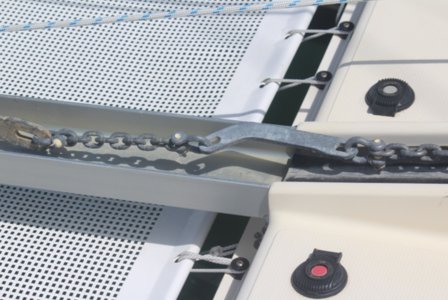
Anchor flipping links...boomerang vs flippers and "isolation links"

Subjectively I'd suggest most new anchors are, or were, a Rocna. Other new anchors come in a small bunch of also rans (why Rocna is so popular as a 'new' anchor ..... does not matter).

But given the numbers I detect, from reading anchor posts and looking at anchors on bow rollers - if Rocna were received upside down or back to front I'd expect more posts on same and less Rocna anchors on bow rollers.

Jonathan
 
Subjectively I'd suggest most new anchors are, or were, a Rocna. Other new anchors come in a small bunch of also rans (why Rocna is so popular as a 'new' anchor ..... does not matter).

But given the numbers I detect, from reading anchor posts and looking at anchors on bow rollers - if Rocna were received upside down or back to front I'd expect more posts on same and less Rocna anchors on bow rollers.

Jonathan
Our Rocna comes up reversed if the boat is moving forward, right way if moving astern. In crowded anchorages and even empty ones, switching from ahead to astern and back is not worth the trouble. The groove in the roller is sized to hold the shank of the Rocna, too wide to prevent 8 mm chain from rotating, which it does readily. The distance between windlass and roller is too short for use of a Boomerang so we continue use a Kong swivel to rotate the anchor before hauling aboard. For us, following many alternative trials this is our preference.
 
A little reverse and the Rocna magically positions itself the right way :) I found no strict need to do it all the time, for some unknown reasons the anchor usually comes up the right way, if it's not then half a turn of the chain after the windlass by hand is all it s needed, or I let it swoosh by itself when it comes at the davit, no harm ever done. Connection is a simple chain-hammerlock-anchor.
Good to see someone using a hammerlock long term instead of a shackle. Easily available from a 'lifting' distributor and can be much stronger than the best shackles. Not easy to find galvanised, so if yo want to try - buy 2, when the first ones is starting to rust and is becoming an emabarasment, swap, paint the first one and then rotate (or buy another new one - they are hardly expensive).

Jonathan
 
Our Rocna comes up reversed if the boat is moving forward, right way if moving astern. In crowded anchorages and even empty ones, switching from ahead to astern and back is not worth the trouble. The groove in the roller is sized to hold the shank of the Rocna, too wide to prevent 8 mm chain from rotating, which it does readily. The distance between windlass and roller is too short for use of a Boomerang so we continue use a Kong swivel to rotate the anchor before hauling aboard. For us, following many alternative trials this is our preference.

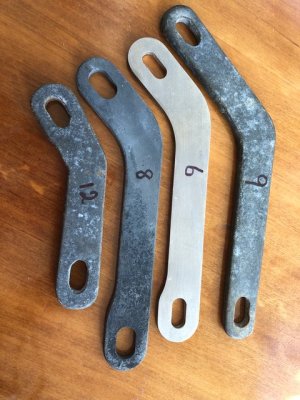
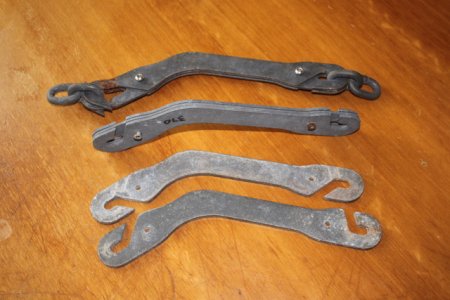
I made a short boomerang, the one on the left 12mm (Biplate 80), for those with limited space for the full assemble. It works as well as the original, the 2 in the middle, but it rights the anchor quite quickly. I had some made a Duplex stainless, the one numbered 6 (6mm) and the one numbered 9 (9mm plate Bis 80 plate) was an early developmental product

IMG_2469 2.jpeg


On the same theme I also made a Boomerang that needed no shackles.

The motivation was similar, to reduce the length of the device, but encouraged by SSAB who make some very thin high tensile steel sheet, for the automotive industry (and make the steel for Viking Anchors that are made in Ukraine). It worked on the basis of 3 interlocking pieces within which the chain link could be connected. The little Alan keyed bolts simply held it together, tapped into the HT plate. I had it Thermal Diffusion Galvanised, Sherardizing in the UK, as coating thickness can be precise and the device was precisely made so that it could be assembled (in my case for 6mm chan) I then tested it, to destruction.

It worked well - except it would be totally unacceptable in leisure yachting as it needed patience to assemble.

IMG_3125.jpeg

Jonathan
 
I cannot answer exactly but when I tested a cranked Osculati swivel I used my usual three chain links between it and the anchor. It seriously affected the setting of the anchor and when I dived to investigate I found the swivel pointing vertically with the chain hooked around its foot. Maybe using ten links avoids this.
My advice would be to avoid anything that bulks up the chain connection to the anchor. As Vyv notes in the above post, this can have a significant negative impact on the anchor’s performance. The boomerang’s flat plate and two extra swivels are extra resistance and complication.

If you must use something like this, always make sure none of the extra hardware cannot become caught and jammed on parts of the anchor as the wind direction changes.
 
Its actually quite easy to chop a link off, just secure anchor, release shackle, chop. Our windlass was under the deck - and not quite so easy as you suggest.

But then I test anchors, shackles and chain - and disengage and change anchors, connectors, boomerangs without thought.

Jonathan
My windlass is readily accessible. 😀
I test my anchor(s) every day, in the real world, and I think about what I'm doing. 🙂
 
Good to see someone using a hammerlock long term instead of a shackle.
I am on my third maybe fourth one in 15 years, when rusted I just chop it off and replace it with a new one, here they are 5-7euro apiece.
Actually, the coating resists ok-ish, it s the central locking collar which rusts first, it s made of two concentric cylindrical slit steel plates, it work mostly by friction I am not sure any galvanizing would last. Anyway, given the price and peace of mind...
 
Our Rocna comes up reversed if the boat is moving forward, right way if moving astern. In crowded anchorages and even empty ones, switching from ahead to astern and back is not worth the trouble. The groove in the roller is sized to hold the shank of the Rocna, too wide to prevent 8 mm chain from rotating, which it does readily. The distance between windlass and roller is too short for use of a Boomerang so we continue use a Kong swivel to rotate the anchor before hauling aboard. For us, following many alternative trials this is our preference.
This lines up with my experience. I used to go astern to flip it around, but it would often flip back between the water and the bow roller (which is close to 2 meters on my boat). Frustrating. So I eventually did what you do, put on a Kong swivel, and would pull it around with a boat hook before pulling it into the roller.

I never tried a boomerang; I don't think they existed in those days.

I'm glad not to have to do that any more.

I think balance also affects the setting behavior. Spade is much more aggressive setting than the Rocna.
 
Subjectively I'd suggest most new anchors are, or were, a Rocna. Other new anchors come in a small bunch of also rans (why Rocna is so popular as a 'new' anchor ..... does not matter).

But given the numbers I detect, from reading anchor posts and looking at anchors on bow rollers - if Rocna were received upside down or back to front I'd expect more posts on same and less Rocna anchors on bow rollers.

Jonathan
Rocna with 50% of the market? I don't have any data, but I would be surprised.

Where I am (the Solent these days) you see a lot of old Deltas, Claws and CQR's. Some Rocnas, but I don't think more than Spades. The big Oyster next to me right now has an Ultra just like mine
 
Rocna with 50% of the market? I don't have any data, but I would be surprised.

Where I am (the Solent these days) you see a lot of old Deltas, Claws and CQR's. Some Rocnas, but I don't think more than Spades. The big Oyster next to me right now has an Ultra just like mine
I think it might be appropriate -sort of- for boats belonging to people participating on internet forum/fora and the like.
Real life, physical marina counting in France shows maybe 5-10% Rocna, 2-3% Spade, 20% delta maybe, 40-70% anchors of varying makes mostly flat FOB Brittany etc; many swivels straight onto the anchor and 0.0x% with the very sensible additional separating links, etc etc. Quite a number of boats have gone RTW or anchor in challenging situations anyway, go figure.
 
Hmm, the trouble with doing surveys of anchor types, based on boats in marinas, is that these boats have, for one reason or another, chosen not to anchor. 🙂
 
I think it might be appropriate -sort of- for boats belonging to people participating on internet forum/fora and the like.
Real life, physical marina counting in France shows maybe 5-10% Rocna, 2-3% Spade, 20% delta maybe, 40-70% anchors of varying makes mostly flat FOB Brittany etc; many swivels straight onto the anchor and 0.0x% with the very sensible additional separating links, etc etc. Quite a number of boats have gone RTW or anchor in challenging situations anyway, go figure.
That lines up exactly with my observations.

In my walk today by far the largest share were old Deltas.
 
My advice would be to avoid anything that bulks up the chain connection to the anchor. As Vyv notes in the above post, this can have a significant negative impact on the anchor’s performance. The boomerang’s flat plate and two extra swivels are extra resistance and complication.

If you must use something like this, always make sure none of the extra hardware cannot become caught and jammed on parts of the anchor as the wind direction changes.
If attached correctly the Boomerang has a smaller cross section than the length of chain it replaces. When the anchor sets the rode is under tension and the Boomerang sits vertically and is buried vertically into the seabed.

it is cross sectional area that is important, a correctly sized Boomerang will be cut from plate of the same thickness as your chain. Swivels have a very high cross sectional area, as do Oscalutti devices that are made from bent rod.


If you want to reduce resistance to burial reduce the size of your chain,

HT chain rules!

If you don't reduce chain size you are not serious about burying your rode :) - all talk and no trousers :)

Jonathan
 
Subjectively I'd suggest most new anchors are, or were, a Rocna. Other new anchors come in a small bunch of also rans (why Rocna is so popular as a 'new' anchor ..... does not matter).

But given the numbers I detect, from reading anchor posts and looking at anchors on bow rollers - if Rocna were received upside down or back to front I'd expect more posts on same and less Rocna anchors on bow rollers.

Jonathan

I meant to imply of new designs, from Spade to the present. I don't consider Delta a new design.

I don't think I mentioned numbers - just that Rocna was the most common of the new designs.

Jonathan
 
If attached correctly the Boomerang has a smaller cross section than the length of chain it replaces. When the anchor sets the rode is under tension and the Boomerang sits vertically and is buried vertically into the seabed.

it is cross sectional area that is important, a correctly sized Boomerang will be cut from plate of the same thickness as your chain. Swivels have a very high cross sectional area, as do Oscalutti devices that are made from bent rod.


If you want to reduce resistance to burial reduce the size of your chain,

HT chain rules!

If you don't reduce chain size you are not serious about burying your rode :) - all talk and no trousers :)

Jonathan
What you are saying lines up with Dashew's eloquent writing on the subject.

Nevertheless, I prefer heavy chain, which brings so many benefits to anchoring, that it's worth the weight penalty many times over. With 12mm chain -- what Bill Dixon specified when my boat was built -- the ride is so completely damped that I don't even need a snubber in less than 30 knots of wind. I rode out a gale in Northeastern Greenland, where there are no rescue services and anchor dragging is death, and where you can't escape by going out to sea because of the sea ice, on 2:1 scope with 100m of 12mm chain out, and was not only completely secure, but even comfortable.

It's 330kg of weight in the very bow, which is awful. I would save 110kg with 10mm HT chain. But despite the fact that we do race from time to time, I don't judge it to be worth it.
 
If attached correctly the Boomerang has a smaller cross section than the length of chain it replaces.
You are presuming that the Boomerang always sits perfectly vertically and disregarding the impact of the additional two shakles. As the depicted image illustrates, this is not a realistic assumption.

There are better KISS solutions in my view with less to inhibit burial or risk jamming on parts of the anchor if the wind changes direction.

IMG_4192~photo-full.jpeg
 
I meant to imply of new designs, from Spade to the present. I don't consider Delta a new design.

I don't think I mentioned numbers - just that Rocna was the most common of the new designs.

Jonathan
Well, you said "most", which implies more than 50%.

But, OK. Rocna is certainly a very popular brand. And I never said it's bad. When I changed the original Delta on my boat for a 55kg Rocna, it was a dramatic improvement. It's a current generation anchor so runs rings around Deltas, Claws, and for God's sake, CQR's.

But in my experience it's significantly less effective than Spades, and other anchors of similar design, including Rocna's own Vulcan. And the balance issue was a real problem for me.

On the plus side, it's much cheaper than those. Because it's a much simpler design made of simple cut steel plate, without ballast. I think that the price is the most important factor in its popularity. The Spade has lead ballast and a fabricated hollow shank. Of course it's double the cost. And for many sailors it's not worth twice the cost. I agree it's not twice as good. Beneteau sell 100x or more boats than X-Yachts. Same principle.
 
Well, you said "most", which implies more than 50%.

But, OK. Rocna is certainly a very popular brand. And I never said it's bad. When I changed the original Delta on my boat for a 55kg Rocna, it was a dramatic improvement. It's a current generation anchor so runs rings around Deltas, Claws, and for God's sake, CQR's.

But in my experience it's significantly less effective than Spades, and other anchors of similar design, including Rocna's own Vulcan. And the balance issue was a real problem for me.

On the plus side, it's much cheaper than those. Because it's a much simpler design made of simple cut steel plate, without ballast. I think that the price is the most important factor in its popularity. The Spade has lead ballast and a fabricated hollow shank. Of course it's double the cost. And for many sailors it's not worth twice the cost. I agree it's not twice as good. Beneteau sell 100x or more boats than X-Yachts. Same principle.
Semantics :)

Most common, could be 25% if none of the other anchors has a share of or less than 20%.

I think when Peter Smith was designing his 'first' anchor which was eventually called a Rocna he actually wanted to update the design of Spade but was discouraged maybe by Patent infringement or simple pride. What he did was take Spade and make the fabrication cheaper, which you point out.. But a Spade fluke is almost identical to that of a Rocna and the shape of the shank is equally similar to Spade, If you put a series of French curves to a Rocna you get a Spade shank - but then they both copy the Delta shank. Adding weight to my ideas - Vulcan, his next iteration, is even close to the Spade design.

But Rocna has ballast - that double thickness of steel in the toe is not there for decoration - its ballast and quite a lot of it

Lead ballast has a bad rap - primarily environmental issues but also cost. I suspect when Spade was designed they never looked to the future and the contortions owners need to go through to remove the lead when they want to regalvanise.

Why Peter Smith cut back on the ballast I don't know but he did realise it was an issue, to getting the anchor to set in some seabeds, hence the roll bar. We were going to buy a Rocna 25 years ago, but found something we thought better, but Craig Smith, Peter Smith's son, mentioned that for most applications the roll bar was unnecessary - but was sometimes essential. He did not elaborate and I did not press him.

Rocna was originally made from steel plate, with the double thickness welded onto the rear section but they now cast the fluke - which is another story.

Jonathan
 
What you are saying lines up with Dashew's eloquent writing on the subject.

Nevertheless, I prefer heavy chain, which brings so many benefits to anchoring, that it's worth the weight penalty many times over. With 12mm chain -- what Bill Dixon specified when my boat was built -- the ride is so completely damped that I don't even need a snubber in less than 30 knots of wind. I rode out a gale in Northeastern Greenland, where there are no rescue services and anchor dragging is death, and where you can't escape by going out to sea because of the sea ice, on 2:1 scope with 100m of 12mm chain out, and was not only completely secure, but even comfortable.

It's 330kg of weight in the very bow, which is awful. I would save 110kg with 10mm HT chain. But despite the fact that we do race from time to time, I don't judge it to be worth it.

Catenary and elasticity perform exactly the same role.

A decent snubber would replace the 110kg, entirely. It would replace the catenary you are sacrificing if you down size - which would materially impact and improve your sailing performance, making it more comfortable sailing to windward. It would cost less, take up less room, allow you to use a small windlass and need a smaller motor (though I would stick with the same size as you use for the 12mm). Catenary has a finite application and as the conditions deteriorate becomes,es less effective. Elasticity works better as conditions worsen but you do need to choose your snubber with care.

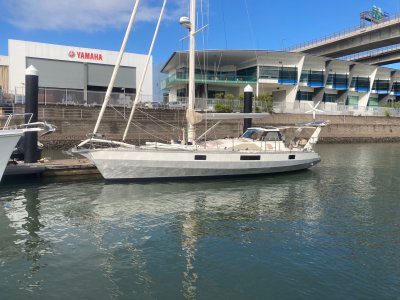
The owner of this yacht thought downsizing from 10mm to 8mm was worth the effort - and he is an owner of one of Australia's largest medium sized both builders Norman R. Wright & Sons – Custom Boats Since 1909.

IMG_0038.jpeg

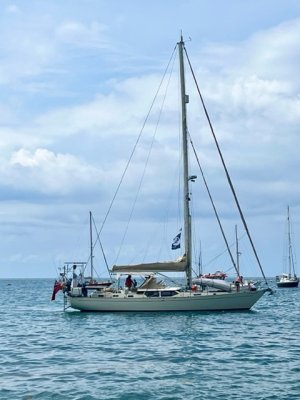
Similarly the owner of this yacht also downsizing from 10mm to 8mm thought it worthwhile and he then sailed round the world.
16621_1_1_WARC22_Lombok_Arrival_Chanto.jpg

I managed production of both rodes coincidentally at the same time.


I don't sell people a rode, they buy it from a chain supplier and a specialist galvaniser. People search me out as an article I had published in Australia ia well known and people decide for themselves if they want one of my rodes, with boomerang and matching connectors. The rodes are made to my specification with a galvanised coating that is harder than HDG and is coated to a thickness 20% greater than that specified by the US Navy.

Jonathan
 
Last edited:
Top