Anchor dragging...

That's very kind and I fully agree. If I find an old sail somewhere I will try to sew a riding sail myself. I have no experience sailing in bad weather, so I can not comment on your ideas. It sounds interesting to me though and fishermen usually do things for a reason.


Do you think trailing it behind like I normally do at anchor could cause a problem in a gale? It's attached with a nylon rope and weighs 20kg. Ofcourse taking the outboard off. The other option would be to deflate and store it in the cockpit or inside, abit of a hassle but as it's not gale winds everyday it would also be doable.

Over the boom sounds like a good solution, it makes sense that it will be well supported. I will think about that, thanks.

No, trailing is not a great solution. They have been known to flip.

Deflate it if you expect winds over about 30 knots. That is the traditional answer. That's why it's inflatable.

Most of the boats I have seen really yawing had a dinghy on the bow. It's like a riding sail at the wrong end.
 
Thanks for the information KompetentKrew I will get an anchor watch app aswell.

No, trailing is not a great solution. They have been known to flip.

Deflate it if you expect winds over about 30 knots. That is the traditional answer. That's why it's inflatable.

Most of the boats I have seen really yawing had a dinghy on the bow. It's like a riding sail at the wrong end.

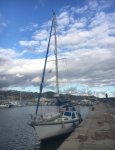
What's the problem if it flips? As its inflatable it will continue to float. Ofcourse you have to take the outboard off first. I understand that deflating is the more proper solution though. I have a liferaft on the roof of the decksaloon, do you think that it adds windage as well? But then it's behind the mast.
 
When anchored in reasonably quiet weather, say up to F6, we leave our Avon Redcrest astern, fairly tight up behind the transom, with twin painters one to each quarter. If we expect wind, we lift it aboard, and it stows fully inflated, on its side, on the side deck up against the side of the deck saloon. We do the same when underway, except that we only tow it in really quiet weather. As has been said, any unnecessary windage forward in strong winds should be avoided.
 
When anchored in reasonably quiet weather, say up to F6, we leave our Avon Redcrest astern, fairly tight up behind the transom, with twin painters one to each quarter. If we expect wind, we lift it aboard, and it stows fully inflated, on its side, on the side deck up against the side of the deck saloon. We do the same when underway, except that we only tow it in really quiet weather. As has been said, any unnecessary windage forward in strong winds should be avoided.

Thanks for sharing. That seems reasonable. I don't think I have the place on the sidedeck, I will just deflate it next time, not like it takes much. To attach it close and with two lines is a good idea. I usually have one long line, don't know where I got that from.
 
Thanks for sharing. That seems reasonable. I don't think I have the place on the sidedeck, I will just deflate it next time, not like it takes much. To attach it close and with two lines is a good idea. I usually have one long line, don't know where I got that from.
One of the principles about not having your dinghy in the water when conditions are getting challenging is that its one less rope to get wrapped round the prop when you really, really need the engine to work. And one less thing to affect the handling, one less thing to distract your attention, etc. That said, a really short bridle could be worth trying.
 
Oh. One more tip I learned last year in the Balearics. Use a stern anchor to keep your bows towards the sea at night. This is to deal with the waves that persist long after the sea breeze dies.

Again, not strictly relevant to the original post, but strong sea breezes are a feature across the Med in summer. They can frequently reach 20kn or more and kick up 1m+ waves. Fine when your bows are facing the sea breeze but horrible when it drops with the sun and the waves continue for hours after. Most boats seem to turn beam on and roll like pigs (I've even seen catamarans rolling horribly!) even when the night breeze kicks in.

I learned to anchor as close to the shore as permitted or seemed sensible, drop back another 20 to 30m, sometimes right into the bouyed swim zone, drop my kedge anchor off the stern and go forward again back to my chosen position. This way I stayed facing the waves when everyone else was rolling.

You can only do this in an uncrowded anchorage or in the last row of boats before the shore. Otherwise when everyone else swings and you don't, collisions occur.
 
One of the principles about not having your dinghy in the water when conditions are getting challenging is that its one less rope to get wrapped round the prop when you really, really need the engine to work. And one less thing to affect the handling, one less thing to distract your attention, etc. That said, a really short bridle could be worth trying.

To avoid the rope fouling the prop I have a floating rope for the dinghy, but then what you say is true, one problem less in an already challenging situation, not very thoughtful of me.

Oh. One more tip I learned last year in the Balearics. Use a stern anchor to keep your bows towards the sea at night. This is to deal with the waves that persist long after the sea breeze dies.

Again, not strictly relevant to the original post, but strong sea breezes are a feature across the Med in summer. They can frequently reach 20kn or more and kick up 1m+ waves. Fine when your bows are facing the sea breeze but horrible when it drops with the sun and the waves continue for hours after. Most boats seem to turn beam on and roll like pigs (I've even seen catamarans rolling horribly!) even when the night breeze kicks in.

I learned to anchor as close to the shore as permitted or seemed sensible, drop back another 20 to 30m, sometimes right into the bouyed swim zone, drop my kedge anchor off the stern and go forward again back to my chosen position. This way I stayed facing the waves when everyone else was rolling.

You can only do this in an uncrowded anchorage or in the last row of boats before the shore. Otherwise when everyone else swings and you don't, collisions occur.

I read about that a long time ago, but never put it into practice. I don't like the idea of having two chains down, that could foul each other. It might be worth a try though, I had some rolly nights this summer on the Cote d'Azur too. And I understand you talk about very settled wetter, with the only nuisance being the swell coming in.
 
I guess so...

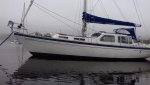
Thanks! A nice boat.

Yeah, it is kind of high windage, and everything forward of the keel center of effort hurts:
  • Dinghy
  • Mast steps
  • Radar
  • Radar reflector (probably redundant if you have AIS)
  • Life raft
  • Jib not furled tightly--but you knew that
Not sayin' you want to remove all of that, but it all contributes.

A riding sail would help. Also, you might try a small (18-24") drogue from the bow. this will slow the swing and reduce the extent. A few feet of chain is enough to keep it down, and just enough rode to keep it in the water during the swings. Quite easy.

Best wishes. You'll get there!
 
...I read about that a long time ago, but never put it into practice. I don't like the idea of having two chains down, that could foul each
other. It might be worth a try though, I had some rolly nights this summer on the Cote d'Azur too. And I understand you talk about very settled wetter, with the only nuisance being the swell coming in.

Normally the secondary rode is rope, with very little chain. It is easier to deploy, easier to untangle, and since swinging is stopped, there is not need for chain. Only the primary is chain.

It is also helpful NOT to end the secondary rode in a chain locker. IF they twist, you want to be able to pass the end of the rode around the chain to undue the twists.
 
Apropos keeping the dinghy inflated.... the problem is guessing what the wind in the night is going to do. Of course....
Sometimes the forecast, or local knowledge, gives you a 'heads up'.... and sometimes one just wings it, hoping it won't be bad enough.

As always, expensive experience teaches.

A good friend and I sat through a summer gale in Oban Harbour, on a rock-solid mooring. He left his dinghy astern on a robust painter. In the night, in the gusts, the d*** thing got completely airborne - more than once. No, the painter didn't break, but the glued-on patch-with-bow-ring it was attached to started to tear off. The thing deflated, of course. That's why the noise stopped....


39438343375_b530683af0_z.jpg


On another occasion, I was 'house-sitting' the same 34' boat on another good mooring on the Lynher River, Plymouth, during a forecast winter storm. Twin 24mm polysteel warps backed up by a 'belt 'n braces' chain meant we were going nowhere. I tied the 'new' dinghy alongside with doubled lines fore-and-aft and took the oars inboard. Despite that, and despite the partial shelter from the hull, the rubber-dubber got airborne and flailed around, more than once. It stayed attached, it didn't deflate - but the fibreglass seat which hooked under straps on each gunn'l was gone in the night.

An £80 lesson.

Today, I carry a 12v electrical inflator/deflator. No more excuses....
 
Thanks! A nice boat.

Yeah, it is kind of high windage, and everything forward of the keel center of effort hurts:
  • Dinghy
  • Mast steps
  • Radar
  • Radar reflector (probably redundant if you have AIS)
  • Life raft
  • Jib not furled tightly--but you knew that
Not sayin' you want to remove all of that, but it all contributes.

A riding sail would help. Also, you might try a small (18-24") drogue from the bow. this will slow the swing and reduce the extent. A few feet of chain is enough to keep it down, and just enough rode to keep it in the water during the swings. Quite easy.

Best wishes. You'll get there!

Thanks for the advice, and the compliment. I too think its a great boat. It has a full keel so I'm not sure where the center of effort is? Radar and radar reflector will come off, as AIS makes more sense to me and is on the shopping list. The dinghy will be deflated and stored in the cockpit next time I anchor in a gale. The liferaft will go on the side of the stern arch, I don't like it on the roof and if I need it one day I think it makes sense to have it closer to the cockpit. The genoa is rolled tighter now, that photo is about two months old and I'm learning on the way. The boat is new to me too and I'm still in the process of sorting everything out. I will see for a riding sail or a drogue. I prefer the idea of a sail.

Today, I carry a 12v electrical inflator/deflator. No more excuses....

Haha. Also your stories are impressive. I will keep storing the dinghy on board, but not on the foredeck in a gale anymore.
 
Trident Voyager 35...almost identical to mine though I dont have radar and my liferaft sits on the foredeck just in front of the coachroof and dont have an arch or mast steps. My dinghy is normally towed up to F4 then its out and deflated in the cockpit
Incidently my anchor is a 13kg Knox as recommended by Knox....so far its been great but not gale tested yet
 
Trident Voyager 35...almost identical to mine though I dont have radar and my liferaft sits on the foredeck just in front of the coachroof and dont have an arch or mast steps. My dinghy is normally towed up to F4 then its out and deflated in the cockpit
Incidently my anchor is a 13kg Knox as recommended by Knox....so far its been great but not gale tested yet

Happy to see another Voyager owner. Where do you sail? The foredeck seems to be a better place for the liferaft than the roof. Still I think it belongs in the cockpit where you could actually reach it when you need it. What do you think? I like how you deal with the dinghy. Having it on the foredeck while sailing it sometimes catches a sheet which is annoying, especially singlehanded as there is nobody you can send upfront to untangle the line, it also reduces deckspace to a minimum.
 
Happy to see another Voyager owner. Where do you sail? The foredeck seems to be a better place for the liferaft than the roof. Still I think it belongs in the cockpit where you could actually reach it when you need it. What do you think? I like how you deal with the dinghy. Having it on the foredeck while sailing it sometimes catches a sheet which is annoying, especially singlehanded as there is nobody you can send upfront to untangle the line, it also reduces deckspace to a minimum.
I sail the west coast of Scotland..as you can see the liferaft doesnt add much windage up forward and is well away from sheets etc
 

Attachments

  • IMG-20190710-WA0000.jpg
    IMG-20190710-WA0000.jpg
    117.7 KB · Views: 27
A decent anchor alarm I feel is one of the most important things to get a good nights sleep and remain safe at anchor.

Interesting (though JD's question might provide the answer).

I have had two threads, 'Dragging of Anchors' and more recently an update imaginatively called 'Dragging of anchors 2'

In both threads no-one admitted to or described their 'modern' anchor dragging - except because it was caught in a Supermarket trolley, crab pot or tin can and surely you know when you catch a supermarket trolley and re-anchor. Now I was surprised that no-one had dragged their anchor, at all, and this thread suggests 'slightly' differently.

If modern anchors are so reliable surely there is less need for an anchor alarm :). In fact are anchor alarms not a bit like life rafts - jolly useful if you need one, but no-one actually needs one :)

I appreciate the concept that an anchor alarm is free, its accurate so why not use it - but surely after a few nights at anchor when the alarm does not sound and then 100 further nights when the alarm does not sound - you get used to it not alarming you and its value of giving you a good night's sleep slowly, or rapidly diminishes.

Jonathan
 
I sail the west coast of Scotland..as you can see the liferaft doesnt add much windage up forward and is well away from sheets etc

Your boat looks great, I can see what you mean about the liferaft. I bet you must get some nasty weather up north, but I'm sure the boat copes well, I get the feeling mine is getting a bit bored here in the Med, so I take her out for the occasional anchor dragging experience in a gale.
 
Top