Anchor connection strength

mattonthesea

Well-Known Member
Joined
28 Nov 2009
Messages
1,519
Location
Bristol
ayearatsea.co.uk
Probably one for@Neeves

I recently got a new 8mm anchor chain. The old one was imperial. Unfortunately I had to downsize the maillon that I used to connect the chain to anchor as the old one's threads do not fit through the chain.

The smaller maillon is rated at 2 tons and the boat is 5 tons. I am wondering what the snatch strain on the maillon would be if the snubber failed in, say, a F8 and 1m swell. She's got a highish bow and likes to turn 70degrees to the wind.

I know this is an inexact science but my free-floating anxiety will fix on it the next time we are in, say, Old Grimsby Sound in a strong NE. ?

Thanks
 
If you squeeze the last link of the chain lengthways in a vice will the old pin pass through?

Is the 2 tonnes the SWL of the maillon? If so it is far stronger than 8 mm chain. The SWL of 8 mm grade 30 is 0.75 tonnes.
 
Probably one for@Neeves

I recently got a new 8mm anchor chain. The old one was imperial. Unfortunately I had to downsize the maillon that I used to connect the chain to anchor as the old one's threads do not fit through the chain.

The smaller maillon is rated at 2 tons and the boat is 5 tons. I am wondering what the snatch strain on the maillon would be if the snubber failed in, say, a F8 and 1m swell. She's got a highish bow and likes to turn 70degrees to the wind.

I know this is an inexact science but my free-floating anxiety will fix on it the next time we are in, say, Old Grimsby Sound in a strong NE. ?

Thanks
What grade of anchor chain did you get? Normal 30 grade 8mm has a breaking strength of 3.2 tonnes. Anyway, I solved the problem with my 8mm maillon connector by filing a small flat on opposite sides of the threaded part just enough so it would pass through the chain. Did not have to remove much material at all. The OD of the thread is larger than the wire diameter.

Www.solocoastalsailing.co.uk
 
You should be using a short snubber, in addition to a long snubber. The long snubber you deploy for its elasticity the short one is there in case the long one fails (they age through cycling) and the short one is to ensure the windlass is protected at all times. The short one might actually be a chain lock. You should carry something that you can rig as a spare snubber, mooring line would be good, you might need a spare hook (they are cheap as chips from the lifting industry)

You are unlikely to experience snatch loads over 500kg if you have a reasonable scope deployed - so failure of components in the rode is VERY unlikely. Stop worrying. If you do experience snatch loads of 500kg you will be scared witless, its not a jolly experience - and you will move to another location (actually before you get as much as 500kg snatches)

Follow the advice given, enlarge the last link (or first link) with a drift and it will all fit together.

Just note that side loading of any device will usually result in a lower failure tension so make sure nothing can lock up sideways. Shackles lose 25% of strength at 45 degree side loading and 50% of strength at 90 degree side loading - so make sure nothing can lock up in the slot in the anchor shank.

This is all short term stuff - what you need to address is the yawing as this thread does not address that issue. To start with consider setting up a bridle this will help manage the yawing.

A Snubber & Hook for all Occasions - Practical Sailor

Remember- the elasticity of the snubber 'absorbs' the snatch loads - but to do so the snubber needs to actually be elastic. Try 8mm 3 plait nylon (best as a bridle). Deploy it 'boat length' - too short and too fat and you will not get elasticity. You should be able to see the snubber stretch say 60 -100cm at 30 knots.

I'd recommend you actually start a new thread on how to address yawing (that's what the Forum is for).

If you have further queries on how to set up your rode - the anchor chain interface keep this thread running.

Jonathan
 
I was in a bit of a rush

I'll expand a bit. If you are using a maillon to attach your chain directly to the anchor, no shackle, I would query the strength of the Maillon. The strength you quote is a straight line pull but yachts do veer, the wind veers and it is possible you will side load the connector - its WLL will then be reduced.

I would suggest look at the Crosby G80 shackles - they have, for a 3/8th" shackle, a WLL of 2t - which if side loaded falls to 1t - and 1t is well above the WLL of your chain. From memory these Crosby shackles only are sold with 3/8th being the smallest on offer but you could source a 3/8th CMP Titan Black Pin shackle whose WLL is also 2t - but this is short tons (though it is not obvious - which I dislike, selling imperial rated equipment in a metric market without making it very clear - I question). These Black pin shackles come in smaller sizes, so you can source a 5/16th Titan black pin shackle. CMPs Titan range encompasses their chain so find someone selling Titan chain - they should have the shackles. They also make or sell Rocna anchors - so again find your nearest Rocna dealer - they might have the black pin shackles. Note - don't buy a yellow pin shackle - they have half the strength.

If you are able to widen the link, using a drift (as suggested by NormanS or simply using a vice and squeezing the length to widen the hole, as suggested by Vyv) then using the Crosby shackle (available from a number of sources but I buy from Tecni in the UK) will fit the link (bow of the shackle through anchor slot). If you use a drift - widen it step by step - if you hammer in a drift until the width is enough then it might be difficult to remove the drift. You need a dec ent vice to widen a link - but a combination of vice and drift works well.

This is all fairly straight forward - but if your anchor will not accept the shackle - it would help if you advise what anchor you are using - or we will simply guess (and likely get it wrong :( ).

Here are some more bed time reading for you - there is a bit, or a lot, of repetition - but hopefully you will not find it too tedious.

The art of snubbing, in the nicest possible way - Mysailing

How to: Dealing with Snatch Loads in an Anchorage

Anchor Snubber Tips

If you have any queries - post on your thread or send me a PM.

Jonathan
 
I would have feared that cold distorting a chain link could risk provoking weakness in the metal, and only did it in non demanding cases.
Since authorities like Vyv and Neeves suggest it as a regular operation, from now on i will open without worrying the first link of a chain if situation would so require.

Is it safer or overkill to temper the link afterwards for easing possible internal stresses? If so at which temperature (color) should the link be heated and which cooling speed should be used? And what will be of the next link/links?

Thanks

Sandro
 
I wouldn't recommend trying to change the shape of a link of high tensile chain, but for ordinary mild steel, say G30 chain, it's nothing to worry about.
 
NormanS is correct and heating Q&T steels should never be attempted. If you take a G70 chain and heat it - the best YOU will achieve is a 30% reduction in strength. I know I've been doing it for a few years now :(

If you use G70 chain or G80 shackles- don't touch them - there are other much better options

G30 chain - not an issue

I'll add some pictures for the options later - I'm time short this morning.

On re-tempering chain - again I would not touch it. Tempering is a science and is tightly controlled and the tempering temperature regime varies with the alloy being used. If you heat the item you are as likely to return it to the strength of mild steel. This is why you should not weld a 'C' link.

Sandro - you were correct to raise the question - I was a bit slack in not underlining that prising open a link is only for steels that have not been heat treated - but then few in Europe use a Q&T high tensile steel like G70, or G80.

Thanks Norman

Jonathan
 
I had never heard of a Maillon , but Mr Google suggests that it is the trade name for something I would think of as a carabiner. (Just to save anyone else from having to look it up.)
 
I had never heard of a Maillon , but Mr Google suggests that it is the trade name for something I would think of as a carabiner. (Just to save anyone else from having to look it up.)

Too late - I'd already looked it up! I guessed it was a fancy name for a shackle but did not realise it was one of these threaded oval links (I too found Mr Google to offer the answer

I had assumed it was a term in common usage in multi-lingual UK :) and I was one of the few whose education had big gaps.
Jonathan
 
I think that the negativity over enlarging s link (specifically the end link). of a High Tensile, Quench and Tempered chain is based on the idea that HT/Q&T chains are brittle and there is a danger (because they are brittle) that enlarging the link with a drift may result in internal cracking of the link and thus weakening of the link.

I don't know where the idea came from that HT/Q&T chains are brittle as the reality is they are less 'brittle' than G30 or G40/43 chains.

The NACM specification for HT alloy chains is that they must have a minimum elongation to break of 20% and that G30/40/43 chains would have a minimum extension to break of 15%.

On the assumption, possibly flawed, that elongation is a measure of brittleness then HT chains can be more safely enlarged than non HT chains.

To check this go to the NACM website and check out 'specification', specifically Page 5. The NACM is an American organisation but does incorporate companies that sell into Europe or are European.

Welded Chain Specifications

The implication, to me, is that HT chains are no more brittle than 'non' HT chains.


I have not tested the idea that as HT chains have a higher minimum extension to break than 'non' HT chains they are thus not brittle and thus not weakened by enlarging the link - but the evidence might suggest enlarging the link, within reason, is not an issue.

As I said I have not tested this - as there are other options - and it never occurred to me to test.

I have tested G80 and G100 chains and can confirm that they have a minimum elongation of at least 20% and commonly have a higher extension than G30/40/43 chains.

Other HT steels may be brittle - but this is not the case for steels used to make HT chains.

In the absence of further information I would not change my advise, as there are options, which I'll explore in a later post.

Jonathan
 
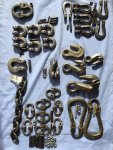
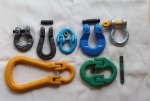
These are a cross section of 'joining' components available from the lifting industry. They are available in G80 and G100 qualities and in sizes from 6mm up - some of them are monsters.

Top left the first 3 components are 6mm, the big blue Omega link is 8mm and the shackle is a 3/8th inch shackle (for comparison purposes). The bottom row are hammerlocks in 8mm, left, and 10mm versions.

I've been using hammerlocks, like the pale blue one in the centre top row - with success and some members here have also used hammerlocks, for the same application with success.

None of these components is as handy as a shackle - you need a punch to disengage - you need to hammer the pin out. The slot, closed by the clevis pin, is of a size to only allow the designated size of chain to fit. The hole in the chain is sized for the clevis pin the slot, between the 2 eyes, is sized for the chain link size - 6mm, 8mm etc.

The hole in the eye of the Omega will comfortably accept the appropriate shackle


IMG_4796.jpeg

These devices only are sold painted and I strip the paint off, see below, and have them galvanised. This batch has only recently been galvanised preparatory for testing.

IMG_9285.jpeg

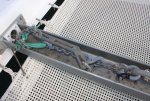
The picture below shows some in use.

I have made the Boomerang so that is accepts the Omega links direct the the Omegas are connected direct to the 6mm chain. The anchor shank, on the right, is simply too big to accept an appropriate Omega so I have an Omega connect to the chain and a 3/8th" shackle connected to the Omega and shank. These Omegas are stronger than the chain.
IMG_3164.jpeg

The green rope is dyneema and is our back up snubber and we also use it, as in this case, to secure the anchor on passage, the chain hook is attached to the chain.

Using the Omegas removes the need to enlarge the HT Q&T chain link. I have had our chain tested and the various connectors I use in the rode and the chain is the weak link. The 6mm chain was chosen to replace the 8mm we had been using and the 6mm is stronger than the 8mm.

Th major downside is that the components are only painted, not galvanised - but they are so cheap you could buy 2, paint them both with 'liquid' gal, use one until it looks grotty, retire, use the spare new one and when you take the old one home clean - up and repaint. Not much different to a gal shackle - that soon loses its galvanising.

We have found Omegas and Hammerlocks useful. The pear shaped, or long Omegas, we have not used yet - and don't know if they will offer any advantage and that long hammerlock, again we have not used and have an open mind - but its a bit bigger than we expected.

Jonathan
 
In theory, distorting the final link in the way that Norman and I describe is cold work that would strengthen the material. The change would be so small as to be unnoticeable in practice. If using the drift method make sure the link is not scored, that might create a stress raiser.

Cold working is widely used to strengthen soft metals where heat treatment is not applicable for some reason. Particularly true of 300 series stainless steels for rigging wire, bottlescrews, bolts and countless other components.

Cromox chain seems to be made from cold worked wire, enabling 316L to have far higher strength than in its annealed state.
 
I do like the idea that business is so good they close on Sundays? :( . Our local chain of chandlers in Oz take on extra staff for weekends, Maxwell have support staff on call, covering Oz and NZ where someone is on call 24/7 - including holidays - as they figure that's when many of the customers are able to use their yachts. Funny old world.

Jonathan
Contrast with France. Not only are all shops other than bars and restaurants closed, we are not allowed to create any noise, so grass cutting, use of compressor, grinding, hammering etc might lead to visits from the authorities.
 
Last edited:
Top