Anchor chain 6mm- DIN or ISO

Stabo

New Member
Joined
17 Oct 2021
Messages
11
Visit site
New anchor winch will be installed this winter and it makes sense to upgrade also the anchor rode in parallel. Currently we have 60 m of 8 mm chain and the discussions on this forum were instrumental for the decision to downsize the chain. Switching to the 6 mm chain will enable the chain to be longer and to save some weight. We bite the bullet and decided for the Cromox stainless duplex chain.

The manufacturer of the chain is able to deliver the chain according to DIN or ISO standard. I have contacted Quick (the winch to be used) and they assured me, that both ISO and DIN chain will perfectly fit their 6mm gipsy. Both chains are nearly identical, however the ISO has slightly bigger internal width of the link ( DIN 7.2 mm and ISO 8.1 mm). I am inclined to order ISO chain, since this could contribute to the easier connection to the anchor.

Input from the forum will be appreciated.
 
Your new G60 chain will be a G60 strength. Your problem if finding connectors of compatible strength that will fit both the chain and the anchor. I think you will find this difficult (to find connectors that match strength and fit).

My advise would be to buy an Omega link along with the chain, made from the same steel. This will fit the chain, physically, and have the same strength (assuming K&W make a 6mm omega link (which I think they do). You then need to find a shackle that will fit the anchor and have no risk of locking up. Again look at what K&W offer but Andersen (in Newcastle I think) make a range of stronger stainless shackles. The alternative is a hammerlock, which you can source from K&W.

It is easy to buy Omega links in G80 or G100 specification but they are not galvanised and will soon look awful with your chain.

You will be using a boat length snubber (or course) K&W make a neat chain hook. You need the snubber as you have sacrificed catenary in opting for 6mm chain and the snubber replaces the catenary function with elasticity.

It would help focus replies if you define which anchor, and what size you are using..

If you are buying from K&W it does not matter which chain specification you use - their components will fit.

I am using 6mm galvanised chain and have tried, and used, Omega links as enlarged links at the end of the chain and then conventional Crosby shackles. Our anchors are all aluminium but the equivalent in steel weigh 15kg and a 3/8th" shackle works fine in the steel anchors but we need a 1/2" for the aluminium version as the shank is thicker and the 3/8th" shackle can lock up. Our spare rode is the same 6mm chain with 40m of nylon we again use Omegas as the enlarged link at the end of the chain, both ends. We have been using 6mm hammerlocks now for 12 months - they work well and obviate the need for the Omega link and shackle. But you really need to try for fit first. See if you can get the suppliers to lend you 'whatever' until you get a neat fit.

Jonathan

If you look at this thread, Post 31, I have pictures of the galvanised components, Omega links and Hammerlocks.

Removing lead and galvanising a Spade anchor

In the fullness of time when I sort out what is best I'll have a picture of the anchor, connectors and chain. But I'm not in a hurry so it might be in a weeks time.
 
Last edited:
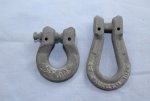
These are the options from the lifting industry. Coincidentally I picked these up from my galvaniser early this week.

IMG_4999.jpeg

IMG_4995.jpeg

K&W offer the conventional Omega link (but not the pear/long link. They also offer hammerlocks. From memory they are all quite chunky and you might not be able to use them to attach chain to anchor directly. You may also need a bow shackle, bow through the shank of the anchor.

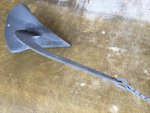
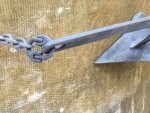
These are my mock ups for 6mm chain to a 10kg Spade. This is a long or pear link, it has more space than a omega link. The omega works well if you need to add a shackle.

The hammerlock has not had its pin inserted
IMG_9381.jpegIMG_9384.jpeg

I'm not aware of any preference of Iso and DIN for 6mm chain. Note that shackle pins tend to be nominal they may not be as precise as implied - check (and check again)

I suggest in cases where there are lots of unknowns that you take the anchor and a couple of links of chain and try them in your local, friendly chandler against a shackle etc. The is not so easy in your case - but talk it through with K&W and Andersen (who I think distribute for K&W) and you should find a sympathetic ear.

I'd be interested to hear the outcome.

Jonathan
 
DIN and ISO in 6 mm have nominally the same dimensions but ISO have rather greater tolerance. It could be argued that DIN is the better choice to fit a gypsy.

So far as the internal dimension of the last link is concerned, it makes no difference. The metal is ductile and can easily be opened up to take a shackle. Either by squeezing the link lengthways in a vice or with a tapered drift.
 
Thanks to both for a wealth of information!

I have S100 ( 20 kg) Spade anchor, which is currently connected to the chain by the Kong swivel. I plan to use Cromox G60 clevis shackle to terminate the chain on both ends. I will try to avoid the swivel by using a bigger bow shackle ( Van Beest, 0,75 t WLL) . In case there will be some problems I will retain the Kong swivel. The boat is quite light 33 footer (empty weight 3.5 t), so I expect the strength of the rode is more than adequate.

I was surprised by the limitations that narrow internal width of the higher grade chain link pose to the use of shackles. In case of the DIN chain it would be only possible to use grade 6 shackle having WLL only 0.33 tons. Hence the temptation to order ISO chain, which would enable use stronger shackles with 8 mm pin in case of emergency. Thanks to Vyv to point out the possibility of the widening the end link, which I was not sure about in case of duplex alloy.
 
Sadly - through higher strength chain, primarily G70 (or your Cromox) is hyped no-one mentions the difficulty of buying compatible components, least of all the chandlers from who you buy the (more expensive) product. You are left to scrabble around and find something that works, sort of. For the French/Slovenia couple on the circumnavigation who have just had galvanised their 6mm chain, same weight of yacht to yours, they ha ve a 10kg Spade S60 I think in the nomenclature and I aim happy with the 6mm hammerlock. I recall that the K&W G60 hammerlock is not so spacious as 'mine' - but I might be wrong

Personally I'd say you have a grossly oversized (and heavy) anchor - its redeeming feature is it will take a decent shackle.

If you read Van Beests small print, or any of the small print of a respectable shackle make they will advise that if you load a normal shackle at 45 degrees then strength will be reduced by 25% and if loaded at 90 degrees the strength of the shackle will be reduced by 50%.

I've tested this and its 'about right'

I have had one sample, see below, of a shackle side loaded it failed (and owner lost his new anchor)

IMGP2663.jpeg


The side loading can occur when the shackle locks up in the shackle slot (so it does not slide round). This might happen with a change of tide (which happens quite often :) - or a change of wind).

I might be uncommon - but it does happen. The best shackle you could source would be a Crosby G209a Crosby® 209A Alloy Screw Pin Anchor Shackles - The Crosby Group
but the smallest size they make is 3/8th" and it has a 2t WLL. It will then, approximately, match your chain (if side loaded) but you might need to buy an Omega link as an end link for the chain and then use the Crosby shackle, bow through the anchor slot.

We used a steel Anchor Right Excel, weighing 15kg and used a 3/8th" shackle with a WLL of 2t and had no issues. We have a weight fetish and downsized our chain to 6mm but a high tensile chain and replaced the steel Excel with the aluminium version (8kg). We retrieved a number of times with the shackle 'locked in' side loaded - the answer (to my surprise) was a 1/2" shackle. We sail a 7t x 38' cat. We also carry an A80, and cannot tell the difference between it and the 8kg aluminium Excel.

We originally used Omega links as end links and the 3/8th" and 1/2" shackle both fit - the Omega link aperture is quite large (compared to the 6mm chain). Now we are using hammerlocks - without issue.

I would take your S100 to you local chandler and sit down on the floor with a cross section (in terms of size) of their shackles and see what fits. Then check those that fit with your link hole sizing. When you check the shackles in the anchor slot - try side loading the shackle and see if it slips round to offer a straight line pull. Once you have found the size - make whatever excuse you like to escape without buying anything - you will then know what size you need and whether the Crosby shackle might fit (maybe you need the next size up). I buy my Crosby shackles from Tecni in the UK (I think based in Bristol) - its the cheapest way I have found.

If you cannot achieve a straight line pull on the shackle you then have very expensive strong chain attached to an, also, expensive anchor and joined by an under strength shackle. Makes no sense - or not to me.

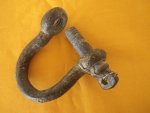
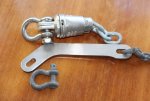
I'd also dump the Kong swivel and use a bent link, banana link, self righting link - its thin and will not detract from anchor performance. This is not a Kong swivel - but it is a Boomerang (aka) bent link etc and a 3/8th" shackle for comparison. This Boomerang is in Duplex stainless, not highly polished.

IMG_4459.jpeg

This one is made by Viking anchors to my design that I was testing. That is 6mm chain and I am using a simple chain hook to secure the anchor on passage (green dyneema line) which we also use as back up to our bridle.

IMG_1758.jpeg

Good luck

Take care, stay safe

Jonathan

edit

If you have contacts in America then shackles of the same quality as those from Crosby are avaialble, primarily from Peerless under their Peerlfit G80 range. The advantage is that they make in much smaller sizes - that will fit your chain. Campbell also make a similar quality - but I don't recall if they make small sizes.
 
Last edited:
Thanks to both for a wealth of information!

I have S100 ( 20 kg) Spade anchor, which is currently connected to the chain by the Kong swivel. I plan to use Cromox G60 clevis shackle to terminate the chain on both ends. I will try to avoid the swivel by using a bigger bow shackle ( Van Beest, 0,75 t WLL) . In case there will be some problems I will retain the Kong swivel. The boat is quite light 33 footer (empty weight 3.5 t), so I expect the strength of the rode is more than adequate.

I was surprised by the limitations that narrow internal width of the higher grade chain link pose to the use of shackles. In case of the DIN chain it would be only possible to use grade 6 shackle having WLL only 0.33 tons. Hence the temptation to order ISO chain, which would enable use stronger shackles with 8 mm pin in case of emergency. Thanks to Vyv to point out the possibility of the widening the end link, which I was not sure about in case of duplex alloy.
Cromox duplex stainless steel has good ductility and should deform quite readily without problems. I would use the vice method and inspect for cracks afterwards, although I think you should be quite safe. For comparison, try bending an 8.8 steel bolt that has similar properties.
 
Stabo,

I have to ask - why did you opt for Cromox and not a galvanised G70. You would have had the same problems in finding connectors to match but then you would have had an all gal rode, including the anchor, (and it would be a bit cheaper). The advantage of the Cromox, that I see is that it will not tower in the locker, it will clean more easily and should last for ever. But to take advantage of the latter you need to keep your yacht 'forever'.

Jonathan
 
Stabo,

I have to ask - why did you opt for Cromox and not a galvanised G70. You would have had the same problems in finding connectors to match but then you would have had an all gal rode, including the anchor, (and it would be a bit cheaper). The advantage of the Cromox, that I see is that it will not tower in the locker, it will clean more easily and should last for ever. But to take advantage of the latter you need to keep your yacht 'forever'.

Jonathan

The main advantage of the Cromox in our viewpoint is its longevity. We returned to the Mediterranean , but sometime in the future we hope the Covid will allow us to continue the circumnavigation. I am not convinced the use of the high grade galvanised chain is a good idea in this context- its availability in remote locations is questionable. The set up the suitable anchor system might be easier by using galvanised G 7 chain- if I am not mistaken the Maggi offers AQUA 7 with bigger end links. But again, if the thinner chain starts to rust, you lose the strength faster…

When we started to consider the use of higher grade anchor chain I thought it will be straightforward, but I was very wrong. So thanks again for the kind assistance!
 
The main advantage of the Cromox in our viewpoint is its longevity. We returned to the Mediterranean , but sometime in the future we hope the Covid will allow us to continue the circumnavigation. I am not convinced the use of the high grade galvanised chain is a good idea in this context- its availability in remote locations is questionable. The set up the suitable anchor system might be easier by using galvanised G 7 chain- if I am not mistaken the Maggi offers AQUA 7 with bigger end links. But again, if the thinner chain starts to rust, you lose the strength faster…

When we started to consider the use of higher grade anchor chain I thought it will be straightforward, but I was very wrong. So thanks again for the kind assistance!

I don't know if you have committed to Cromox. It is an excellent product and should last a lifetime.

Galvanised chain should last 'about' 4 years - this is a fudged lifespan - I've simply watched what long term liveaboards say on various forum about their chain life and taken an average. Frankly I think this is extraordinary - a galvanised thickness is 100 microns, if you are lucky, and considering abrasion and chemical wear (mud) I think 4 years is remarkable. The first few links will corrode faster but chopping off say 100mm of chain every year is neither here nor there.

You are right finding somewhere to galvanise chain or replace galvanised chain on passage through the NW passage or in Patagonia (or even the outer islands of Scotland) would be an interesting logistical exercise but within a 4 year period it should not be difficult to plan to be near a sensible source of new chain or a galvaniser. You soon identify your chain is getting to end of its suable life (it starts to rust) and you then probably have 6 months to do something about it. I'm using Thermal Diffusion Galvanising, TDG, (Armorgalv, Greencote and Thermiglon (not sure of the spelling of the latter) and there are plants across Europe, Scandinavia, South Africa, USA, Oz, China (using the original Sherardising process) and very likely in Japan. Hot Dipped Galvanisers are scattered world wide and anywhere with an agricultural industry has a galvaniser somewhere (though galvanisers can be reluctant to re-galvanise chain). TDG offers the ability to have a precise coating thickness, commonly 70 microns, and the coating is harder than HDG which should give a longer life. These two advantages are why the US Navy have phased out much of their HDG, small, chain used in small craft and as tie downs of military vehicles on landing craft.

Most people don't use their chain 365 and their's lasts for ever (well almost).

Check this link:

Into the wind | La vie au fil de l'eau et du vent

and this thread

Removing lead and galvanising a Spade anchor

This gives an alternative view to the same issue - they are making a circumnavigation, slowly. From France across the Atlantic (I think then via Patagonia) and then Pacific, currently in Oz and thinking of 'retracing' their steps via the NW Passage. They are changing their rode from 8mm to HT 6mm (I have their new rode sitting in a bucket in my workshop waiting for them to move on from Tasmania to Sydney) - to have more chain but not suffer the extra weight. They retrieve by hand.


I'm not discouraging you from the Cromox route - just suggesting there are alterantives and at the end of the days you have to decide if the cost of Cromox is justifiable against the cost of, say G70. The downside of TDG is that you have to arrange it yourself, buy the base chain, buy the connectors, find the processor - dictate the spec you want, check out that you get what you expected (which is where I come in for the couple in the link - I made my own rode and have made 4 more since). As far as I can ascertain Maggi 'closed down' or disappeared but Jimmy Green now offer an alternative source (where I think the owner of Maggi is now a team member). So you can still buy in Europe - but I have no knowledge of the product.

But if you are already committed - this is all academic :)

Jonathan
 
Update on chain connectors – Producer of the chain was helpful and offered bigger end links, what gives many possibilities in using anchor-chain connectors.

The main challenge remaining is to optimise the outrageous transport cost of 60 kg heavy item from Germany to Greece.

Thanks to all for the valuable input!
 
It is a welcome and refreshing pleasure to hear of the successful outcome to your problem. Simple really :)

Good luck with the freight issue.

In the fullness of time let us know what you think of the chain.

Jonathan
 
Top