Anchor alarms....

pandos

Well-Known Member
Joined
15 Oct 2004
Messages
3,202
Location
Ireland, (Crosshaven)
Visit site
As far as I know the way gps based anchor alarms operate is that we set a position, with a zone around that. Thus creating a circular area within which the boat can move without the alarm triggering.

My boat is 12m or so in length. My GPS Ariel is on the stern. If I anchor in tidal water s with 3.5m of water and 3.5m range I would leave out about 30m ish...of scope. To cover all positions that my stern could be the zone would need to be about 42m in diameter centered 42m from the anchor or in other words the boat could drift 42m before that alarm would trigger....?

So why not put a tracker ( or the gps aerial) on the bow. Move the bow above the anchor and set that position as the center point of a 30 m guard zone centered on that point.

Now if the boat pulls the anchor even a few meters the alarm will trigger...whilst it can move freely within the zone ...

Am I missing Something?
 
When GPS first became available it wasn't as accurate as it is now, mainly due to "Selective Availability", so the position of the aerial on the boat didn't matter. One of the easiest places to mount it was on the pushpit. Now that SA has been discontinued, GPS is amazingly accurate, and it makes sense to have the aerial either forward or amidships. Most current plotters etc have built in aerials, so the decision is made for you. Ideally, any anchor drag radius should be centred on the position of the anchor. If I set an anchor alarm, I set it from the estimated position of the anchor, using direction and scope to the anchor.
 
I prefer to set it to a small area and then have alarm triggered when boat swings with tide etc. I then do a check of position and feel much more secure than having a larger radius - which may put you in conflict with another boat.

Basically I never feel as though I can leave a boat at anchor completely unless its a drying out location.
 
I believe Pandos’ analysis is correct. With the GPS aerial at the stern, we would be a boatlength out if we set the GPS position at the time of anchoring as the position from which the allowed radius of swing were set. In this case, it would be at about 12m from the position the anchor was dropped. Trinity House says that DGPS is accurate to 5m for moving applications and even better for stationary applications, so we should add at least a 3m uncertainty to our radius of swing. Now if we consider that the best charts are made using DGPS, we should add another 2 to 3m of uncertainty to our swing radius to allow for chart inaccuracy, making 6m or half a boat length of uncertainty to be added to the swing radius around a position that is already a boat length away from where the anchor was dropped. Now, if the anchor moved a metre or 2 before it dug in, we could add another 2m of uncertainty to our swing radius. We would then have to add Pandos’ figures for scope based on height and range of tide, and, well, we might be just as well off taking bearings on shore features! I do use an anchor alarm, but I will use it with more skepticism next season. Thanks for raising the question.
 
I believe Pandos’ analysis is correct. With the GPS aerial at the stern, we would be a boatlength out if we set the GPS position at the time of anchoring as the position from which the allowed radius of swing were set. In this case, it would be at about 12m from the position the anchor was dropped. Trinity House says that DGPS is accurate to 5m for moving applications and even better for stationary applications, so we should add at least a 3m uncertainty to our radius of swing. Now if we consider that the best charts are made using DGPS, we should add another 2 to 3m of uncertainty to our swing radius to allow for chart inaccuracy, making 6m or half a boat length of uncertainty to be added to the swing radius around a position that is already a boat length away from where the anchor was dropped. Now, if the anchor moved a metre or 2 before it dug in, we could add another 2m of uncertainty to our swing radius. We would then have to add Pandos’ figures for scope based on height and range of tide, and, well, we might be just as well off taking bearings on shore features! I do use an anchor alarm, but I will use it with more skepticism next season. Thanks for raising the question.
I don’t really see the problem - you set the anchor position by adding the scope in the direction the boat is facing, then the circle a bit wider to allow for boat length if the phone is normally aft and soon find out if you have added enough. Seems to work well enough even with total wind changes. Only a few extra metres and it beeps nicely.
 
As far as I know the way gps based anchor alarms operate is that we set a position, with a zone around that. Thus creating a circular area within which the boat can move without the alarm triggering.

My boat is 12m or so in length. My GPS Ariel is on the stern. If I anchor in tidal water s with 3.5m of water and 3.5m range I would leave out about 30m ish...of scope. To cover all positions that my stern could be the zone would need to be about 42m in diameter centered 42m from the anchor or in other words the boat could drift 42m before that alarm would trigger....?

So why not put a tracker ( or the gps aerial) on the bow. Move the bow above the anchor and set that position as the center point of a 30 m guard zone centered on that point.

Now if the boat pulls the anchor even a few meters the alarm will trigger...whilst it can move freely within the zone ...

Am I missing Something?
With the GPS receiver on the stern it is still possible to set the anchor alarm so if the anchor moves a small distance, even a couple meters, (although this on the limit of GPS scatter) the anchor alarm will sound. However, as you note the distance setting will be 12m more than the rode length you have deployed.

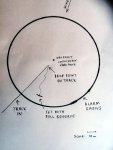
Importantly, when you drop your anchor the GPS alarm needs to be displaced 12m from the reading when the anchor hits the bottom. Many people do not understand this. If you draw a diagram it helps understand what is going on.

The basic principle is the anchor alarm needs to centred over the anchor, not where the GPS receiver is located when you drop the anchor.

A GPS on the bow would solve the above problem. The excellent anchor alarm on the Vesper AIS units will make this correction automatically (providing you have heading information) but it is the only unit that will automatically compensate the position in this way.

If you sart the app after finishing setting rather than when the anchor is dropped the process is slightly different. Here you need to add the GPS to bow distance to the setting when centring the circle.

Note: The if setting the centre point when dropping the anchor the above assumes the anchor sets immediately where it is dropped. Good anchors in reasonable substrates set in such a short distance any introduced error can be ignored you have a convex plough anchor I would deduct some distance (5m might be a good start, more is soft substrates) off the 12m bow to GPS distance.
 
Last edited:
I prefer to set it to a small area and then have alarm triggered when boat swings with tide etc. I then do a check of position and feel much more secure than having a larger radius - which may put you in conflict with another boat.

Basically I never feel as though I can leave a boat at anchor completely unless its a drying out location.

Our boat is regularly left at anchor all day, when we are off hillwalking etc. She is also left with two anchors for a month every year. I have confidence in my anchors, and in my ability to use them. West Coast and Hebrides.
 
The future of DGPS ?

Since about 2016 - USA as example has been shutting down its ground stations that provided the DGPS service ... and how much longer other countries will continue ...

The original reason for DGPS was removed years ago when SA was switched off ...
 
With the GPS receiver on the stern it is still possible to set the anchor alarm so if the anchor moves a small distance, even a couple meters, (although this on the limit of GPS scatter) the anchor alarm will sound. However, as you note the distance setting will be 12m more than the rode length you have deployed.

Importantly, when you drop your anchor the GPS alarm needs to be displaced 12m from the reading when the anchor hits the bottom. Many people do not understand this. If you draw a diagram it helps understand what is going on.

The basic principle is the anchor alarm needs to centred over the anchor, not where the GPS receiver is located when you drop the anchor.

A GPS on the bow would solve the above problem. The excellent anchor alarm on the Vesper AIS units will make this correction automatically (providing you have heading information) but it is the only unit that will automatically compensate the position in this way (although if you adjust the anchor position after finishing setting it is relatively easy to centre the alarm correctly on most apps).

Note: The above assumes the anchor sets immediately where it is dropped. Good anchors in reasonable substrates set in such a short distance any introduced error can be ignored, but if you have a convex plough anchor I would deduct some distance (5m might be a good start, more is soft substrates) off the 12m bow to GPS distance.

The important point is, to switch the alarm on when the AERIAL of the alarm is exactly ABOVE the anchor. Then you set the distance just above the distance your rode lets you get away from the anchor. That way you can achieve accuracy practically limited only by the margins of the GPS - as little as 2-3 m and the position of the alarm on the boat is irrelevant. If you should be pedantic, it always means moving the boat for the purpose of setting the alarm. If you don't, you always leave some room for error.
 
The future of DGPS ?

Since about 2016 - USA as example has been shutting down its ground stations that provided the DGPS service ... and how much longer other countries will continue ...

The original reason for DGPS was removed years ago when SA was switched off ...
There are two differential systems a ground based signal system and a satellite signal system.

The ground based system is no longer used so it has mostly been shut down. The satellite differential signal is still very popular and makes a significant difference to the anchor alarm if it is available in your area.

The satellite system still needs some ground hardware to calculate part of the error but importantly the differential correction is sent via satellite
 
GPS is not always that accurate.
The 95% confidence of position can be several metres.
What false alarm rate would you like? I don't want a false alarm very often, 1% of 3 second intervals would be a lot of alarms every night.
It depends how your plotter averages the indicated GPS positions.
Last time I logged a day's worth of indicated GPS positions, it covered a fair area, and that was with a high quality aerial bolted to a building with a perfect view of the sky.
So I suspect attempting to tighten the circle by 10m might be a waste of time?
I prefer to anchor where dragging (or digging in) 30m or more won't be a problem.
 
There are two differential systems a ground based signal system and a satellite signal system.

The ground based system is no longer used so it has mostly been shut down. The satellite differential signal is still very popular and makes a significant difference to the anchor alarm if it is available in your area.

The satellite system still needs some ground hardware to calculate part of the error but importantly the differential correction is sent via satellite

I am well aware of the difference ... but it is also true that DGPS in both forms is dated and being reduced.

Singapore still has two ground stations providing DGPS ... but they are hanging on.

The significant part of your post is : if it is available in your area.

Which is getting less all the time.
 
GPS is not always that accurate.
The 95% confidence of position can be several metres.
What false alarm rate would you like? I don't want a false alarm very often, 1% of 3 second intervals would be a lot of alarms every night.
It depends how your plotter averages the indicated GPS positions.
Last time I logged a day's worth of indicated GPS positions, it covered a fair area, and that was with a high quality aerial bolted to a building with a perfect view of the sky.
So I suspect attempting to tighten the circle by 10m might be a waste of time?
I prefer to anchor where dragging (or digging in) 30m or more won't be a problem.

GPS in all forms is not as accurate as they try to sell to you ... anyone with a plotter can see that as you indicate. Whether you have Ground based Differential signal or Enhanced Sat signal based GPS .... its still there.

That is why I only use a small area alarm radius and accept that I will be awakened / disturbed by alarms ... better that than suffer other consequences.
 
With the phone apps that I use I try to set the anchor position/press go at the bow just as I drop the anchor, let out X metres of scope, then add Y metres for amount of drift and another 6 metres for moving the phone back inside from the bow before alarm goes off. That way any swing is allowed for but it doesn't allow for the fact that the scope is at an angle and I haven't yet resorted to trigonometry...
 
GPSs and plotters are incredible. My PC chart software (TimeZero) says I have a 2m or better accuracy. The data comes from the AIS, which uses a standard cheap passive antenna. It plots my position every 15 secs or so and shows the location of the antenna on the stbd aft deck graphically. I have spent hours watching it and I can confirm it is bang on. The anchor alarm derived from it is also bang on. I further have cross checked it with the radar and plotters too (Furuno and Raymarine) and ditto. All can give great data and accurate anchor alarms. No need to overthink this.
 
GPSs and plotters are incredible. My PC chart software (TimeZero) says I have a 2m or better accuracy. The data comes from the AIS, which uses a standard cheap passive antenna. It plots my position every 15 secs or so and shows the location of the antenna on the stbd aft deck graphically. I have spent hours watching it and I can confirm it is bang on. The anchor alarm derived from it is also bang on. I further have cross checked it with the radar and plotters too (Furuno and Raymarine) and ditto. All can give great data and accurate anchor alarms. No need to overthink this.

Accuracy of GPS depends a lot on 'Averaging'

GPS calculates many positions over a time period but uses a filter to reject those that fall outside of area of probability. Second - that the position plotted or displayed is updated based on the averaging period set by manufacturer in a fixed set .. or by you the user in a user configurable set.
 
The important point is, to switch the alarm on when the AERIAL of the alarm is exactly ABOVE the anchor.

Yes this is correct, but you can calculate the correct position or compensation without physically moving the boat. It will be the distance between the GPS and the bow in the direction the boat was facing when the anchor was dropped.

Then you set the distance just above the distance your rode lets you get away from the anchor.
Yes, but this distance will not be rode length. It will be the rode length plus the distance between the bow and GPS unit (plus an allowance for any error in GPS).
 
Yes this is correct, but you can calculate the correct position or compensation without physically moving the boat. It will be the distance between the GPS and the bow in the direction the boat was facing when the anchor was dropped.

Exactly ... most plotters allow you to set a position point similar to a waypoint and designate a Guard on it ...
 
Top