aluminum lead corrosion on centerboard/keel

sewardsfolly

New Member
Joined
16 Jun 2018
Messages
7
Visit site
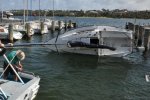
My yacht, a Neptune 16, has a leaded centerboard which has bloated up for the second time, jamming in the trunk; aluminum/lead electrolysis.

I have pulled it off and cleaned off most of the white oxidation that pushed the lead away from the aluminum blade and plan to seal the aluminum blade with epoxy , epoxy two segments of lead back onto the blade and wrap it well with fiberglass. The goal is to isolate the two metal connection from any electrolyte (salt water). My question is: if limited residue of oxidation is enclosed and isolated from oxygen and electrolyte, will that oxidation give birth to more oxidation within this closed system which has no electrolyte. I ponder this because I have learned that once you have iron rust it is self feeding and will continue in a closed system even without access to additional oxygen or elements.

This will be my second attempt to fix this. In my first fix, I thought that I had closed off/sealed the bi-metal contact from additional electrolyte, but somehow the bloating/battery electrolysis happened again. This second time, I went ahead and tore the "liberated" lead from the main body and I have been able to clean out most (99%) of white oxidation but tiny amount remain. Will it be OK to seal this away from air /oxygen and salt water?

I want to upload images but cannot figure out how to do that.

Thank you for your expertise!
 
This the same combination as exists with aluminium Spade anchors that have lead weighted tips. Spade have tried coating the internal surface with epoxy before casting in the lead but this has not been successful. Your suggestion sounds good in principle. There is no mechanism I am aware of whereby corrosion will continue in a dry environment.

For images sign up to Postimage or Photobucket, save them there and post a link to the forum. Far better than using the ybw facility.
 
My yacht, a Neptune 16, has a leaded centerboard which has bloated up for the second time, jamming in the trunk; aluminum/lead electrolysis.

I have pulled it off and cleaned off most of the white oxidation that pushed the lead away from the aluminum blade and plan to seal the aluminum blade with epoxy , epoxy two segments of lead back onto the blade and wrap it well with fiberglass. The goal is to isolate the two metal connection from any electrolyte (salt water). My question is: if limited residue of oxidation is enclosed and isolated from oxygen and electrolyte, will that oxidation give birth to more oxidation within this closed system which has no electrolyte. I ponder this because I have learned that once you have iron rust it is self feeding and will continue in a closed system even without access to additional oxygen or elements.

This will be my second attempt to fix this. In my first fix, I thought that I had closed off/sealed the bi-metal contact from additional electrolyte, but somehow the bloating/battery electrolysis happened again. This second time, I went ahead and tore the "liberated" lead from the main body and I have been able to clean out most (99%) of white oxidation but tiny amount remain. Will it be OK to seal this away from air /oxygen and salt water?

I want to upload images but cannot figure out how to do that.

Thank you for your expertise!


You cannot post images using the "on board" attachment method as a new member.

Unfortunately Photobucket, as suggested by Vyv is no longer an option unless you are prepared to pay for it

Postimage I dont know but it looks worth a try. I never figured out Drop box but in place of Photobucket I now use Tiny Pic
 
Last edited:
Unfortunately Photobucket, as suggested by Vyv is no longer an option unless you are prepared to pay for it

Sorry, not true. Seajet received a mail from them admitting they had it wrong and have reverted to their previous regime. I looked and found my albums of 200+ photos intact and posted one immediately. Here is another

 
Sorry, not true. Seajet received a mail from them admitting they had it wrong and have reverted to their previous regime. I looked and found my albums of 200+ photos intact and posted one immediately. Here is another

I knew they had restored old links to but I did not realise that I could again use the pictures I'd already uploaded. Thanks for that info.

Can you upload new photos and link to them ? As I understand it I would have to sign up to the new "Beginners Plan" at $4 per month in order to use "3rd party hosting"... and then only be allowed 2 GB of space, about 400 photos ( I have about 2000 stored at the moment!) Or the "Intermediate Plan" at $5.83 per month for 20 GB of storage

As I understand it a Free account does not allow 3rd party hosting and is limited to 2 GB. I am half expecting my existing account to be deleted because it exceeds the 2GB limit. That will be very annoying as I dont have copies of much of what is stored there and am down loading pictures again as and when I want to use them, either as attachments or via Tiny Pic.

I have signed up to Postimage but not yet investigated its capabilities


Well it works !
 
Last edited:
Sorry, cannot answer your quedtions. I only investigated my albums a day or two ago and was pleased to find I can use them again.

Postimage seems good, I went to it when Photobucket introduced its new rules. No idea how they fund it but it seems to have few limits.
 
I'm not sure why you cannot clean all trace of corrosion from the foil. A wire brush or abrasive pad on a drill or angle grinder should get you back to bare metal and will be a better foundation for the 'insulation' you plan to use to separate the 2 metals.

I don't entirely agree with Vyv, we have had our alloy Spade, with lead in the toe, for 10/12 years now with no sign of any corrosion/reaction between the lead and alloy in which it is encased. Our alloy Excel which is a similar construction to the Spade, lead cast into an alloy pocket then sealed - which is a bit younger 6 years - also has no sign of corrosion - but the pocket is welded shut.

Jonathan
 
I hope OP can get some pictures up as I have difficulty imagining what CB is like. However it occurred to me that it does not contain very much lead by weight and so perhaps you can just remove it replace with ali. Now this may seem a drastic redesign however stiffness of the boat in a wind can be reinstated by fitting lead under the floor around the CB case. You may be able to fit a lot more lead here. My 21fter has about 200kg under the floor and a 100kg CB and has been tested to prove self righting. Now certainly without the lead at the bottom of the CB you self righting from horizontal will be less powerful but for stiffness (resistance to heel) it is the hull shape and mass that matter. Further the lead under the floor will be at a lower point than the centre of buoyancy when horizontal so will still be somewhat but less effective in self righting. olewill
DSC_1897.jpg (96.1 KB) using YBW manage attachments
 

Attachments

  • DSC_1897.jpg
    DSC_1897.jpg
    96.1 KB · Views: 0
IMG_20180617_081921_zpsqinrpexo.jpg
[/URL][/IMG]

here are some images...thank you for teaching me how to do it


in stead of 1 and 1/2 large 6" diameter holes for the lead to attach to the fin, there are actually six 2" diameter holes for the same purpose
 
Last edited:
My yacht, a Neptune 16, has a leaded centerboard which has bloated up for the second time, jamming in the trunk; aluminum/lead electrolysis.

I have pulled it off and cleaned off most of the white oxidation that pushed the lead away from the aluminum blade and plan to seal the aluminum blade with epoxy , epoxy two segments of lead back onto the blade and wrap it well with fiberglass. The goal is to isolate the two metal connection from any electrolyte (salt water). My question is: if limited residue of oxidation is enclosed and isolated from oxygen and electrolyte, will that oxidation give birth to more oxidation within this closed system which has no electrolyte. I ponder this because I have learned that once you have iron rust it is self feeding and will continue in a closed system even without access to additional oxygen or elements.

The person who told you that about iron is an idiot - dont you remember the experiment in the school chemi labs where you boiled water to expel dissolved air and then put a clean nail in it, which didnt rust at all? For iron to rust you need iron, water, air and temperature - remove any one and no rust reaction.

Basically the same with lead and ally. Your problem will be getting a true closed system. GRP is water permiable to a degree , hence osmosis in boats.
 
I'm not sure why you cannot clean all trace of corrosion from the foil. A wire brush or abrasive pad on a drill or angle grinder should get you back to bare metal and will be a better foundation for the 'insulation' you plan to use to separate the 2 metals.

I don't entirely agree with Vyv, we have had our alloy Spade, with lead in the toe, for 10/12 years now with no sign of any corrosion/reaction between the lead and alloy in which it is encased. Our alloy Excel which is a similar construction to the Spade, lead cast into an alloy pocket then sealed - which is a bit younger 6 years - also has no sign of corrosion - but the pocket is welded shut.

Jonathan

A friend had an aluminium Spade that suffered severe gakvanic corrosion. Spade replaced it with one that had an epoxy isolating layer. That suffered similar corrosion and before it progressed to the same extent I photographed it, pics on the website. Spade replaced that one with a steel one.
 
OK so delete my earlier comments re taking the lead out. No possible from photos. Unless you want to make an entitirely new CB out of wood or GRP (or both). I think if it was mine I would be grinding keel back to shape and size and coating with epoxy. I would then be prepared to do the same each lift out if corrosion continued.
The CB on my little boat is made of wood at the top and lead inside at the bottom all inside a GRP moulding. So you could after grinding the old one to shape use it as a male mould to make 2 half moulds out of GRP. Use those moulds to make 2 halves of the final CB. (at least 6mm thick) You then fill the top parts with glass and resin and the lower parts with lead. The lead is glassed in finally the 2 halves are glued together. All a bit tricky and quite a job but certainly no more corrosion. just a few thoughts. olewill
 
A friend had an aluminium Spade that suffered severe gakvanic corrosion. Spade replaced it with one that had an epoxy isolating layer. That suffered similar corrosion and before it progressed to the same extent I photographed it, pics on the website. Spade replaced that one with a steel one.

I'm, obviously, not disputing the evidence you produce - but suggesting it is possible, to isolate lead from alloy (or seal it such that no reaction occurs). In the cases you quote they did not get it right in my case they, both Spade and Anchor Right have got it right. Why they got it right and why Spade got it wrong in your cases - I'm not going to speculate - maybe I've been lucky or your examples were unlucky. But there was another member of these forum who had an alloy Spade who did not indicate he had any issues (they are not common).

But I would buy both a Spade alloy and Excel alloy again (and in both cases find they perform no different to their steel equivalents). The Excel has a plate of aluminium welded across the end of the ballast chamber - so it is completely sealed (I'd need to check how Spade finished off their ballast chamber).

Jonathan
 
Thank you to all the wise sailors. I have a plan to follow the original plan with, as suggested, a bit more cleaning before sealing it up.

thank you all!
 
Top