Aluminium boats - maintenance

manifold

New Member
Joined
26 May 2011
Messages
9
Visit site
Hello.

I've recently bought a small aluminimum yacht (5083 2.6mm & 5mm) called an Extrovert 22. A few were made in the early 1980s.

Just wondered what people did who have owned these or other ally boats as part of care and maintenance for these type of hulls.

I'm particularly concerned with anode protection for electrolysis and galvanic corrosion as this boat will be used in a sea/river eastuary, albeit dry sailed from a dipping trailer. It does not appear to have ever had an anode fitted.

Also what preparations for antifoul as I am currently in the process of ripping all the coatings off below the waterline to enable thorough inspection. The first coat appears to be some kind of red paint rather than the atomic yellow etch primer I was expecting.

This one doesnt seem to have done too badly after 37 years with only light corrosion markings here and there where the paint has previously failed.

Thanks in advance.

David
 
Unlikely any anode required, particularly if dry sailed. Galvanic corrosion will only occur if you have two different metals together in aa wet environment. So you might get corrosion if there are any stainless fastenings, although they are usually bedded in a paste to minimise this. If it has survived 37 years then unlikely to be a problem.

For paint follow the paint manufacturers instructions. antifouling needs to specifically for aluminium together with its own primer. Trilux is the International type, but other manufacturers will also have suitable paints.
 
Thanks Tranona.

I'm looking to minimise paint as much as possible, leaving her as a bare metal hull. Maybe even below too waterline too depending on how much shes in the water and on whether I find any unwanted surprises with the paint removed.

The dipping trailer has rubber insulators on the pads, presumably to avoid dissimilar metal contact issues (except the cast iron drop keel which sits on the trailer).
 
Hello.

I've recently bought a small aluminimum yacht (5083 2.6mm & 5mm) called an Extrovert 22. A few were made in the early 1980s.

Just wondered what people did who have owned these or other ally boats as part of care and maintenance for these type of hulls.

I'm particularly concerned with anode protection for electrolysis and galvanic corrosion as this boat will be used in a sea/river eastuary, albeit dry sailed from a dipping trailer. It does not appear to have ever had an anode fitted.

Also what preparations for antifoul as I am currently in the process of ripping all the coatings off below the waterline to enable thorough inspection. The first coat appears to be some kind of red paint rather than the atomic yellow etch primer I was expecting.

This one doesnt seem to have done too badly after 37 years with only light corrosion markings here and there where the paint has previously failed.

Thanks in advance.

David

I used to have one of those, called Extranef.

For antifouling the best advice would be to contact International and see what they say. They will be able to provide the full paint system from primer outwards.

If you are dry sailing no anode needed. If keeping in salt water the usual solution is 2 hanging zinc anodes replaced every year.

Keep you bilges dry, & check them every now & then for stray coins. Best thing is to get everyone to put all coins in a plastic bag as soon as they arrive on board. If you do any wiring using copper cable clean up very thoroughly afterwards.

Absolutely no mercury thermometers on board. You are unlikely to have shore power on a 22' boat but if you do you need to be very careful or seek professional advice.

Other snippets of information - designed by Julian Everritt of Enterprise & E-Boat fame. Made my Dalton Linkleter in Amble which became Alnmaritec of Blyth...

http://www.alnmaritec.co.uk

Keel must be down & locked before you go to sea. Never raise it at sea or while sailing.

I had great fun in mine. I cruised all round the Irish sea. They are almost indestructible.
 
Last edited:
Angus beat me to it... Absolutely no copper to be left touching the ally. Copper eats ally for breakfast. Lost watch button cells are deathly too, there are tales of them eating a hole right through.
Next up is mixed metal. Lets face it you are going to have stainless somewhere. Again an absolute must... there is some very nasty barrier cream that really ought to be applied to all stainless fittings where they interface to the ally every time they are inspected and reassembled (which ought to be on every few year basis)

If you ever need repairs or patches ensure that the welder knows about different ally alloys.... Mix alloys at your peril.
A regular inspection for pitting is a good idea.

Now for the good news. Ally (on its own) dont rot, ever. The first thing it does on exposure to oxygen is anodise itself to a hard, crystalline coating. But bare ally looks a bit like dirty concrete.
 
Aluminium yachts made of marine grade aluminium, like your 5083, only need anodes to protect against dissimilar metals.

Thus, it is not unusual to see an aluminium yacht with no hull anodes. This is not a cause for concern.

However, I understand you have an iron keel. That is a very large lump of dissimilar metal. Ideally the ballast would be encapsulated.

With iron and aluminium exposed to water it would be normal to fit several anodes. Two anodes on the iron keel and two on the hull near the keel might be typical (aluminium or magnesium anodes for freshwater). The iron keel and aluminium hull should be kept electrically isolated, but this is difficult to do over the long term and the anodes will provide some back up protection.

If your boat has no problems after 37 years, this is obviously not urgent or even perhaps essential. Marine aluminium is almost completely corrosion free on its own, but you do need to be very careful with large lumps of dissimilar metal. So I would try to maintain the original isolation between the iron and aluminium and fit some anodes as well.

Etch primer is not commonly used these days (although it still a good system).
 
Last edited:
Angus beat me to it... Absolutely no copper to be left touching the ally. Copper eats ally for breakfast. Lost watch button cells are deathly too, there are tales of them eating a hole right through.
Next up is mixed metal. Lets face it you are going to have stainless somewhere. Again an absolute must... there is some very nasty barrier cream that really ought to be applied to all stainless fittings where they interface to the ally every time they are inspected and reassembled (which ought to be on every few year basis)

If you ever need repairs or patches ensure that the welder knows about different ally alloys.... Mix alloys at your peril.
A regular inspection for pitting is a good idea.

Now for the good news. Ally (on its own) dont rot, ever. The first thing it does on exposure to oxygen is anodise itself to a hard, crystalline coating. But bare ally looks a bit like dirty concrete.

Duralac is the stuff. It comes in chandlers in tubes, but eventually it separates & you can't stir it in a tube. It's no more expensive to buy it in a tin which can be stirred...

https://www.silmid.com/sealants/jointing-compounds/duralac-jointing-compound-500ml-tin-dtd369b/

Most boats have stainless/aluminium alloy interfaces on their masts & often toerails.
 
Aluminium yachts made of marine grade aluminium, like your 5083, only need anodes to protect against dissimilar metals.

Thus, it is not unusual to see an aluminium yacht with no hull anodes. This is not a cause for concern.

However, I understand you have an iron keel. That is a very large lump of dissimilar metal. Ideally the ballast would be encapsulated.

With iron and aluminium exposed to water it would be normal to fit several anodes. Two anodes on the iron keel and two on the hull near the keel might be typical (aluminium or magnesium anodes for freshwater). The iron keel and aluminium hull should be kept electrically isolated, but this is difficult to do over the long term and the anodes will provide some back up protection.

If your boat has no problems after 37 years, this is obviously not urgent or even perhaps essential. Marine aluminium is almost completely corrosion free on its own, but you do need to be very careful with large lumps of dissimilar metal. So I would try to maintain the original isolation between the iron and aluminium and fit some anodes as well.

The Extrovert is designed so that when the keel is raised it is electrically isolated from the hull. Normal practice is to raise the keel when the boat is left. It's stable enough like this. There is no inboard engine either so that removes an issue of bronze prop.

The only anodes Extroverts ever have are hanging ones. These are taken in when sailing. If the OP is only ever dry sailing then they won't be needed either.
 
Last edited:
The Extravert is designed so that when the keel is raised it is electrically isolated from the hull. Normal practice is to raise the keel when the boat is left. It's stable enough like this. There is no inboard engine either so that removes an issue of bronze prop.

The only anodes Extraverts ever have are hanging ones. These are taken in when sailing. If the OP is only ever dry sailing then they won't be needed either.

Yes, I agree. Maintaining isolation between the iron on the aluminium is the most important factor. If this can be done, the anodes are unnecessary. However, it is hard to retain complete electrical isolation from heavy structural elements that need to move, like the keel. Anodes are good insurance from this sort of situation, especially in a 37 year old yacht.

A simple test that can be done out of the water (but insulated from the trailer) is put the probes of a multimeter on an exposed bit of the iron keel and aluminium keel and hull. The result should be infinite resistance, if the isolation is working
 
Yes, I agree. Maintaining isolation between the iron on the aluminium is the most important factor. If this can be done, the anodes are unnecessary. However, it is hard to retain complete electrical isolation from heavy structural elements that need to move, like the keel. Anodes are good insurance from this sort of situation, especially in a 37 year old yacht.

A simple test that can be done out of the water (but insulated from the trailer) is put the probes of a multimeter on an exposed bit of the iron keel and aluminium keel and hull. The result should be infinite resistance, if the isolation is working

The way it is done is two fold. Firstly the studs coming out of the keel are insulated from the plate at the top of the keel using rubber gaskets and Tufnol washers. The keel guides in the trunk are nylon. Secondly when the keel is raised it is supported by a cable running over a Tufnol pulley and the winch is isolated from the hull.

When the keel is locked down the secondary isolation is no longer in place.

I had mine surveyed when I bought it. The report stated that the hull was as good as the day it left the yard when new. The only corrosion strangely was on the iron keel. The fact that the less noble aluminum had not galvanically protected the more noble iron keel suggests that the electrical isolation was working.

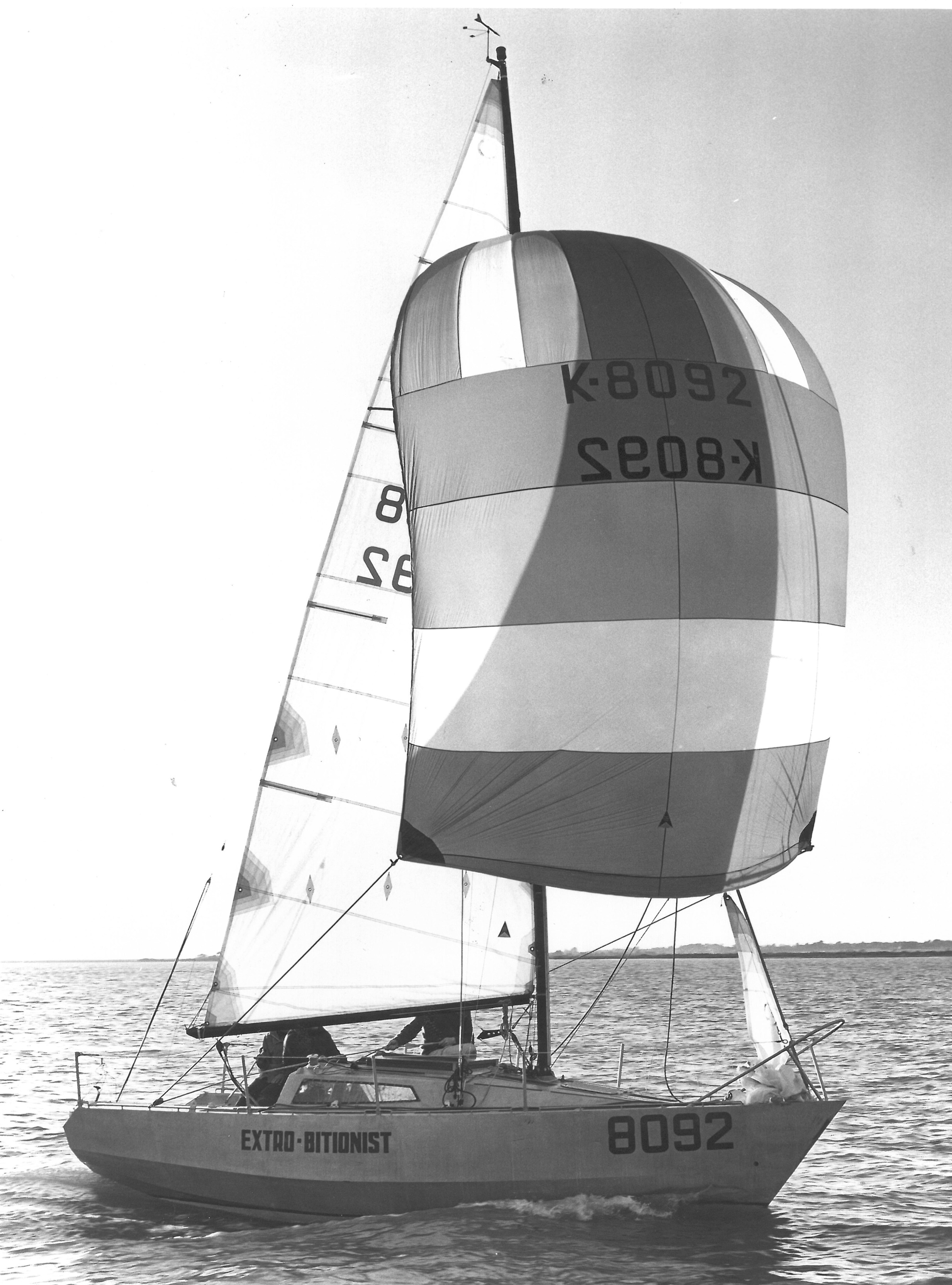
Just for interest, this is an example of the type of boat under discussion as not many people will have seen one. The rig is fractional unlike the preceding Everitt E-Boat (it's the same rig as a Jaguar 22). PY handicaps them slightly faster than a Sonata, to which it is very similar.

image30.jpg


Although that image is black & white that really is the colour of them :).
 
Last edited:
I enquired about a slightly larger version of this when I was buying my boat about 4 years ago. It was an aluminium Everitt quarter tonner called Tumbling Dice. Very similar lines but just a bit larger and also fractional rig. In the end I decided it was a bit bare bones for my needs and bought a small GRP benny instead.
 
I enquired about a slightly larger version of this when I was buying my boat about 4 years ago. It was an aluminium Everitt quarter tonner called Tumbling Dice. Very similar lines but just a bit larger and also fractional rig. In the end I decided it was a bit bare bones for my needs and bought a small GRP benny instead.

That's known as the stretched Extrovert. Only half a dozen of those were made.
 
Cheers guys for all the useful input on this subject on aluminium boats. Much appreciated.

I have seen this photo of Extro-Bitionist before and is what sold it for me.

A small piece of history is that these boats are closely related to one my father used to own during the 1980s called Silver Dream Racer (SDR). We only had it for a short time before it was sold on, hence the reason for my questions today regarding maintenance.

I'm not sure what happened to SDR and would love to know what where it is now. I had heard it lost its keel in North Wales, although this is only a rumour. Silver Dream Racer had a fixed keel whereas my boat has the drop keep as mentioned by AngusMcDoon.
 
talking of hanging anodes over the side - how are these attached? I've never seen one of these kind of anodes although I heard that this is sometimes done on OVNIs and the like? What kind of cable is attached to them? Im assuming some kind of ally cable seeing as copper is a no no?
 
A said corrosion is most likely to be evident in the bilges inside outwards. Especially where water can collect. Not sure of the corrosion process but it is very common. Lots of ali dinghies and mobos here in Oz so many show this problem when left on trailer. good luck olewill
 
talking of hanging anodes over the side - how are these attached? I've never seen one of these kind of anodes although I heard that this is sometimes done on OVNIs and the like? What kind of cable is attached to them? Im assuming some kind of ally cable seeing as copper is a no no?

They are a conical lump of zinc on the end of a stainless wire with an eye swaged on the other end. You bolt the eye on to the hull.
 
Thanks AngusMcDoon. I now know what to look for. Never seen these before.

It makes sense having one stored in the anchor well with all the wet chain.
 
If you want, you can make your own hanging anodes for very little cost.

All you need is some plastic coated stainless lifeline wire and an old anode (saildrive anodes are good). It is a good way to reuse something that would otherwise just be thrown away. Remove some of the plastic coating around the wire. Wrap the wire around a large bolt and washer and bolt the bare wire to the zinc. Sand the zinc where it meet the wire to ensure good contact.

Periodically check the electrical connection for low resistance.
 
Top