Alternators - converting to LiFeP04

I've been running on LifePo4 for a year now on our Sealine S37. we have 560AH Lifepo4 (8 individual cells in a 2P4s configuration) with a Rec external BMS, Balmar 100A alternators on Volvo Kad44 (single V) running through Wakespeed WS500 regulators and all controlled via CAN bus and Victron.

I wish there was a way to run a serpentine belt on the alternators on the Kads coz then you could use a much bigger alternators

Lithium is amazing you won't go back to lead once you have tried it.

regarding charging options you either have to go down the DC-DC charger route which wont get you many amps or external regulators

we did run of the standard volvo alternator for a while until i got the Balmar's though if hindsight and if i do it again i would probably go with Lece Nevile alternators next time as Balmar are a rip off..

let me know if u have any questions

Fantastic. Yes I will shortly. I'm currently looking at a MasterVolt drop in solution including alternator but the alternator may have to be adapted to fit. Let me have a look at this Lece Nevile and I'll come back with a job lot of questions.
 
also if you are looking at drop in style batteries then have a look at renogy, they are a well known brand and cheaper then all the ones u listed 12V 100Ah Smart Lithium Iron Phosphate Battery【Pre-Order】

regarding the dump load we use a sterling Alternator Protection Device (APD12) on each alternator they are about £40 each and an insurance policy on the alternators

Renology? I saw them initially but on reading up for externals to support LifePO4 all the literature from the charge regulation and BMS swots absolutely slated them. They even went so far as to say they would refuse to programme for them. I stopped looking at that point. Do you have a rebuttal?
 
slightly OT, care to elaborate on that?
I've got all the victron setup palava working properly, even on the N2K bus and I see there's a BMS pluggin or something (haven't checked yet!) that can run on them, is that what you have? if so, any info appreciated!

cheers

V.
So with the Rec BMS connected to VE CAN it displays cell voltages and temperature plus it stops the victron charging sources (shore power and solar) if the cells go over voltage and cuts the inverter if cell low voltage ocurs.

The Wakespeed regulators are on the same CAN network so again they are controlled if there is a cell over voltage situation and with reduce alternator field

We have the Cerbo GX with touch screen so we can monitor on board plus we have remote web monitoring with VRM portal
 
  • Like
Reactions: vas
Renology? I saw them initially but on reading up for externals to support LifePO4 all the literature from the charge regulation and BMS swots absolutely slated them. They even went so far as to say they would refuse to programme for them. I stopped looking at that point. Do you have a rebuttal?
No I have no experience with them Never tried them just heard of them as what seems a larger brand and at the price seemed resonable.

Mine are EVE 280ah cells direct from China which I found after reading loads on the DIY solar forum I started to film the build here https://youtube.com/playlist?list=PLKy8tKtE43DddI8BrEb7fijeYZBkILQAC

However I have been a bit lapse with part 4 5 6 as once I built it i needed to get it installed and operational for the season so will re visit build videos over the winter.

Another good source more local in Europe is GWL in Czech I have just got a 90ah lifepo4 starter battery from them to have a play with and it was shipped within a week.

GwL do individual cells from a company called elerix LiFePO4 Battery Cells - 3.2 V | shop.GWL.eu

They have a 100ah cells for $59 (you need 4 for 12v) but at ~$240 for a 100ah battery that's pretty good (obviously u need an external BMS too though)
 
So with the Rec BMS connected to VE CAN it displays cell voltages and temperature plus it stops the victron charging sources (shore power and solar) if the cells go over voltage and cuts the inverter if cell low voltage ocurs.

The Wakespeed regulators are on the same CAN network so again they are controlled if there is a cell over voltage situation and with reduce alternator field

We have the Cerbo GX with touch screen so we can monitor on board plus we have remote web monitoring with VRM portal
thanks, interesting!

will have a look at this Rec BMS when I'm back to base, only concern is the VECAN as I'm running everything via Raspberry pi and will need some extra HAT to run another CAN (on top of NMEA2000) protocol on it. Sounds ideal if VenusOS turns on and off loads/consumptions according to states of charge.

cheers

V.
 
thanks, interesting!

will have a look at this Rec BMS when I'm back to base, only concern is the VECAN as I'm running everything via Raspberry pi and will need some extra HAT to run another CAN (on top of NMEA2000) protocol on it. Sounds ideal if VenusOS turns on and off loads/consumptions according to states of charge.

cheers

V.

Looking at the GWL site their extended module does canbus but also support for PC via USB - I;m out of my depth here but it may interest you

123ELECTRIC BMS123 Smart - Extended Module | shop.GWL.eu
 
thanks Bruce will have a look,

the whole issue for me is integration:
Since I already have gone through the trouble of getting a sh1tload of data from engines/envinronment/vessel/even stabs on the N2K bus and since a fair amount of them relate to how the whole system performs, I'd rather have the raspberry pi, running Victron VenusOS, that is picking up the data from the MPPT and battery charger/inverter (as well as the battery monitor - all being Victron) to "instruct" them (note no mention on alternator yet-working on it!) what to do with the LiFePO4s
Easier than having large 200A contactors turning things on and off, if you simply instruct this and that to send or not send current the LifePO4 way via an thin bus wire (ethernet cable most likely)!

looking forward (not!) to the next lockdown to sort that lot out :rolleyes:

V.
 
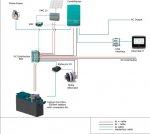
This is what came back from MasterVolt as a end to end complete drop in solution. It's simply battery cost that is the limiter. When I saw sterling at 500 odd quid for 100 A/hr and that been echoed with other manufacturers there was a real chance. But at ~ £1500 per 100 Ahr it makes less sense. The question now is adopt early or wait till the Ah/hr cost drops?
But if you are interested in the return this is it.

MasterVolt.jpg


1 x 12/5500 MLI Ultra battery (400ah)with connection kit (this could be 2 x 12/2750 (200ah) with 2 connection kits connected in parallel)

the connection kit incudes the required safety relay and Class T fuse holder mounted on a bracket that fits onto the battery (fuse to be specified and ordered separately)

MLI Ultra 12/5500 | Mastervolt

MLI Ultra 12/2750 | Mastervolt

Ultra Connection Kit 12 V | Mastervolt

The 25a solar regulator requires a multipurpose contact to connect it into the masterbus system to receive stop charge events from the battery#

SCM25 MPPT | Mastervolt

Multipurpose Contact Output | Mastervolt

the CombiMaster inverter output is rated at 1600w continuously with a peak power of 3200w

CombiMaster 12/2000-60 (230 V) | Mastervolt

the easyview 5 gives monitoring and control of all on the masterbus network and the USB interface allow PC connection for configuration and service

EasyView 5 | Mastervolt

MasterBus USB Interface | Mastervolt

the DC Distribution may not be required depending on the current installation

there are a range of alternators the 12v 90a is delivered with a double V belt if this cant be accommodated most alternators can be adapted to be regulated and controlled by the alpha pro

part numbers and RRP for all below

Product CodeDescriptionQuantityUnPrice £ ex vatPer
M66015500MV MLI ULTRA LITHIUM ION BATTERY 12V/5500Wh
1​
EA
5146.4​
EA
M66012750MV MLI ULTRA LITHIUM BATTERY 12/2750 - 2.75KWH
1​
EA
2928.9​
EA
M79007712Mastervolt Connection Kit c/w Relay & Fuse Block for 12V MLI-Ultra
1​
EA
315.19​
EA
M131902500MV SOLAR CHARGEMASTER SCM25 MPPT
1​
EA
211.68​
EA
M77030500MV MASTERBUS MULTI PURPOSE CONTACT OUTPUT
1​
EA
121.11​
EA
M35012000MV COMBIMASTER INVERTER/CHARGER 12/2000-60 230V
1​
EA
1051.92​
EA
M77010310MV EASYVIEW 5 - TOUCH SCREEN PANEL
1​
EA
316.11​
EA
M77030100MV MASTERBUS USB INTERFACE
1​
EA
153.32​
EA
M48612090MV ALTERNATOR 12-90 INCL 3-STAGE CHARGE REGULATOR
 
This is what came back from MasterVolt as a end to end complete drop in solution. It's simply battery cost that is the limiter. When I saw sterling at 500 odd quid for 100 A/hr and that been echoed with other manufacturers there was a real chance. But at ~ £1500 per 100 Ahr it makes less sense. The question now is adopt early or wait till the Ah/hr cost drops?
But if you are interested in the return this is it.

View attachment 123686


1 x 12/5500 MLI Ultra battery (400ah)with connection kit (this could be 2 x 12/2750 (200ah) with 2 connection kits connected in parallel)

the connection kit incudes the required safety relay and Class T fuse holder mounted on a bracket that fits onto the battery (fuse to be specified and ordered separately)

MLI Ultra 12/5500 | Mastervolt

MLI Ultra 12/2750 | Mastervolt

Ultra Connection Kit 12 V | Mastervolt

The 25a solar regulator requires a multipurpose contact to connect it into the masterbus system to receive stop charge events from the battery#

SCM25 MPPT | Mastervolt

Multipurpose Contact Output | Mastervolt

the CombiMaster inverter output is rated at 1600w continuously with a peak power of 3200w

CombiMaster 12/2000-60 (230 V) | Mastervolt

the easyview 5 gives monitoring and control of all on the masterbus network and the USB interface allow PC connection for configuration and service

EasyView 5 | Mastervolt

MasterBus USB Interface | Mastervolt

the DC Distribution may not be required depending on the current installation

there are a range of alternators the 12v 90a is delivered with a double V belt if this cant be accommodated most alternators can be adapted to be regulated and controlled by the alpha pro

part numbers and RRP for all below

Product CodeDescriptionQuantityUnPrice £ ex vatPer
M66015500MV MLI ULTRA LITHIUM ION BATTERY 12V/5500Wh
1​
EA
5146.4​
EA
M66012750MV MLI ULTRA LITHIUM BATTERY 12/2750 - 2.75KWH
1​
EA
2928.9​
EA
M79007712Mastervolt Connection Kit c/w Relay & Fuse Block for 12V MLI-Ultra
1​
EA
315.19​
EA
M131902500MV SOLAR CHARGEMASTER SCM25 MPPT
1​
EA
211.68​
EA
M77030500MV MASTERBUS MULTI PURPOSE CONTACT OUTPUT
1​
EA
121.11​
EA
M35012000MV COMBIMASTER INVERTER/CHARGER 12/2000-60 230V
1​
EA
1051.92​
EA
M77010310MV EASYVIEW 5 - TOUCH SCREEN PANEL
1​
EA
316.11​
EA
M77030100MV MASTERBUS USB INTERFACE
1​
EA
153.32​
EA
M48612090MV ALTERNATOR 12-90 INCL 3-STAGE CHARGE REGULATOR

Plus fitting?

We were quoted roughly the same by Mastervolt. I can get a gennie big enough for my requirements purchased & installed for £6k.
 
that is Insane! ?
i paid about £900 for 560AH battery + £300 for BMS

I think, as always, I shall have to take @vas 's advice and do some bed time reading on DIY. But my engineering skills are those of a fitter and not a designer. Maybe when Vas gets bored and builds his own I will piggy back off him. I have the utmost faith that should I go Fred in his Shed I will shortly be visited by the fire brigade with a bomb disposal squad in tow.
 
back home, catching up

Bruce, I'm not the god of hacking, don't have to only listen to me :p

nfluester has done it already, his boat hasn't exploded, he started a series of v.nice videos showing how the thing is put together, I'm v.loosely working on it, still trying to figure out how to get the cells cheaply to Greece - @nfluester 900quid for a 8S 280Ah pack would be lovely, worried that local customs will shoot that up to 1300 and I don't like that!
So, instead of getting silly expensive quotations from various companies, go over to the PBO and spent 3-4 evenings reading (over again) this thread:
270ah DIY LiFePO4 build

Your setup will be relatively easy as you mainly care about alternator charging and inverter loads, two devices, fairly easily linked to any half decent BMS. A fuse and a couple of other bits and bobs and you're good to go.
 
No, these are house batteries. There is no splitcharging on my system one engine looks after the starter batteries and the other the house batteries. I have currently a shunt that connects starter and house batteries should the starter batteries fail that enables starting but that wont be possible with lithium. I would be able to charge the starter battery though with the shunt or DC-DC charging. The starter battery is also connected to an independent solar panel and as it's only function is to start the battery is always optimal, fully charged and never required shunting the two banks to start the engines in 8 years of ownership so I dont rate the risk very high.
If the batteries are no suitable for a starter motor, are they suitable for a windlass?
 
We've moved on since then. The latest battery would be able to kickout 5000W so absolutely yes.
That's what I'd have thought, so I'm a little surprised they cannot be used to start an engine, albeit I'm sure your engine is bigger than I'm used to.
Quite small Lithium batteries are used to start motorbikes.
Used car salesweasels have those Lithium jump packs the size of a big paperback.
 
The Sterling Leisure pack's out put was restricted to 150A, but we were put off them by member comments
 
The Sterling Leisure pack's out put was restricted to 150A, but we were put off them by member comments
It's not something I've looked into much, but I think the BMS's are more complex, and doing a harder job than many people realise. I'd have to see a big quick gain to be an early adopter, as the tech will only get cheaper and better. Possibly quite quickly.
 
@BruceK I’m really late to this thread but it’s interesting to me because of real world job crossover.

Firstly, rather than going down the route of the alternator directly charging the LiFePO4 bank, I think you should reconsider the dc/dc charger route.
I presume you currently have two functional engines each with the standard 70A alternators on them. These should each be able to supply at least 40-50A continuously without overheating.
If you were to fit a couple of Victron 30A dc/dc chargers, you would have a 60A charge current. You could put smaller 18A chargers in parallel with them (and only engage them when the engines were above a certain speed) to get circa 100A charge
These things are dirt cheap (sub £150 quid each) and just work. You can also limit the charge rate via Bluetooth app if it’s taxing the alternator too much.

You would have to reconfigure your start batteries. Ideally you would want a single say 100AH AGM battery connected to each alternator as the two start batteries. These could have a crossover switch in case one dies.
The capacity of the start batteries are irrelevant other than it being big enough to spin the engine over. When the dc/dc chargers are on, the current be coming straight from the alternator into the charger effectively bypassing the start batteries.

So with the 60/96A of charge current you now have with both engines running, you need to be able to dump this current into a LiFePO4 battery. I won’t go too deeply into that, other than to say that I’d favour a system made up of multiple smaller packs each with their own BMS. Whether you want to build your own pack from Prismatic cells, play roulette with a no name ‘drop in’ or pay Victron 700% markup for Winston cells is up to you.

On the basis the LiFePO4 would only be running house loads and nothing critical, the risk seems manageable.
You could always have a crossover to let you run house load off the start batteries if the house batteries cut out completely for some reason.

You’d probably also need a third AGM battery for the bow thruster, which could be charged with a small Victron dc/dc charger from one of the engine banks.

Overall I reckon you could put together a 7kwh ish battery with alternator charging system for sub 2 grand quite easily.
 
Top