Alternator doesn’t start charging...

So I checked the wiring over the weekend and it appears to be correct.. The red/black connects from all the relevant lights and the switch..
While the engine was running I measured the voltage across the charge light and it was 9.7v, when revving over 2000rpm it dropped to 9.2v.. Never lower.. After shorting it to get the alternator to start charging it measures 0.3v..
I can order an try another bulb, if that fails is it likely an alternator problem?
 
So I checked the wiring over the weekend and it appears to be correct.. The red/black connects from all the relevant lights and the switch..
While the engine was running I measured the voltage across the charge light and it was 9.7v, when revving over 2000rpm it dropped to 9.2v.. Never lower.. After shorting it to get the alternator to start charging it measures 0.3v..
I can order an try another bulb, if that fails is it likely an alternator problem?
Yes but did you check the red black all the way to the R terminal on the alternator, assuming it goes to the R terminal ... older versions are wired differently from the diagram I posted

Unlikely to be an alternator problem because it works OK once you kick start it but by all means get it tested by an auto- electrician. If its OK it eliminates it from the equation and gives peace of mind.

Check the volts on the R terminal ..
 
Last edited:
To check that Alternator is good and not weak ...

Initial start after being left for a while - field has dissipated and means excite current has to be applied to field - which is what you do when you short it.

OK - so you short and alternator kicks in charging ... 0.3V on the lead shows its working ... (and I'm suspicious it may be an LED lamp !) .... 9.2v is too low .... it should show similar to battery voltage. I'm no auto-electrician but I would expect to see at least 11v ...

Let her run a bit and she's charging away. Now stop engine ... Let it come to complete stop ... then restart again ...

If the alternator is good - the field should still be good and lamp should not be lit - showing she's charging. If the lamp comes back on and needs shorting again to start charging .... then I think there's a problem .... maybe a weak field coils.
 
So I checked the wiring over the weekend and it appears to be correct.. The red/black connects from all the relevant lights and the switch..
While the engine was running I measured the voltage across the charge light and it was 9.7v, when revving over 2000rpm it dropped to 9.2v.. Never lower.. After shorting it to get the alternator to start charging it measures 0.3v..
I can order an try another bulb, if that fails is it likely an alternator problem?
You have a high resistance in the lamp circuit, somewhere, I would say definitely a faulty connection , either wire terminal or contact. Could be the lamp/lamp holder/connections or could be a connection problem in the key switch. All points to the lamp area but worth checking whole circuit. Can you measure for voltage drop across the switch terminals or from the input of the switch to either side of the lamp holder, likewise output side of switch.
Suspect that you may have an LED warning light which would explain the difference in voltage : - 12. ?? - 9.7 = 3 volts (ish)
 
Last edited:
I have a new charge light and will check voltages all the way through the circuit and see if I can find a point where there is a significant change.. Going to the boat of Thursday to fingers crossed I can get to the bottom of it..
 
So I have fitted the new charge lamp and still no luck. The New lamp is identical to the existing one. Maybe I should have got a completely different one.

I have measured voltage at the alternator connector and it’s down less than 2v with the lamp in the circuit and if I short the lamp I get full voltage at the alternator plug. So it would seem that the wiring is all good but the lamp is causing a voltage drop. Still I would have thought that 10 odd volts would have been enough to Initially energise the alternator after which it would energise itself the rest of the way to 14v as it started making power.

I know it’s a hack but I’m almost tempted to install a momentary switch across the charge lamp terminals which I can flick to get it charging. :confused:
 
It sounds like your lamp holder may be the problem. I assume that when you short out the lamp - you are putting shorting lead across the terminals that alternator leads connect to on the holder ?

Just bear with me ... my Volvo XC70 has been driving me nuts with a 'lazy' front left indicator. I lift bonnet ... wiggle the lights lead and it comes on ... stays working maybe one or two flicks of switch - then stops again.
I took bulb and holder out .. and same as before checked that bulb was fully home and locked ... but this time decided to go a little further ... I took a thin key and scratched about in the holder because there was a small patch of corrosion one side ... it matched a mark on the bulb as well. Scratched that as well ... then once I was happy with having cleaned them - I prised the holder sides together slightly to make sure bulb was very secure.
Put it back in the slot ... perfect - everything fine again.

My point is that all looked and felt good - but the holder was the cuiprit. A slight corrosion and I mean this was barely a few degrees of the circumference of the holder ... but it was enough ...

I suggest you go to work on that lamp holder ..... in the boat environment - its not best for lamp / fuse / electrical holders / connections.

Small wire brush or thin blade scraper ... a good pull to check connectors .... clean it all up and make holder little bit more tight to ensure least resistance ...

??
 
So I have fitted the new charge lamp and still no luck. The New lamp is identical to the existing one. Maybe I should have got a completely different one.
I know it’s a hack but I’m almost tempted to install a momentary switch across the charge lamp terminals which I can flick to get it charging. :confused:
OK you have tried that now read again what I said in #8 and subsequently
Look at he wiring diagram I posted, which is from the current Yanmar GM manual, and check the red/ black connection from the ignition switch to the R terminal on the alternator.

Unless your engine installation is old, predating the current manual .
With the ignition switched on , but the engine not running, you should get battery voltage on the R terminal. .... check it !

I think you said your boat is 18 years old so the wiring digram I posted should be the correct one
 
Last edited:
This could also be caused by one or more of the auxiliary diodes in the rectifier pack having failed, or a faulty stator coil.
Or even damage to the iron pole pieces.
Or high resistance in the brushes, slip rings etc.
Or a regulator fault.

Measure the current into the w/l terminal. For a conventional alt, you expect it to be about 70 to 100mA? ie 12V less a few diode drops into a nominally 1.2W bulb or something.
You could try temporarily wiring in a slightly bigger bulb or two in parallel. See 150mA going in, and if it doesn't work, something else is broken?
 
If you are dropping 10v across the bulb, it would be glowing or even lit. You have a poor high resistance connection somewhere between the ignition switch and the alternator terminal. The bulb holder is a possibility. Short the bulb out AT THE BULB to find out.
 
If you are dropping 10v across the bulb, it would be glowing or even lit. You have a poor high resistance connection somewhere between the ignition switch and the alternator terminal. The bulb holder is a possibility. Short the bulb out AT THE BULB to find out.
It is lit. and it stays lit ... see #1

The bulb is working correctly ........ showing that the alternator is not generating.
If there was a high resistance anywhere in ts circuit it would only be glowing dimly if at all.
 
It is lit. and it stays lit ... see #1

The bulb is working correctly ........ showing that the alternator is not generating.
If there was a high resistance anywhere in ts circuit it would only be glowing dimly if at all.


What is the bulb? Usually it will be 12v 5 watts minimum. Is it a miniature bayonet? I would try a bigger wattage bulb or 2 in parallel. Just jury rig them in, you won't get bigger than 5w in miniature bulbs.

The way it works is the ignition puts 12v on one side of the bulb, the stationary alternator draws current through its exciter circuit so the bulb lights. When the alternator starts to generate, it puts 12v on the other side of the bulb. So with 12v on both side, no current flows and it goes out.
If the bulb is too low a wattage. there is not enough exciter current, so no generation.
If it works shorting the bulb out, it would suggest that the alternator is OK but needs more exciter current than the bulb can pass.
 
What is the bulb? Usually it will be 12v 5 watts minimum. Is it a miniature bayonet? I would try a bigger wattage bulb or 2 in parallel. Just jury rig them in, you won't get bigger than 5w in miniature bulbs.

The way it works is the ignition puts 12v on one side of the bulb, the stationary alternator draws current through its exciter circuit so the bulb lights. When the alternator starts to generate, it puts 12v on the other side of the bulb. So with 12v on both side, no current flows and it goes out.
If the bulb is too low a wattage. there is not enough exciter current, so no generation.
If it works shorting the bulb out, it would suggest that the alternator is OK but needs more exciter current than the bulb can pass.
Blimey ... and I thought I posted how it all works days ago ... in fact right at start of the thread ... ;)

Your last part of statement as well is only part answer. The alternator could be old and tired - in need of service. Then it needs higher excite input - usually indicated by higher throttle needed to put out the light !

I think over the course of the thread we have got it down to poor connection - at the lamp holder, because when he shorts the lamp out - charging starts.
 
What is the bulb? Usually it will be 12v 5 watts minimum. Is it a miniature bayonet? I would try a bigger wattage bulb or 2 in parallel. Just jury rig them in, you won't get bigger than 5w in miniature bulbs.

The way it works is the ignition puts 12v on one side of the bulb, the stationary alternator draws current through its exciter circuit so the bulb lights. When the alternator starts to generate, it puts 12v on the other side of the bulb. So with 12v on both side, no current flows and it goes out.
If the bulb is too low a wattage. there is not enough exciter current, so no generation.
If it works shorting the bulb out, it would suggest that the alternator is OK but needs more exciter current than the bulb can pass
.
There you have hit the nail on the head
The little encapsulated bulb does not pass enough current .......... that is why there is the circuit I highlighted in red on the diagram I posted in #8
It supplies current directly to the R terminal from the ignition switch.
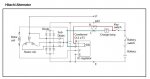
The R terminal is linked to the warning light circuit by a 50 ohm resistor inside the regulator....... The 50 ohm resistor will deliver as much current as a bub between 2.5 and 3 watts

The circuit inside the alternator is ( the coloured highlighting is mine)
Hitachialternatoredited and hilighted.jpg
 
Last edited:
...
The R terminal is linked to the warning light circuit by a 50 ohm resistor inside the regulator....... The 50 ohm resistor will deliver as much current as a bub between 2.5 and 3 watts
..
The cunning thing about using a bulb is that its resistance is quite low at low currents. When there is some voltage generated at the auxiliary diodes, the regulator can still draw some current via the bulb...
 
.....
If the bulb is too low a wattage. there is not enough exciter current, so no generation.
If it works shorting the bulb out, it would suggest that the alternator is OK but needs more exciter current than the bulb can pass.
If it's the standard bulb which has worked in the past, then the fact that the alternator needs more exciter current is probably caused by the alternator being faulty. Covering up the fault by using a fatter bulb might help diagnosis, but as a permanent fix it's liable to leave you in the lurch if the fault in the alternator gets worse.

Having woken the alternator with a bigger bulb, it would be prudent to at least check the alternator can deliver a proper current and voltage, not just enough volts to put the light out.
 
Top
