Alternator Charging Question

There are bullyboy tactics clearly shown on this thread for all to see. If you aren't in the VSR camp you are derided as a fool.

Unless you're paranoid, there are surely no "bullyboy tactics" in this thread. There's been no mention of VSRs other than by Refueler and you (and PaulRainbow who responded to Refueler's snide remark that "Everyone knows you are a VSR installer / provider").

As an aside, can I say that I fully support the idea that the 1-2-Both switch is an antiquated lump which has no place on a boat today. It's much, much easier to just have a simple on/off switch for the start battery and another simple on/off switch for the domestic batteries. No chance of getting it wrong. Nothing to remember.

And, can I also say that I've never owned a VSR in my lifetime of boating. My current boat has a low-loss splitter with 3 outputs for the start, domestic and thruster batteries.
 
Last edited:
No No ... just add a bank of switches and its all tickety boo ....

Yeh right !!

I'll just live with my crappy old system of deciding which battery to use today ..
Um!! What you suggest is what I lived with for 33 years and in some ways prefer so I am unclear on your point. Indeed I was suggesting that if you do have dedicated engine battery, then you need joining switch to give back up.

I have 3 way low loss diode splitter for current boat and it works fine though I note leisure battery has slightly lower voltage. Van has VSR and I note leisure battery doesnt charge on tickover. Both are fine as was alternator driven relay in old van. Many ways to skin a cat.
 
Last edited:
But he specifically said he doesn't want a Vsr but you still ram it down his throat

The OP has not mentioned VSRs and i've not suggested he fit one. In fact, i haven't suggested any specific split charging system for the OP, or anyone else.

My first mention of spit charging systems was post #23, where i said:

"I install VSRs, FET based splitter, B2Bs, twin alternators and all sorts of other systems and i freely give advice on the installation of all of them, including posting example schematics that no one else in the UK marine industry is prepared to do on these forums, or any other UK forum that i'm aware of "
 
Last edited:
Anyone else fancy answer my question rather that bicker at each other?

I don't entirely understand how you mean to connect the starter motor to one battery and the alternator to the other, via "switches", what switches? This doesn't sound like the correct way to connect a B2B.

I believe that having separate switches, with dedicated engine and domestic batteries is a better system, irrespective of how you charge the batteries. Post #18 illustrates an example using a VSR, the VSR can be replaced with a B2B or a low loss splitter, such as the Victron ArgoFET could be used \(the wiring is slightly different in that case.

Charging-2-Batteries-One-Engine-with-ArgoFET.png


That give three different split charging option, using separate switches. But, i'll assume for now that you'll stick with the 1-2-B switch and that you are looking for a better, automatic method of ensuring both batteries get charged, hence your thoughts regarding the B2B. Some options:

  • Connect the alternator output to the engine battery. Fit a VSR between the two banks, as per the schematic i posted earlier, post #23 This ensures both batteries get charged by the alternator, irrespective of the switch position. It also ensures that any charging source, connected to either bank, will charge both banks (subject to using a dual sensing VSR) VSR cost, £43
  • Fit a B2B, similar wiring to the VSR, you connect the alternator to the engine battery, connect the "in" on the B2B to the same place and connect the B2B "out" to the domestic battery. This ensures both batteries get charged by the alternator, irrespective of the switch position. It also ensures that any charging source, connected to the engine bank, will charge both banks, any charging source connected to the domestic bank will not charge the engine battery. B2B cost, starts at about £160 for the Victron 10a smart version
  • Fit low loss splitter, such as the Victron ArgoFET. Connects the same as the schematic above. This ensures both batteries get charged by the alternator, irrespective of the switch position. You could connect a mains charger to the "in/alt" terminal and it would also charge both banks. Doesn't work well splitting the solar controllers i tried it with. Cost, 2 output 100A version £97
 
Anyone else fancy answer my question rather that bicker at each other?

Alternator exciter is via ignition light, as long as earth is common it will be happy. probably, may be odd alternator.

B2B, no fail save to engine charge, B2B fails, flat engine battery, could be after you have been at anchor for 2/3 days with low service battery.

VSR wired to batteries, it is not isolated batteries off, battery drain, additional fire hazard

Brian
 
"Given the antiquated, stick in the mud attitude of some in this thread "

But the difference is : We are not in business to sell systems ...... we are just users quite happy with our old tried and tested systems ..

My business has nothing to do with it, i post here because i like to help out where i can. I don't make anything from posting here, in fact, as far as making money goes, it's a dead loss. Rather than wasting my time with people like you, i could be on a paid job. Let's hope the OP appreciates my time, many do.

Second - the comment about motoring around with both batterys paralleled - is that not same as a VSR would do ? Only it does it automatically and to stop it - you would have to operate a switch.

I never mentioned a VSR, didn't suggest the OP fit one, didn't suggest you fit one, didn't suggest you change your switches.

However, this just highlights your total lack of understanding. The VSR only closes when the voltage reaches a specific set point, when it falls below another specific set point. So, when certain faults develop. anyone having a 1-2-B switch set to both could lose all power, someone using a VSR would not, because the VSR would open
 
Last edited:
  • Like
Reactions: pvb
Alternator exciter is via ignition light, as long as earth is common it will be happy. probably, may be odd alternator.

B2B, no fail save to engine charge, B2B fails, flat engine battery, could be after you have been at anchor for 2/3 days with low service battery.

The B2B should be wired to the engine battery, so the engine battery always gets charged, even if the B2B fails. One of the main points of fitting a B2B is to provide a different/better charging regime for the domestic batteries. If, for instance, you have deep cycle batteries that require a higher charging voltage than your alternator outputs, a B2B will solve the issue. VSRs cannot do this.

VSR wired to batteries, it is not isolated batteries off, battery drain, additional fire hazard

Brian

Where should i wire my VSR then ?
How is it an additional fire hazard ?
If it really is a fire hazard, why do you manufacture and sell them ?
 
My business has nothing to do with it, i post here because i like to help out where i can. I don't make anything from posting here, in fact, as far as making money goes, it's a dead loss. Rather than wasting my time with people like you, i could be on a paid job. Let's hope the OP appreciates my time, many do.


I never mentioned a VSR, didn't suggest the OP fit one, didn't suggest you fit one, didn't suggest you change your switches.

However, this just highlights your total lack of understanding. The VSR only closes when the voltage reaches a specific set point, when it falls below another specific set point. So, when certain faults develop. anyone having a 1-2-B switch set to both could lose all power, someone using a VSR would not, because the VSR would open

Ignored
 
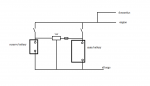
At present I have 2 on/off battery switches that allow me to choose which battery bank to use to start the engine/ run boat electric’s from. i Love the simplicity but need to remember to switch over to the domestic bank once the engine is started and the starter battery has had a bit of charge. If I connected the alternator output via one switch directly to the domestic bank and connected the starter battery via the other switch directly to the starter I could use a B 2 B charger to recharge the starter battery My question is will the get an excitement current to get going if the output is not to the same battery as the starting current?
Am I making this over complicated?
engine is MD2020D.
So to specifically answer just your question - Your alternator only needs a few volts to excite, and certainly 10v from even a flat battery will get it going. Once it is producing its own output the internal field diodes feed the field current and keep it excited.
 
Anyone else fancy answer my question rather that bicker at each other?
I basically agree with the answers in #2 and #3 but i would use a vsr and do it like this, normally using the main battery for everything.

1625003097856.png
 
How about one of these, much cheaper and I save myself lots of money, also looks simper that b2b
Cyrix Battery Combiners - Victron Energy

It's nothing like a B2B, that is a VSR, my schematic in post #23 shows how to wire it with your B2B switch. The schematic in post #18 shows how to wire it with separate switches.

If your charging sources are less than 120A, one of these will be just the job: Victron Energy Cyrix-ct 12/24V 120A Intelligent Battery Combiner - CYR010120011 This is what i referred to in post #45
 
So to specifically answer just your question - Your alternator only needs a few volts to excite, and certainly 10v from even a flat battery will get it going. Once it is producing its own output the internal field diodes feed the field current and keep it excited.
Our feed it the sparks this thread has "generated" ! (I'll get my coat !)
 
How about one of these, much cheaper and I save myself lots of money, also looks simper that b2b
Cyrix Battery Combiners - Victron Energy

That's what we have installed, on the strength of a recommendation by Paul (along with the schematic in #18 that he has posted numerous times). We have had it installed for about a year and it works very well. One variation though is that I connected it to the load side of the battery isolation switches, so that when the batteries are off (and charging) the VSR won't connect them.
 
Last edited:
Top