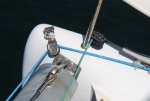
Allen Stanchion mounting block.

eddystone

Well-Known Member
Joined
18 Aug 2013
Messages
1,936
Location
North West Devon
Visit site
I've replaced a few of the original stanchion mounted running blocks for my genoa furling line with these. Yesterday another of the original ones parted company with its mounting (quite lively outside Plymouth Breakwater!) and Allen do as well as 2 versions of the block, a stanchion mounted fairlead. Apart from being a lot cheaper, this has a 600Kg breaking limit, as opposed to 280Kg for the blocks - think this refers to the joint between block cheeks and stanchion bracket. As the fairlead version is s/s lined looks to me a better solution? I've notices on smaller BenJanBavHan the furling lines just run through guides, not blocks.
 
The advantage of the one from Tranona is that you don't need to remove the guard wires to fit the Harken one.
 
I can see the advantages of the alternatives suggested but for just one think I’ll stick with what I’ve got but I’ll get the block rather than the fairlead.
 
We simply run the furling lines through the bracket at the base of the stanchion with a turning block only needed, for us, when we turn from the hull across the bridge deck. For most monohulls you should be able to run most lines direct to the bow as there are no right angle d turns and the friction (plus abrasion) if you have 'open' stanchion bases is minimal.

The problem with the blocks attached to the stanchions is that they only take one line and sometimes you need more. We have a line for a self tacking jib, the furling line for the headsail, another furling line for our screecher and then two lines comprising our anchor bridle. All these lines fit neatly into the stanchion bases, using both sides, and we have dedicated turning blocks at the bow for each line.

All our control lines pass through the stanchion bases, the black flecked line is the furling line for the screecher and the blue line is one arm, port, of our anchor bridle. The other blue line, not passing through the stanchion bases is a (spare) head sail sheet (that we use when reaching)

IMG_4862.jpeg


We have turning blocks on each bow. The green line is the headsail furling line and the spare sheave is for the sheet for the self tacker (which, the sail, is a bit of a waste of time - far too small). The blue line is the starboard arm of our bridle - the blocks for the bridle need to articulate as the bridle needs to be able to run freely well forward when fully deployed.

IMG_4868.jpeg

The green line for the furler is obvious, the floppy line with the little block runs to the end of the prodder where the screecher furler is located. The 4 blue lines represent the bridle. In strong winds the bridle would be extended well forward, offering a much longer bridle (snubber) providing more elasticity


IMG_4782.jpeg


Few monohulls are going to turn these lines through 90 degrees and turning blocks (might be neat) don't really seem necessary.

Jonathan
 
Last edited:
I've replaced a few of the original stanchion mounted running blocks for my genoa furling line with these. Yesterday another of the original ones parted company with its mounting (quite lively outside Plymouth Breakwater!) and Allen do as well as 2 versions of the block, a stanchion mounted fairlead. Apart from being a lot cheaper, this has a 600Kg breaking limit, as opposed to 280Kg for the blocks - think this refers to the joint between block cheeks and stanchion bracket. As the fairlead version is s/s lined looks to me a better solution? I've notices on smaller BenJanBavHan the furling lines just run through guides, not blocks.
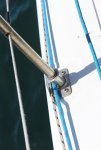
I'm not sure the system on my Sadler 32 is any improvement on yours, but for what it's worth...

My furling line runs through the bases of the stanchions. Originally there were just two blocks, both attached to the toe rail, one where the line led from the furling drum and one at the other end of the run leading to the cam cleat on the cockpit coaming.

With the run thus following a banana shape along the deck, there was considerable friction through the stanchion bases. I resolved this by adding a couple of blocks about midway between stanchions, attached to the toe rail. These are just lashed on where they best provide a straight run to the others, still through the stanchion bases.

When I replaced the previous Furlex, I got a set of the Allen stanchion mounting brackets with the new Furlex, but never used them because I didn't think they were an improvement.
 
Top