Aerogen 4 capacitors

Smith9

New Member
Joined
3 Dec 2025
Messages
5
Visit site
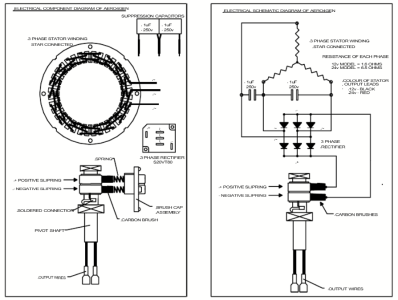
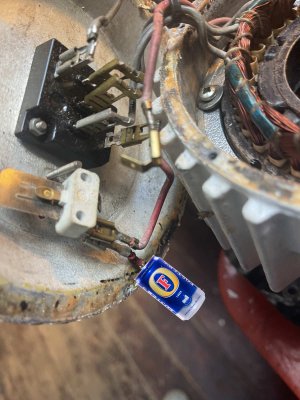
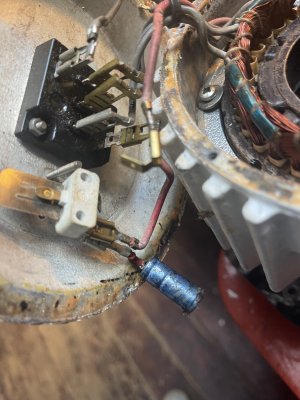
Hi. My fabulous Aerogen 4 has served me for 22 yrs. I’ve changed bearings and painted it but that’s it. It stopped working so I opened it up and found a wire broken that is connected to a blue capacitor (I think - about an inch long cylinder shape but marking are worn off ) The wiring diagram shows a couple of 1uf capacitors connected between the 3 AC phase wires. I’m tempted to just bin it and connect without as impossible to re solder. Any help or comment much appreciated. Ideally I’d love a look inside another one as, I suspect, mine isn’t a ‘standard’ arrangement.IMG_9412.jpeg
 
I would be wary of leaving out one of the capacitors. I'm not sure I properly understand the obstacle to replacing it? 1uf presumably-non-polarised axial-lead capacitors are a common part and quite cheap...
 
I would be wary of leaving out one of the capacitors. I'm not sure I properly understand the obstacle to replacing it? 1uf presumably-non-polarised axial-lead capacitors are a common part and quite cheap...
Thanks for your reply. I should have been clearer. I ‘think’ this blue thing ( guessing a capacitor) was wired in series in the positive dc out wire. There are no other capacitors. That’s the confusing thing as the wiring diagram shows 2 (1Uf) connected across the rectifier (ac in ) terminals. In an ideal world I’d love a photo of the insides of another one.
 
oh I see. Sorry, I don't think I understood clearly before. A capacitor in series in the positive out wire sounds odd to me. It does look very like a capacitor but you do get the occasional thing that is in a similar can but isn't.

I'm reasonably familiar with electronics but not, unfortunately, with the aerogen. Fingers crossed someone who's taken one apart before finds the thread.

I take it the lead is so far gone from the blue can that it's beyond testing?

You are starting to make me think your plan of simply bypassing the damaged component might not be as bad as I first thought... are you sure it wasn't just a capacitor between + and 0 to smooth any spikes?
 
oh I see. Sorry, I don't think I understood clearly before. A capacitor in series in the positive out wire sounds odd to me. It does look very like a capacitor but you do get the occasional thing that is in a similar can but isn't.

I'm reasonably familiar with electronics but not, unfortunately, with the aerogen. Fingers crossed someone who's taken one apart before finds the thread.

I take it the lead is so far gone from the blue can that it's beyond testing?

You are starting to make me think your plan of simply bypassing the damaged component might not be as bad as I first thought... are you sure it wasn't just a capacitor between + and 0 to smooth any spikes?
Unfortunately I the lead snapped from the blue thing , leaving just a brass dot ! In Addition I’m starting to question whether the broken lead actually was in series ( with the positive dc output). When you say 0 I assume you mean the negative. I might end up trying to solder a couple of capacitors (1uf 250v) to the 3 ac input wires, as per the original wiring diagram. Do you think ‘non polarised axial lead’ then ? Thanks again for trying to help !
 
Just a bit of fred drift here. But I notice in the photo a very standard 3 phase rectifier block. It would be worth while using a multimeter with "diode" test facility to check if it is as I suspect a silicon rectifier. (.7 volt drop) (1.4 between one AC terminal and a dc output terminal) (may be schottky anyway)
It seems to me that by replacing this with schottky diodes (6) you could get as lot lower volt drop from the diodes so better charge at lower wind speed. (I did this with my outboard lighting coil charger with much better charge current in to a battery)
The bridge rectifier will effectively have 2 silicon diodes in series for each path of current at .7volt drop each diode.(1.4 volts lost) Schottky diodes have something like .1 volt drop so only .2v volts lost.
Re capacitor, in my limited understanding there should be no reason to need capacitor in the rectifier circuit. Possibly a capcitor across the DC output could be useful. Not on the AC lines. You would use standard polarised capcitor (pos to pos) not a non polarised C. ole'will
Schottky Diodes - Altronics
 
Ol' Will, I take your point, but it sounds as though it's time to focus on the basics rather than potential upgrades.

Yes, a capacitor across the DC out lines would be polarised type (that is, a non polarised would work but be needlessly bulkier and more expensive). It would probably want to be bigger than 1uf though.

Caps between phases of 3 phase generation are definitely a fairly common thing and those would be non polar type, but I think their presence in this thread has turned out to be a distraction - the generator would probably work with them missing, at a small efficiency loss.

Problem is, the thing is not working. Losing a capacitor across the output won't make the device not generate power, it'll just be really rough power. I guess that might cause issues downstream, but the capacitor on its own might not be the whole story.

If this were mine I'd want to check the rectifier works and all the connecting wires are really connected. It also sounds as though there's not quite enough in the thread to be sure exactly what that broken connection is doing.

Smith9 do you think you could draw a simple diagram?
 
Ol' Will, I take your point, but it sounds as though it's time to focus on the basics rather than potential upgrades.

Yes, a capacitor across the DC out lines would be polarised type (that is, a non polarised would work but be needlessly bulkier and more expensive). It would probably want to be bigger than 1uf though.

Caps between phases of 3 phase generation are definitely a fairly common thing and those would be non polar type, but I think their presence in this thread has turned out to be a distraction - the generator would probably work with them missing, at a small efficiency loss.

Problem is, the thing is not working. Losing a capacitor across the output won't make the device not generate power, it'll just be really rough power. I guess that might cause issues downstream, but the capacitor on its own might not be the whole story.

If this were mine I'd want to check the rectifier works and all the connecting wires are really connected. It also sounds as though there's not quite enough in the thread to be sure exactly what that broken connection is doing.

Smith9 do you think you could draw a simple diagram?
Hi again and thanks for this. The generator is working ( fault was a broken slip ring carbon connection). The wire on the ‘blue thing’ fell off when I moved it ! As a result of chatting on here I’m beginning to think that it isn’t a capacitor - possibly a ‘choke’ ? - as a capacitor wouldn’t be in series with the dc positive output. Guessing this was added as a mod. There are no capacitors at all ( although 2 x 1uf 250v are shown fitted between input 3 phase ac on the wiring diagram. Also says this is ‘in later models’ so maybe before mine hence not there). I think I can either replace this ‘choke’ ( if that’s what it is to smooth spikes etc) or modify the input to the rectifier by popping the 2 capacitors on , as per diagram. Any thoughts appreciated, especially if you’ve heard of an ‘in series choke’. Cheers again, Smith
 
Hi Smith. Yes, it is definitely not a capacitor in series with the DC positive output (that would block the DC component of the output...), but it doesn't look like the chokes I am familiar with either. Series would be the right place for a choke though. It does look extremely like a capacitor! You should be OK without it and you could consider putting a new capacitor in a more usual configuration if it turns out to need output smoothing.

Glad you found the actual fault. It also sounds like basically good news that the capacitors referred to in the wiring diagram are marked "on later models" so the lack of them is not a problem.
 
Thanks. Sorry to keep asking stuff but would you know a way I could test this mystery blue thing to confirm if it’s a capacitor ( which would be baffling !) or, indeed, a choke ? Just dead curious now ! No worries if you don’t have a clue.
 
Thanks. Sorry to keep asking stuff but would you know a way I could test this mystery blue thing to confirm if it’s a capacitor ( which would be baffling !) or, indeed, a choke ? Just dead curious now ! No worries if you don’t have a clue.
Assuming a basic multimeter and you can reach the brass bit at the broken connection with the meter probe:

Try the continuity tester (beep) first. If it beeps it is either a choke, or a dead capacitor with an internal short. If it beeps and your meter has an "inductor" mode (in "henries") try setting up for that mode and see if it has a measurable inductance.

If it doesn't beep it is either a capacitor, or a dead choke with an internal break. If it doesn't beep and your meter has a "capacitor" mode try setting up for that mode and see if it has a measurable capacitance. Start at the high range. Note that not all basic meters can actually measure a capacitance as big as a large dc-output-smoothing capacitor might have, so this may not be enlightening.

You can also check if something is a cap with an LED and a coin cell...
 
Hi. My fabulous Aerogen 4 has served me for 22 yrs. I’ve changed bearings and painted it but that’s it. It stopped working so I opened it up and found a wire broken that is connected to a blue capacitor (I think - about an inch long cylinder shape but marking are worn off ) The wiring diagram shows a couple of 1uf capacitors connected between the 3 AC phase wires. I’m tempted to just bin it and connect without as impossible to re solder. Any help or comment much appreciated. Ideally I’d love a look inside another one as, I suspect, mine isn’t a ‘standard’ arrangement.View attachment 203122
I am not sure where the end of the object was connected to. It is not in series with the DC output as such but is in conjunction with what looks like a thermal (Bi-metallic) switch? What is the connection waving in the air adjacent to the rectifier? It looks like a capacitor, unusual but you can get them with "head and tale " connections, as opposed to both connections being at the same end. Sorry but from that picture I cannot be of more help. I have had a look at the aerogen 4 diagram and neither that unit nor the switch are shown. The suppresion capacitors, which you don't appear to have are shown?
Why not send the photo to aerogen and ask them? They do seem a bit elusive, perhaps someone will come up with a contact :unsure:
Edit:- May be of help? https://www.randoequipement.com/lib...QURpS_V9zAMOzyzxewg0VpSSud3IkK4Hb1y4Hg-6kCrve
 
Last edited:
I am not sure where the end of the object was connected to. It is not in series with the DC output as such but is in conjunction with what looks like a thermal (Bi-metallic) switch? What is the connection waving in the air adjacent to the rectifier? It looks like a capacitor, unusual but you can get them with "head and tale " connections, as opposed to both connections being at the same end. Sorry but from that picture I cannot be of more help. I have had a look at the aerogen 4 diagram and neither that unit nor the switch are shown. The suppresion capacitors, which you don't appear to have are shown?
Why not send the photo to aerogen and ask them? They do seem a bit elusive, perhaps someone will come up with a contact :unsure:
Edit:- May be of help? https://www.randoequipement.com/lib...QURpS_V9zAMOzyzxewg0VpSSud3IkK4Hb1y4Hg-6kCrve
It looks like a capacitor.

I suspect it may have been across the bi-metallic device you mentioned to suppress arcing at the contacts.

For the reasons already given there cannot be a capacitor in series with the DC output.

Next question is what is the bimetallic device for ?

I think I might be temped to rewire the whole thing as shown in the available owners manuals
 
Capacitance on a simple multimeter (without C check function) can often be checked by using the high ohms range. Connect across the capacitor and you will see a lowish resistance which then changes to high resistance. The capacitor charges then stops accepting a charge. If you reverse the connections you will see the same effect. Of course this only works for capcitors in the multi microfarrad range. ol'will
 
It looks like a capacitor.

I suspect it may have been across the bi-metallic device you mentioned to suppress arcing at the contacts.

For the reasons already given there cannot be a capacitor in series with the DC output.

Next question is what is the bimetallic device for ?

I think I might be temped to rewire the whole thing as shown in the available owners manuals
I think that age of the unit may be a factor in what is shown in available diagrams, due to modifications etc.
 
The full schematic, showing the two suppression capacitors on the AC output from the stator coils, is further on, on page 13:

View attachment 203179
Yup, Think that is the diod(s) Graham376 refers to. I have looked all over at all the manuals I can find online and no ref. to OP's setup:(
I did wonder if it could be part of a brake switch arrangement? but don't think so. It seems that some of the connections from that thermal switch have been removed which makes it a bit more difficult. Just to note these thermal swiches in my experience are normally associated with overloads?
 
Last edited:
Although you're sorted now, since the blue component was trashed you could just poke the insides out.

If a load of tin foil came out, it's a capacitor, if a long length of copper wire, a choke/inductor.

If beer comes out, you've got a miniature can of amber nectar.

IMG_9412.jpg
 
Last edited:
Yup, Think that is the diod(s) Graham376 refers to. I have looked all over at all the manuals I can find online and no ref. to OP's setup:(
I did wonder if it could be part of a brake switch arrangement? but don't think so. It seems that some of the connections from that thermal switch have been removed which makes it a bit more difficult. Just to note these thermal swiches in my experience are normally associated with overloads?

To brake ours, I just inserted a switch below deck to short the two wires coming down from the Aerogen.
 
Top