Advice on splicing 12-strand

BabaYaga

Well-Known Member
Joined
19 Dec 2008
Messages
2,509
Location
Sweden
Visit site
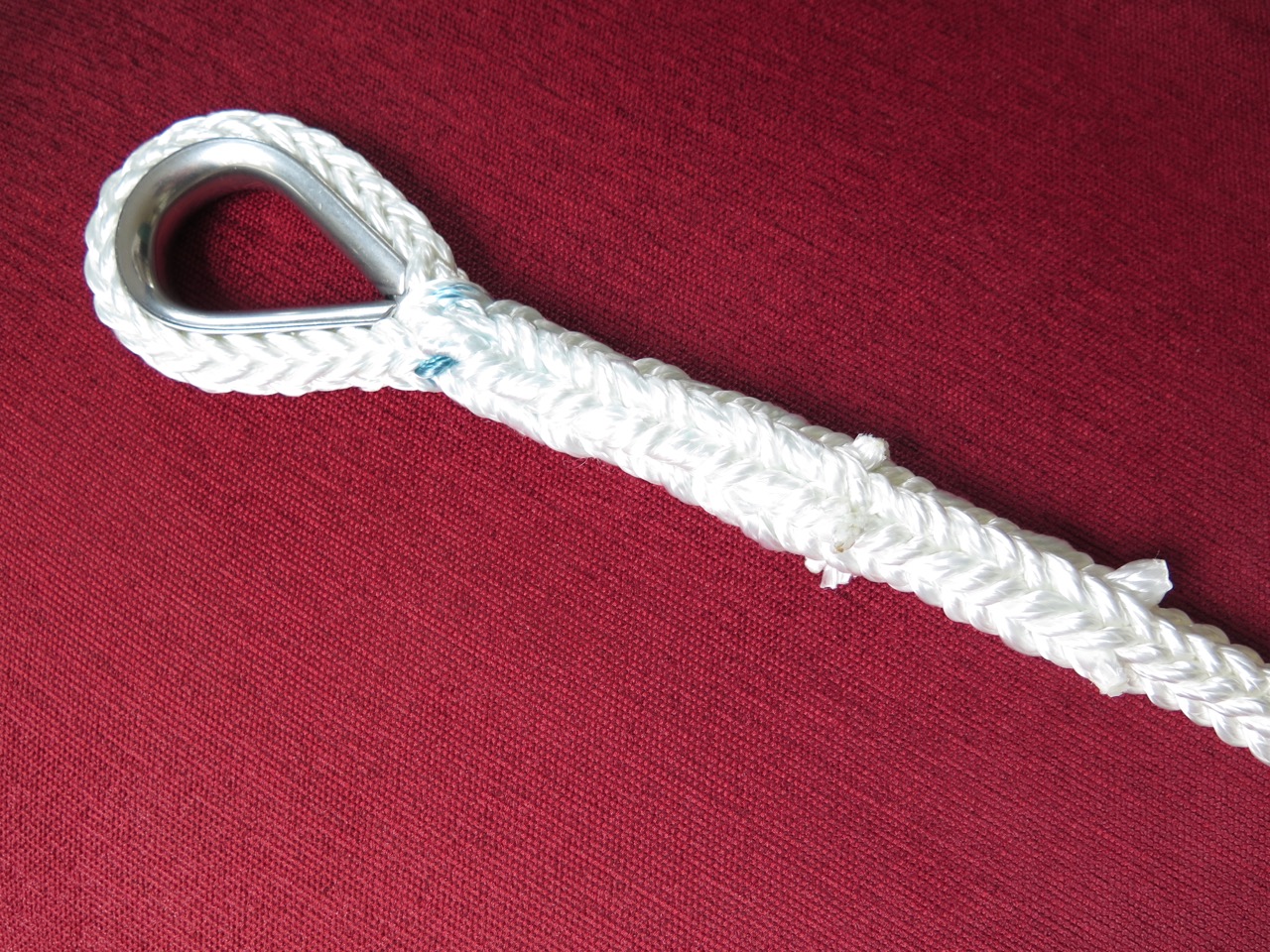
I need to make an eye splice around a thimble at the end of a new 14mm polyester anchor line, which is 12-strand braided. It looks like in the photo below and I believe the construction is called round plait.
If so, there is a splicing instruction for that type of rope to be found here
http://www.samsonrope.com/Documents/Splice Instructions/RndPlt_C1_Eye_Splice_WEB.pdf
suggesting a kind of tucking technique somewhat similar to how ordinary 3-strand is spliced.
However, there is also another type of 12-strand plaited rope (which to my eyes look very much the same as the first type) and for that rope the same website suggests a totally different splicing technique
http://www.samsonrope.com/Documents/Splice Instructions/12Strand_C1_Eye_Splice_WEB.pdf
where a reduced tail of the rope is buried in the middle of the standing part and lock stitching is used to secure it.
Does anyone have any experience of splicing this kind of rope? Any advice would be much appreciated.
IMG_7060%20%281%29.jpg
 
Last edited:
You may have found them, but in case not, splices for many ropes and tasks can be found on YouTube. Here's one of them - https://www.youtube.com/watch?v=CGo7pR8G2Oc - with others listed ( on my screen ) down the side.

I'd suggest the SECOND of the two techniques you have linked above is suitable for your purpose.

There are other approaches, including the 'Brummel locked' technique, and all benefit from previous experience. In your case I'd recommend acquiring, say, 3 metres or so of identical rope and doing a practice splice on each end.

Once you have inserted the wanted thimble and pulled very tight - and put on a couple of G-clamps or similar to hold the 'very tight' - then do the square locking stitches.
Finally, finish off with a tight whipping in polyester cord to hold the 'throat' secured. There are several different forms of whipping, and again these are shown via YouTube.

You are likely fortunate, in that being in Sweden, the best tools for this job - 'Swedish Fids' - are probably much cheaper there than here.....
 
If you can, rep!ace with octoplait.
I have the 12 strand polyester ( duo-deca plait?) on my riser and spliced hard eyes in both ends. It was a difficult job requiring an above average quota of four letter words. The splice becomes very tight to the point where it is very difficult to make further tucks and keen eyesight a must.
A job I won't be repeating.
 
I'd recommend a Brummel Splice in 12 strand, it's not hard to do, there are two forms depending on whether you have access the standing part of the rope or not. The second form where you only have access the the bitter end, is marginally more difficult.

Both splices are much easier if you have access to tubular fid, or a bit of pipe of the correct diameter, which make it much easier to slide the bitter end of the rope down the middle of the standing part, look for YouTube videos and it'll become much clearer.

Getting a tight fit round the thimble is the trickiest part, and I found using temporary whippings to hold the thimble inplace a useful method.

A good whipping around the throat (sounds a bit harsh!) is essential if the thimble is likely to see off axis loads, and a few stitches down the section of the rope where the bitter end is buried, gives a bit of extra security, especially if the spice is going to vibrate under no load. It locks solid when loaded.

I've used 12 strand for many functions on my boat and have literally dozens of Brummel splices, including one in the Dyneema D12 main halyard.
 
My experience was with round plait where splices such as the Brummels are not an option. I'm sure Brummels are perfectly good for the other types of construction and if the rope is loosely woven, so much the better.
 
Many thanks for the replies so far.
I will have to sit down and delve a bit deeper into Brummels and other things unfamiliar to me. Will report back...
 
I have done a few for our mooring holders. the principle is similar to 8 strand except that you cannot get right around the outside at the start. my solution is to pass half the strands through the middle of the rope at the start of the splice then these can run down one side of the rope & the others can run down the first side. Rather than tuck single strands it is easier to tuck pairs.. When you get 5 tucks down grip the strands in long nosed pliers, 2 at a time & role the strands round the pliers so you draw the strands down really tight against the thimble. As you roll the pliers it puts tension on the strands which pulls tighter than you can do by normal pulling.
 
12 strand unpaired line is mind-blowingly awkward.

If you have the paired 12strand it is much easier. Here's my mooring pennant in 12 strand (paired) nylon.

ulIpNLo.jpg
[/IMG]

Serving (or taping) the standing and running parts as close to the throat of the eye is the only way to get a close fit.


I really would not like to splice copolymer (polysteel) rope.
 
Last edited:
Out of interest, I asked Marlow's technical department what kind of splice they'd recommend for 12 strand polysteel, here's their answer, from their technical manager.

"The 12 strand polysteel can be spliced by the Brummel splice as you would for a 12 strand Dyneema type rope. In the larger sizes this can get difficult though, in that case the rope can also be spliced with a 12 strand tuck splice method."

Marlow make polysteel in the following sizes:

12mm 18mm 22mm 24mm 28mm 32mm 36mm 40mm 44mm 48mm 52mm 56mm 60mm 64mm 68mm 72mm 76mm 80mm 88mm 96mm

I've successfully spliced polysteel in 12mm and 18mm sizes for mooring ropes, using a Brummel splice.

I've also used a brummel splice in 14mm round ropes designed for moorings, although I can't remember the manufacturer.

Samson recommend a 12-STRAND CLASS II splice for Amsteel and Amsteel Blue, this is not a Brummel splice, but you bury the bitter end inside the standing part of the rope without the locking tucks of a Brummel splice, the buried part is tapered and the whole length of the tapper is stitched with a locking stitch. I've never used Amsteel Blue, but the class ll splice looks a lot easier the a tuck splice method, which I've found very time consuming.

If you need conformation of the above check out the manufacturer websites.

I don't know the manufacture of the OP's rope is, but at 14mm 12 strand, I'd be surprised if you couldn't use either a Brummel splice or a Samson class ll splice, both of which in my experience are much faster and easier than a tuck splice.
 
Thanks again for your replies. In the end I decided to try option number one.
http://www.samsonrope.com/Documents/Splice Instructions/RndPlt_C1_Eye_Splice_WEB.pdf
The result wasn't too bad for a first attempt, I think, but I could have made the eye just slightly smaller, to get a tighter fit around the thimble.
Trickiest part was routing the six paired strands into the standing part (step 4a and 4b), avoiding the subsequently introduced from interfering with those already in place. Failed twice getting this right, my 50m length is now 48,5m...
Then tucking down the standing part was easy in comparison.

splice.jpg
 
Top