Advice on choosing outboard for sailboat with engine well

On our previous 23 foot Pegasus 700 we had a Tohatsu 6hp extra long sail drive, clearly not short enough for your original request BUT when the swell picks up it keeps the prop well submerged providing good solid drive. Someone mentioned reliability, well on several occasions it ran for 12-14 hours none stop due to lack of wind. When we left the boat we would lift it out and store it in the cabin.
 
The standard shaft length works nicely in the well of an Anderson 22. I've never had it come out of the water in a chop.
People have used 6hp engines but they seem very heavy at least on paper, and that last 1hp doesn't get used often I suspect.
The key thing with 2 strokes seems to be to run them fairly hard to keep the plug clean. If going along a river or canal for hours I'd probably want a 3.5hp 4 stroke because the noise does get wearing after a while !
 
The standard shaft length works nicely in the well of an Anderson 22. I've never had it come out of the water in a chop.
People have used 6hp engines but they seem very heavy at least on paper, and that last 1hp doesn't get used often I suspect.
The key thing with 2 strokes seems to be to run them fairly hard to keep the plug clean. If going along a river or canal for hours I'd probably want a 3.5hp 4 stroke because the noise does get wearing after a while !
With the current batch of 4-6hp 4 strokes the engines are the same just some internals different so they are all about 26kg with minimal difference between the weight of a 4hp and a 6hp.
 
The fumes never really bothered me, but it was noisy.

Aboard my Achilles, the two-stroke fumes accumulated in the cockpit one calm morning until the engine couldn't draw enough clean air to keep running, and it cut out. I thought it was something wrong that would need a mechanic's knowledge to fix, until I realised the atmosphere was intolerable - choking. A minute spent wafting the smoke out of the cockpit, then the engine restarted easily. But an engine well in the bottom of a deepish cockpit has that disadvantage in very still conditions, and it won't do the crew any good.

...something like the 5hp 2 stroke Mariner.

Mine was one of those, a long shaft. At 20kg, it seemed to me such a heavy and awkward thing that despite the Achilles owners' forum promising how much better the boat sailed with the engine removed and the well-plug in place, I never bothered. An engine well seems cleverer than a transom bracket, but having actually used one, I'd prefer a transom mounting next time, and tilt the engine up to stay out of the water. The presence (bulk), noise and fumes of the engine in the cockpit are much less agreeable than its alleged advantages justified, for my purposes.

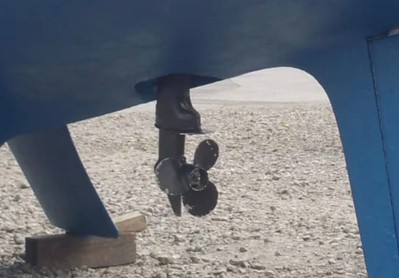
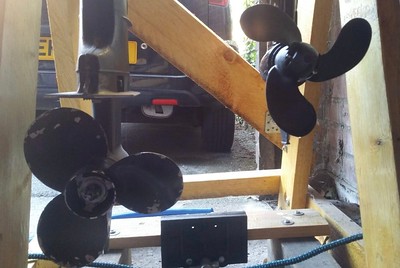
That's not to say anything against the 2-stroke Mariner, which was reassuringly solid and powerful. I also bought a two-stroke Tohatsu 3.5hp short shaft (13kg), in case the Mariner ever let us down, which it did not. But when I tested the smaller engine I was impressed by its adequacy for the job, even with its short shaft, against what I had been told to expect. The long shaft Mariner stuck far down below the hull...

52679795920_e2eb8492f5_w.jpg
52679645239_bd3c35c84b_w.jpg


...relative to which, even the short shaft Tohatsu's prop was properly submerged, as the props' relative depths suggest when aligned on a bench.

On that basis, as well as the virtually unanimous advice of other Achilles 24 owners, I'd recommend the smallest two-stroke engine that is up to the job. The Anderson 22 is said to be equally competent under sail, therefore little of its use may be anticipated to be under power, justifying a smaller unit. Assuming you only intend to use the auxiliary to navigate non-sailing areas, any bigger engine becomes a royal pain to move and stow. (y)
 
Aboard my Achilles, the two-stroke fumes accumulated in the cockpit one calm morning until the engine couldn't draw enough clean air to keep running, and it cut out. I thought it was something wrong that would need a mechanic's knowledge to fix, until I realised the atmosphere was intolerable - choking. A minute spent wafting the smoke out of the cockpit, then the engine restarted easily. But an engine well in the bottom of a deepish cockpit has that disadvantage in very still conditions, and it won't do the crew any good.
The cockpit filling with fumes is an odd thing, as the exhaust is supposed to exit below water level so presumably surfaces in the wake - but I have had something similar, which turned out to be the rubber grommet around the gear operating rod vanishing into another dimension, so allowing fumes up into the well. Took some head scratching to find that out.
I wonder if the extra depth of immersion given by a well causes more back pressure so forcing gasses out of any gaps above the water rather than down and away as intended
 
The cockpit filling with fumes is an odd thing, as the exhaust is supposed to exit below water level so presumably surfaces in the wake - but I have had something similar, which turned out to be the rubber grommet around the gear operating rod vanishing into another dimension, so allowing fumes up into the well. Took some head scratching to find that out.
I wonder if the extra depth of immersion given by a well causes more back pressure so forcing gasses out of any gaps above the water rather than down and away as intended
On my Etap, there is a similar engine well with a large rubber "bung" which surrounds the engine leg. However, the rear leg of the engine is tapped with a flexible exhaust hose which exits through the stern of the boat. This is a factory fitting and eliminates fumes in the cockpit. Maybe something like this could be adapted for your boat?
 
On my Etap, there is a similar engine well with a large rubber "bung" which surrounds the engine leg. However, the rear leg of the engine is tapped with a flexible exhaust hose which exits through the stern of the boat. This is a factory fitting and eliminates fumes in the cockpit. Maybe something like this could be adapted for your boat?
With my engine the gasses should all exit out of the prop, and only water from the telltale above that, so unless one's grommet has disapparated no gas should exit into the well. Other engines may be different of course.
I have considered a shaped bung but it would be considerable effort for the short time I use the engine - I can sail off the mooring and after some attempts back on!
 
The cockpit filling with fumes is an odd thing, as the exhaust is supposed to exit below water level so presumably surfaces in the wake

Good point. I'm confident that the Mariner's exhaust was well submerged under way, emerging astern, but on the occasion I described we were just warming up at the dock with no wind at all. The exhaust must have floated back up and filled the well, becoming concentrated in the space above it.
 
Hi
I’m not too familiar with the modern versions of such engines, but certainly with reference to the comparable models years ago, the difference between a sail model and a normal model would be;
Sail model often or perhaps always had a longer shaft. Likely deemed an extra long shaft and a few inches longer than a normal long shaft
Sail model would usually have a larger diameter but less pitch on the prop compared to a normal model, with more capability in terms of slow speed manoeuvring and thrust from a standstill. Some models even had a lower ratio gearbox to accomplish such a thing too. More often seen on the larger models around 8hp + perhaps.
Charging output as you mention, but not that it should be considered anything other than a trickle charge or even next to nothing at all, unless she has some real throttle open on her.

But as you say…such things aren’t always required. The most important thing about it all, is that the engine has the ability to have its lower unit deep enough to have a free flow of undisturbed water to its prop without ventilation. You can re pitch the prop if need be..
As for the charging, if it’s a box to be ticked…many outboards have the ability to do this but not enabled or fitted out with the kit to do it. And almost all certainly have the ability or have such a thing fitted as standard above around 8hp.
 
Engine wise you are basically looking at the 4-6 hp range as other have said they are basically the same unit just different carb or jets. The main issue with 4strokes is the increased size in the well, bearing in mind the boat would have been designed for a smaller lighter 2stroke.

Anything smaller than a 4hp won't have a reverse gear, so unless you have the space to spin the engine these are not really going to work.

Sail drive, not really needed, you can swap the prop for a higher thrust one if required, the output from the coil is not really much use for charging, you would be better with a solar panel.

Leg length wise, in a well a standard shaft should be fine, there was an issue with some offset designs (hunters) where because the engine was not on the centreline, depending on the crews location / the boat heeling it caused the prop to be out of the water. I had a well on my super seal and swapped a long shaft for short as I had issue with the exhaust being bogged down due to the longer leg.
 
With my engine the gasses should all exit out of the prop, and only water from the telltale above that, so unless one's grommet has disapparated no gas should exit into the well. Other engines may be different of course.
I have considered a shaped bung but it would be considerable effort for the short time I use the engine - I can sail off the mooring and after some attempts back on!
2 strokes suffer from back pressure and there is a relief hole in the leg to try and deal with that. Does not take long for enough exhaust gas to escape from there to fill the well. Worse when you are standing in the rear of the cockpit and the stern sinks a bit so the back pressure increases. The nose referred to in posy#26 used by Etap is a solution
 
Top