
Adding fuses to my batteries

Phil_boat

Well-Known Member
Joined
6 Jul 2025
Messages
114
Visit site
My boat is a bit lacking in fusing on the batteries...

My batteries are under aft cockpit and have chunky cables running forward a couple of metres to the isolators. I'd be happier with some fuses on the battery terminals.

I've found these from 12v Planet Horizontal Positive Battery Terminal Clamp For Cube Fuses

which on the face of it look ideal, except it's a petrol boat so think I should probably use ignition protected MRBF fuses? Or are the normal cube fuses OK?

And for the domestic battery a 60A should be plenty - I only have basic electrics.

The engine battery though I'm struggling to find what size I'd need. It's a 200HP Suzuki outboard, I'd guess around 200A? (I will measure the cable and check I don't go above the cable rating).

Here's a pic illustrating why it concerns me, there's no fuse before this lot and it would be catastrophic if they shorted out. (I guess this is quite common on boats though?)
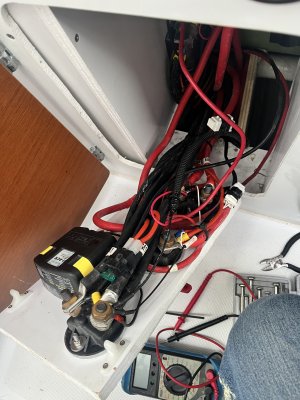
IMG_5762.jpeg
 
I kind of disagree with that for the main cable fuse. if adding everything together that could be switched on totals 50 amps max I would stick to a 75 amp fuse. A fuse should blow at the first sign of a short not at the cable rating. Some very heavy cables are rated for 100s of amps and could do a lot of damage to equipment if allowed to carry that sort of load. If my depth sounder burns 3 amps but the cable is good for twenty amps I am putting in a 5 amp fuse to protect the equipment not the cable.
 
I kind of disagree with that for the main cable fuse. if adding everything together that could be switched on totals 50 amps max I would stick to a 75 amp fuse. A fuse should blow at the first sign of a short not at the cable rating. Some very heavy cables are rated for 100s of amps and could do a lot of damage to equipment if allowed to carry that sort of load. If my depth sounder burns 3 amps but the cable is good for twenty amps I am putting in a 5 amp fuse to protect the equipment not the cable.
Technically, Paul is correct. I prefer, like you, to use a smaller fuse. If 'kit' comes off a main cable, the kit should have it's own fuse to protect it a bit like a 13 amp rated plug would have a small fuse to protect the wire to a table lamp.
 
I kind of disagree with that for the main cable fuse. if adding everything together that could be switched on totals 50 amps max I would stick to a 75 amp fuse. A fuse should blow at the first sign of a short not at the cable rating. Some very heavy cables are rated for 100s of amps and could do a lot of damage to equipment if allowed to carry that sort of load. If my depth sounder burns 3 amps but the cable is good for twenty amps I am putting in a 5 amp fuse to protect the equipment not the cable.
You have a very poor understanding of electrical installations.

Battery cables on the typical small-medium boat are 35mm, rated at 240A, fuse them at 200A-240A. The engine battery cable goes to the engine isolator switch, with a link wire to the emergency parallel switch, then to the engine, it needs a big fuse. A lighter cable will come off of the circuit somewhere for the instrument panel, it's fused with a smaller fuse.

The domestic battery is also 35mm and fused as above. It goes to the domestic isolator switch, but also has a link wire to the emergency parallel switch. If you fit a low rated fuse at the domestic battery you can't use it for engine starting. In addition, some installations will also have a bow thruster, windlass, inverter etc running from the domestic bank, a small fuse won't cut it. From the isolator it goes to a busbar, anything being taken off of the busbar will be fused with lower rated fuses, according to the cable sizes. Heavy loads, using heavy cable, will also be fused accordingly. There will be a cable going to a fuse panel, switchboard etc, this is also fused for the cable. One at the fuse board or switch panel individual cables are again reduced in size and fused accordingly.

Just because a 200A fuse is used at the battery it doesn't mean that's for you depth sounder, unless an idiot wired your boat. No matter what the fuses are they won't damage your equipment, if the short is internal, the equipment is dead anyway, unless it has internal fuses, maybe. There are some exceptions, such as windlasses, bow thrusters and heavy, motor driven loads, that can be overloaded, in which case thermal circuit breakers should be used.
 
Last edited:
Technically, Paul is correct. I prefer, like you, to use a smaller fuse.
But you don't just have a 200A battery fuse protecting all of the circuits, it only protects the battery cables, up to the point they change to smaller cables.
If 'kit' comes off a main cable, the kit should have it's own fuse to protect it a bit like a 13 amp rated plug would have a small fuse to protect the wire to a table lamp.
There you go ;)
 
I will keep using relevant fuses to suit the amps draw of my equipment. If it draws 3 amps then a 5 amp fuse and if it draws 20 amps then a 25 amps fuse and so on, I am capable of thinking for myself, working things out for my self and leave the books for those who cant.
 
I will keep using relevant fuses to suit the amps draw of my equipment. If it draws 3 amps then a 5 amp fuse and if it draws 20 amps then a 25 amps fuse and so on, I am capable of thinking for myself, working things out for my self and leave the books for those who cant.
Do you get many fuses blowing for no reason? What about inductive loads, start up surge, higher current flow when battery volts low eg if your resistive device is drawing 20 amps at 13.5v, then it will draw 25 amps when the batteries are at 10.8v.

What sort of fuses? Fast acting, ultra rapid, slow blow? A slow blow fuse might tolerate an overcurrent of 2 or 3 times as much until it blew. There are lots of reasons not to use fuses in this way. You may well find delicate electronics has it's own methods of protection, inc physical fuses, inside the box.
 
I will keep using relevant fuses
That would be the correct way of selecting fuse, problem is, you don't know how to work out what fuses are relevant.
to suit the amps draw of my equipment. If it draws 3 amps then a 5 amp fuse and if it draws 20 amps then a 25 amps fuse and so on, I am capable of thinking for myself, working things out for my self and leave the books for those who cant.
Unfortunately, you have clearly demonstrated that you cannot work things out for yourself, for instance, you couldn't grasp that the main battery fuse rating has nothing to do with protecting your depth sounder. Perhaps you should buy a book or two ?
 
Ah, I hadn’t considered the (not yet fitted but planned) emergency connect. So yes that makes sense to go bigger on the domestic as well.

And had forgotten the windlass runs from it (bow thruster had its own battery).

And I’m asking about the main battery fuses. I have a fuse box with blade fuses that most things are connected to with the odd wire straight off the isolators, which I’ve made sure are now all fused.
 
Last edited:
And can I use those normal cube fuses or should I go for MRBFs? That would require some new 8mm lugs and a hydraulic crimper.

Batteries in front of lazarette, fuel tank boxed in at the back of the laz.
 
I will keep [doing it wilfully wrong], I am capable of thinking for myself, working things out for my self and leave the books for those who cant.

It’s drivel spouted like this that has three significant knock on effects;

1) it devalues the the overall value of the forum by having to weed out this as against a the other, correct posts.

2) It opens your nonsense to be fed into a AI engine which then may regurgitates it out to an unsuspecting individual

3) makes insurance harder for the rest of us who do DIY correctly and by the book.
 
Ah, I hadn’t considered the (not yet fitted but planned) emergency connect. So yes that makes sense to go bigger on the domestic as well.

And had forgotten the windlass runs from it (bow thruster had its own battery).

And I’m asking about the main battery fuses. I have a fuse box with blade fuses that most things are connected to with the odd wore straight off the isolators, which I’ve made sure are now all fused.
Why do you have "Odd" wires coming off the isolators:unsure: Fused or not it is bad working practice, all the stuff like that should be in a fuse box/Panel and properly ID'd.
Some may say it doesn't matter but we all have differing standards:p
 
Why do you have "Odd" wires coming off the isolators:unsure: Fused or not it is bad working practice, all the stuff like that should be in a fuse box/Panel and properly ID'd.
Some may say it doesn't matter but we all have differing standards:p

I’m just guessing but the boat was built without them and also without an engine. Dealer(?) fits the engine and for ease connects the ECU / Control wires to the back of the isolators with inline fuses.

Previous owner adds another toy and because the proper fuse box is awkward to get to decides to also add them to the back of the isolators.

I have a plan to really tidy it up but that’s not a job for this winter. I think I’ve added fuses to everything now (apart from batts & VSR) so apart from being untidy isn’t unsafe.
 
Last edited:
And can I use those normal cube fuses or should I go for MRBFs? That would require some new 8mm lugs and a hydraulic crimper.

Batteries in front of lazarette, fuel tank boxed in at the back of the laz.
You need ignition protected fuses MRBF stands for Marine Rated Battery Fuse, of which there are more than one type, for instance : Battery Terminal (Cube) Fuses | 12 Volt Planet
 
I’m just guessing but the boat was built without them and also without an engine. Dealer(?) fits the engine and for ease connects the ECU / Control wires to the back of the isolators with inline fuses.

Previous owner adds another toy and because the proper fuse box is awkward to get to decides to also add them to the back of the isolators.

I have a plan to really tidy it up but that’s not a job for this winter. I’ve think I’ve added fuses to everything now (apart from batts & VSR) so apart from being untidy isn’t unsafe.

Actually a lot of outboard engine installation guides will suggest/insist you connect the engine directly to the battery, bypassing even a battery isolator switch. So the dealer hasn’t done anything wrong and it was possibly even required for the warranty sign off.

The manufacturers certainly advise against fitting any sort of fuse in the wire.

The argument is that with modern electronically controlled engines losing power suddenly could cause bad things to happen.

In my opinion it’s complete bollocks and I added both isolators and fuses to my old Verado 250 engine. However, you will get lots of diehards waffling on about “clean power” for the ECU or similar. Here’s the first example I found on a Google search: https://www.thehulltruth.com/boating-forum/844279-verado-dts-harness-setup.html
 
Top