
Adding extra leisure battery

scruff

Well-Known Member
Joined
2 Mar 2007
Messages
1,171
Location
Over here
Visit site
On our boat we have 2 batteries - both 110ah deep cycle leisure batteries connected to the 1/2/both switch.

In normal use we use battery 1 one domestic loads and battery 2 in reserve for engine starting. "Both" is enabled to start engine and kept at "both" until engine has been stopped.

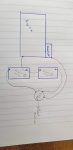
The alternator output is connected to the 1/2/both switch also - see attached schematic "Existing Setup".

I'd like to replace one of these leisure batteries with a bog standard van starter battery and have 2 batteries for domestic loads.

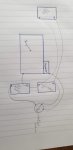
My thought is to put the new van starter battery connected to "2" and both leisure batteries linked in parallel and connected to "1". In practice the two domestic batteries will be 2m apart, one in the existing engine box and the other in a new battery box in the after cabin under the bunk see attached schematic "Planned Setup".

Does this seem like a reasonable proposition?

Thanks
 

Attachments

  • Existing Setup.jpg
    Existing Setup.jpg
    30.4 KB · Views: 41
  • planned set up.jpg
    planned set up.jpg
    31.3 KB · Views: 40
It's not how I'd suggest building a system from scratch with the same batteries, but it's a reasonable retrofit and quite common on older boats.

Pete
 
On our boat we have 2 batteries - both 110ah deep cycle leisure batteries connected to the 1/2/both switch.

In normal use we use battery 1 one domestic loads and battery 2 in reserve for engine starting. "Both" is enabled to start engine and kept at "both" until engine has been stopped.

The alternator output is connected to the 1/2/both switch also - see attached schematic "Existing Setup".

I'd like to replace one of these leisure batteries with a bog standard van starter battery and have 2 batteries for domestic loads.

My thought is to put the new van starter battery connected to "2" and both leisure batteries linked in parallel and connected to "1". In practice the two domestic batteries will be 2m apart, one in the existing engine box and the other in a new battery box in the after cabin under the bunk see attached schematic "Planned Setup".

Does this seem like a reasonable proposition?

Thanks
Put your two lesre batteries next to each other and interconnect with short cables ( make the positve connection on one and the negative connection on the other,)

Put your new engine start battery in the new location.

Personally I'd connect the engine start battery to position 1 on the switch and te house bank to position 2.

Start the engine with 1 selected, allow it time to recharge then switch to "2" via the both position. Stay on "2" until you next want to start the engine ot to switch eveything off to leave the boat

Golden rule with a 1,2 both switch is "ONLY THE SKIPPER IS ALLOWED TO TOUCH THE BATTERY SWITCH"

Better idea ... Separate the electrical systems fit separate isolators and an emergency crossover switch Use a VSR to enable both batteries to always charge. Find some sucker who will buy the 1,2 both switch
 
The possible danger with fiddling with the switch while the motor is running is that if you inadvertently go to 0 you could damage the alternator.

The set-up on mine is what it came with and has some sort of splitter to which the alternator is connected (the splitter is Dutch and so is the handbook - others here might know what it's called) with one output going to the engine battery and one to the house bank, presumably according to need. Voltage sensitive relay?

The switches (one for house, one for engine) have nothing to do with charging, they merely isolate the batteries from any part of the circuit.
 
I combined my 2 /110 a/h batteries as my domestic bank and added a Red Flash starter battery.

Now don't shout at me because I like my 1/2/both switch and have had them on three boats now for many years. As Vic says I use 1 as my start position and after 10/15 minutes or so switch to no 2 position. I like being able to control my charging regime myself.
I tried a VSR but it kept "hunting" switching back and forth so I gave up on it.

When my engine is warm I don't bother switching back to no 1 but start using the domestics saving a trip below.

My Numax sealed batteries lasted 8 seasons using this regime and I replaced them with the same although they are now marked as 105a/h not 110a/h
but seem the same.
 
Put your two lesre batteries next to each other and interconnect with short cables ( make the positve connection on one and the negative connection on the other,)

Put your new engine start battery in the new location.

Personally I'd connect the engine start battery to position 1 on the switch and te house bank to position 2.

Start the engine with 1 selected, allow it time to recharge then switch to "2" via the both position. Stay on "2" until you next want to start the engine ot to switch eveything off to leave the boat

Golden rule with a 1,2 both switch is "ONLY THE SKIPPER IS ALLOWED TO TOUCH THE BATTERY SWITCH"

Better idea ... Separate the electrical systems fit separate isolators and an emergency crossover switch Use a VSR to enable both batteries to always charge. Find some sucker who will buy the 1,2 both switch

I agree with all of this.

Only thing i'd add, if staying with the 1-2-B switch, fit a VSR so you don't have to mess around with the charging.

Oh, don't leave the switch on the both setting.
 
The possible danger with fiddling with the switch while the motor is running is that if you inadvertently go to 0 you could damage the alternator.

The set-up on mine is what it came with and has some sort of splitter to which the alternator is connected (the splitter is Dutch and so is the handbook - others here might know what it's called) with one output going to the engine battery and one to the house bank, presumably according to need. Voltage sensitive relay?

The switches (one for house, one for engine) have nothing to do with charging, they merely isolate the batteries from any part of the circuit.

Almost certainly a split charge diode. Something like this:

D70A2.JPG
 
Connecting 2x12v batteries in series will create a 24v supply. Does your boat run on 24v if its 12v the batteries need connected in parallel.
 
Almost certainly a split charge diode. Something like this:

D70A2.JPG
Similar, inasmuch as it has three terminals as I recall. What's the difference between a split charge diode and a voltage sensitive relay please? I ask because I've recently fitted a humungously expensive Mastervolt 50 amp mains charger which has three output channels, of which I only use two, but despite the book hinting that they're separate and independent I can't see that they are - there's only one temperature sensor which is on one of the two house batteries, and whatever the charger pushes out whether in bulk, abosorption or float seems to go to the house and starter batteries in equal measure. Maybe I need something to sense need on either side and dispense juice as required?
 
Oh, don't leave the switch on the both setting.

Without wanting to miss something obvious, but why?

I can see the risk or running both batteries flat if kept at "both" when engine off and subsequently not being able to restart the engine, but why not keep at both when engine running? Presumably once engine battery fully charged, all the alternator output will be flowing into domestic battery?

Happy to be corrected tho
 
Similar, inasmuch as it has three terminals as I recall. What's the difference between a split charge diode and a voltage sensitive relay please? I ask because I've recently fitted a humungously expensive Mastervolt 50 amp mains charger which has three output channels, of which I only use two, but despite the book hinting that they're separate and independent I can't see that they are - there's only one temperature sensor which is on one of the two house batteries, and whatever the charger pushes out whether in bulk, abosorption or float seems to go to the house and starter batteries in equal measure. Maybe I need something to sense need on either side and dispense juice as required?

The split charge diode is actually a pair of diodes, one for each battery/bank. The input from the alternator connects to both diodes and one diode connects to each bank, they only allow current to pass in one direction, so they allow the alternator to charge both banks, whilst preventing current from flowing from one bank to the other, stops you draining the engine battery with the ice maker when you're at anchor. it only splits the charge from the alternator and has no bearing on mains charging.

Your mains charger may just have three diodes in it, to allow it to charge three banks separately, whilst preventing one to drain to another. It also might have two outputs for domestics and a trickle charge for the engine, depending on the model. Either way, no connection to the split charge diode and no need for a VSR.
 
Connecting 2x12v batteries in series will create a 24v supply. Does your boat run on 24v if its 12v the batteries need connected in parallel.

His diagram shows them connected in parallel, although incorrectly. There should be a negative connection to one battery and the positive should come from the other.
 
Without wanting to miss something obvious, but why?

I can see the risk or running both batteries flat if kept at "both" when engine off and subsequently not being able to restart the engine, but why not keep at both when engine running? Presumably once engine battery fully charged, all the alternator output will be flowing into domestic battery?

Happy to be corrected tho

It's possible for a fault to happen whilst using the both setting that would leave you with no power. using the switch on 1 or 2 prevents this possibility, adding a VSR (or a split charge device of your choosing) means there is no need to fiddle with the switch for charging.
 

Other threads that may be of interest

Top