Adding a push button starter to a keyed switch panel

  • Thread starter Thread starter Mark Turner
  • Start date Start date
On my boat the alarm does not sound when the "lights are on", only when tested, and I'm happy to have the key in that position with the engine off, and so ready to go "on the button" when the Queen's Harbour Master insists I have to have my engine running.

It sounds as though I can rig something up to test before I make holes in the cockpit to take the button so I'll give it a go. That's one job on the to do list that I can half tick as now knowing what to do. I'll report back when I've done it, but for now, thanks.
Been wondering about this, and I don't think it's a great idea to have the panel switched on for hours when you're not using the engine. There isn't an alarm problem, but there will be a (small) drain on the starter battery all the time the panel's on. I'd be much happier to have a remote on/off switch (just wired in parallel with the key switch) as well as a remote starter button.

But at the end of the day, this is merely papering over the cracks, what you should do is move the switch panel somewhere more convenient. Then you'd be able to see gauges/warning lights as well.
 
But at the end of the day, this is merely papering over the cracks, what you should do is move the switch panel somewhere more convenient. Then you'd be able to see gauges/warning lights as well.[/QUOTE]

Pvb - you are right, located where they are the instruments are wasted when I'm single-handed and I've thought about moving the lot, but its not easy to see where they might go - perhaps next winter it will get onto my to do list.

Mark
 
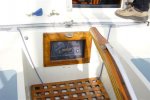
I'd second moving the panel into the cockpit. My own is in a small recess on the companionway face (forward end of the cockpit), with a perspex panel over it. It's quite convenient except that to see the panel I have to squat - but that's better than having to go into the cabin. your thread has reminded me that I have long meant to fit a remote start button in the engine compartment! Thank you.

cockpit.JPG

Rob.
 
I moved just the key switch from the instrument panel to a position just inside the companion way, housed inside a small weatherproof box I can easily reach it without

going below . I also made a small cockpit panel to repeat the engine warning lights simple job using red led panel lights 50p each.
 
So, based on the advice received above I opted for a half way house this season. I installed a second key switch (genuine Volvo Penta second hand from The Chandlery Barge) rather than a push button in a sheltered but convenient positon close to the helms position and was deighted that when switched on it turned over the engine. Somewhat less delighted to report that now the boat is back in the water I can't remember where I put the key!
 
This thread has inspired me to add the job of moving the engine control panel to somewhere more accessible from the helm to the to do list. Two switches, two warning lights and the Tiny Tach, copying the idea I've seen on a number of boats where the bit you don't need to touch is covered by pespex*.

However, I may just leave the key below and use it as a security switch, controlling power to the outside panel.

*Bugger. I had a clearout of my workshop and a perfect lump of perspex that's been hanging around for years went in the bin last Sunday :( :( And some UPVC sheet that would have been ideal for the box :( :( :( And the dustmen came round yesterday :( :( :( :(
 
Having the engine 'ignition' turned on with a diesel without the engine running should illuminate the alternator charge light and the oil pressure light. If there is an alarm circuit there should be a low oil pressure instigated alarm. An electrical rev counter will be energised but obviously not indicating.

When the engine is running the 'idiot lights' for oil and alternator should go out.

So leaving the key turned on without the engine running is of no consequence except that bulbs may eventually blow if left on indefinitely.

The alternator will be receiving a field current from the charge light so some heat may be generated in the alternator but it should be well within spec.

The biggest problem is the alarm sounding all the time unless you have some fancy circuit that only enables the alarm after the actual start up. Not seen one of those.
 
No need for fancy wiring or a key switch. Wire a simple on-off switch at remote position in series with the main feed to the panel. Switch the main panel on at the key switch leaving the remote switch off until you want to start the engine using your push to make switch, this way you have no current drain from warning lights or the alternator. One down side, this switch would need to be on to start the engine with the key switch, look at it as added security. The extra length of wire to the remote on-off switch may introduce a small volt drop, but unless the original is right on the limit I doubt it would present a problem. The remote on-off switch and its wiring would need to be rated for the full load draw of the panel and its feeding fuse. It may be simpler to break the panel feed circuit at the fuse, which may be nearer to the remote position?
 
The biggest problem is the alarm sounding all the time unless you have some fancy circuit that only enables the alarm after the actual start up. Not seen one of those.

You have obviously not got too involved with BUKHs then :D They (at least all I have encountered) have some basic resistor-diode logic which does just that. Problem is it is notoriously troublesome (often due to corrosion on the little circuit board) and leads to all sorts of confusion. (I have rewired mine in the normal basic fashion!).
 
Top
