Adding a fitting to a cored GRP deck

Kukri

Well-Known Member
Joined
23 Jul 2008
Messages
15,562
Location
East coast UK. Mostly. Sometimes the Philippines
Visit site
I apologise in advance if this is old hat but I am coming from fifty years of wooden boats. I am looking at my copy of Du Plessis, fifth edition, page 140:
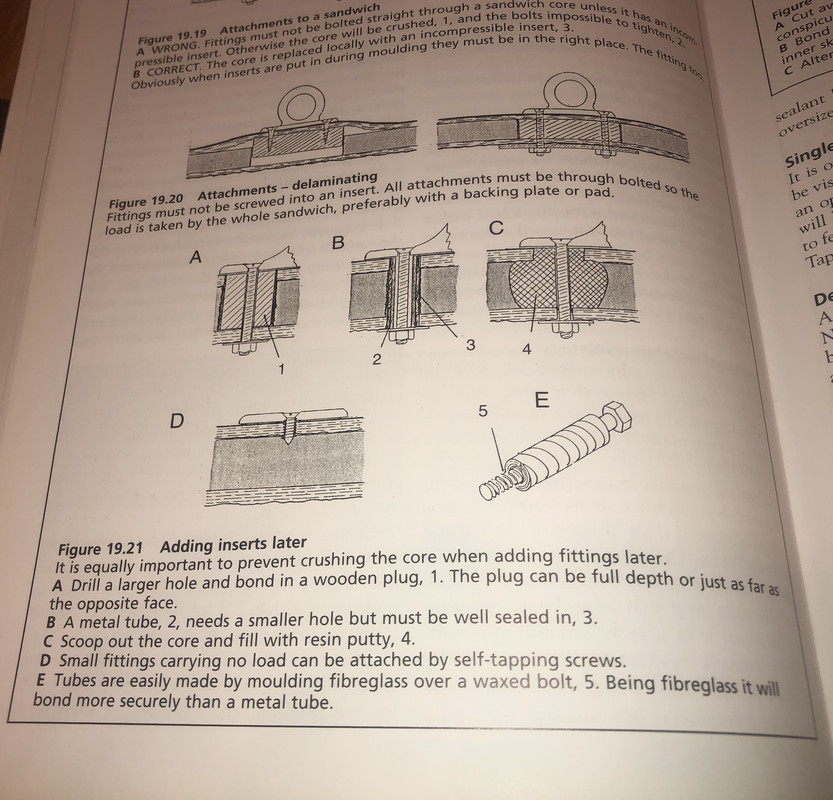


If I want to fit a windlass, on a pad, on the deck, held in place by four bolts, fitted as studs, with a pipe for the chain, with the heads of the bolts on penny washers on a marine ply backing pad, which is the best method to avoid compressing the core, whilst being as sure as I can that nothing is going to leak into the core? "A", "B" or "C"?
 
Last edited:
I would go for 4, filling the scooped hole with resin putty and then drilling the holes for the bolts. BUT I would also put a large hardwood (or marine ply) backing pad on the inside surface of the deck to spread the load. If the windlass is of considerable size I would also add a stainless plate between the pad and the nuts instead of individual washers.
 
IIRC you have a Nich 43. I thought they either had a wooden deck or fiberglass side decks with a wooden coach roof. I very much doubt you have a cored deck. If there was anything as a core it would be plywood. You need to drill a hole to check. It will either be solid GRP or supported with plywood, in my opinion.
 
IIRC you have a Nich 43. I thought they either had a wooden deck or fiberglass side decks with a wooden coach roof. I very much doubt you have a cored deck. If there was anything as a core it would be plywood. You need to drill a hole to check. It will either be solid GRP or supported with plywood, in my opinion.

Nic 55, MOD version (Ray Wall calls these "MOD 55s") Some 55s (Lutine, Quailo III) were GRP with wood decks - those two have had complete new decks. Some (Pacha) were alloy with wood decks. The MOD 55s - those built direct to MOD order as opposed to bought in - were all GRP.
 
I have been sorting out my Nic 35, and the method that works is 1) drill oversize, 2) remove as much core as you can, 3) fill with epoxy and finally 4) drill the right sized hole. Done it for all the deck fittings on the port side of the boat and all the leaks are fixed. Just the starboard side to do now!
 
I have been sorting out my Nic 35, and the method that works is 1) drill oversize, 2) remove as much core as you can, 3) fill with epoxy and finally 4) drill the right sized hole. Done it for all the deck fittings on the port side of the boat and all the leaks are fixed. Just the starboard side to do now!

Thanks. Just what I needed to know... what epoxy mixture do you use? (Incidentally have a deck leak over the port cockpit locker, which I think is down to a deck fitting...)
 
Epoxy mix - Standard resin & standard hardener, thoroughly mixed in the proportions recommended by the manufacturer. Then gradually add colloidal silica filler, e.g. West 406 (or other non-water absorbing load bearing filler) until it reaches a semi-liquid consistency which will slowly sag to fill the space it's put in. (More elsewhere in West manual (and no doubt vids) on thicknesses of fillers.)

Follow the West Manual Poignard links to - 7.1.1 paras 1, 2, 3 and second half (only) of para 4. (I don't see the point in epoxying the fitting or backing plate to the deck unless there's a particular reason to do so.)

I agree with Puff that something like Du Plessis diagram no. 4 is what you're aiming at. Very important that the point is to ensure not only that the deck is not crushed, but that any water leaking under the fitting (sealant should keep it out, but . . . ) goes into the boat interior, where you'll see it before it's too late, not into the deck core.

I can't see Adwuk's purpose in drilling holes oversize. Why?

Drill holes the size you need, and clear out core around hole c 1 - 2cm, trying to ensure as best as possible that there is a good, clear, surface on the now exposed internal faces of the two GRP layers for the epoxy to adhere to. Cover underside hole (inside boat) with tape to stop epoxy running through before its set.

The vid below quickly shows the basics. (There is a much better one somewhere but can't find it just now. )

Most informative bit is perhaps the brief view of his cut-away demo piece. I prefer to also give the epoxy mix, once it's in the hole/void, a poke and stir to ensure its penetrated as far as possible. Also watch out for the epoxy settling after you've first filled - may need a little top up to ensure there's enough to thoroughly reach the underside top surface.

https://www.youtube.com/watch?v=L-Y0cIS6fSA
 
Last edited:
I used colloidal silica after mixing the epoxy, and thickened as far as I could but so that the mix was still pourable. Its really important if you want to avoid air pockets. The oversized hole makes it easier to remove bits of balsa core as well as ensuring that you don't get air pockets when you refill. I found that, for me, the smallest hole you can sensibly work with is about 10mm. Obviously when you refill, you will need to put some tape on the underside - ensure it doesn’t come off as it will make a hell if a mess!
 
I used a slight variation.
Drill a 5mm hole right through.
Open out the top grp to desired size.
Use the good old sharpened allen keys to remove core around the hole. Depending on what the core is and what the bolt is for, you may want to remove more or less core. You'll want a hoover to remove core debris...
Stuff dry chopped glass fibres into the void
Put a dowel through hole, plugging the small lower hole.
Mask deck, pour in resin. Warm the deck to make the resin extra runny.
Beware a small amount may run through...
Use masking tape to keep the tops of the dowels centred.

When its hard, open out holes to desired size. It's easy to drill out the dowels.

This way you get some strength from the glass, and liquid resin seals the core and re-bonds it to the skins if it was starting to fail.
 
Thanks, everyone. The task is losing its terrors.

I forgot to ask how to treat the much bigger hole that the chain goes through!

I thought of cutting the hole with a hole saw, then putting a former in the hole wrapped in polyethylene, but then I realised that there would be no way to get the epoxy in ... Homer Simpson moment!
 
I’ve done loads of these. Once the initial hole through deck is drilled, a bent nail in the drill to start the process of mashing up the balsa followed by an Allen key. Vacuum the bits out as you go to get the void nice and clean.

My top tip is to use a disposable syringe to inject the thickened epoxy into the void. Trying to spoon it in is messy and difficult. The syringe fills the void perfectly.

For a windlass I’d be using a large plywood pad and then a stainless metal plate. (Or possibly just a stainless plate?)

I’ll try and fulfil my promise of calling down to see the Nich.
 
Thanks, everyone. The task is losing its terrors.

I forgot to ask how to treat the much bigger hole that the chain goes through!

I thought of cutting the hole with a hole saw, then putting a former in the hole wrapped in polyethylene, but then I realised that there would be no way to get the epoxy in ... Homer Simpson moment!

How I would do is:

1. cut the hole in the upper skin only with the hole saw

2. remove the core material below the hole and for some distance under the lip of the upper hole (up to 10mm perhaps) and vacuum out the debris

3. coat the expose surfaces of the core with un-thickened epoxy to seal them and to provide a bonding surface for the next stage

4. apply thickened epoxy to the undercut area (peanut butter consistency) with a spatula. Let it set hard.

5. from below, using the pilot hole left by step 1 to guide it, drill upwards using the hole saw

6. clean up and coat any remaining exposed laminate with unthickened epoxy

7. fit some kind of bronze or s/s skin fitting into the hole to protect the deck from the chain, ie a hawsepipe. I used one like this https://www.englundmarine.com/products/bronze-thru-hulls|BKA00TH.html

I'm sure there are other ways of doing it but I happen to have a large collection of hole saws!
 
Last edited:
QUOTE=Poignard;6884371]How I would do is:

1. cut the hole in the upper skin only with the hole saw

2. remove the core material below the hole and for some distance under the lip of the upper hole (up to 10mm perhaps) and vacuum out the debris

3. coat the expose surfaces of the core with un-thickened epoxy to seal them and to provide a bonding surface for the next stage

4. apply thickened epoxy to the undercut area (peanut butter consistency) with a spatula. Let it set hard.

5. from below, using the pilot hole left by step 1 to guide it, drill upwards using the hole saw

6. clean up and coat any remaining exposed laminate with unthickened epoxy

7. fit some kind of bronze or s/s skin fitting into the hole to protect the deck from the chain, ie a hawsepipe. I used one like this https://www.englundmarine.com/products/bronze-thru-hulls|BKA00TH.html

I'm sure there are other ways of doing it but I happen to have a large collection of hole saws![/QUOTE]

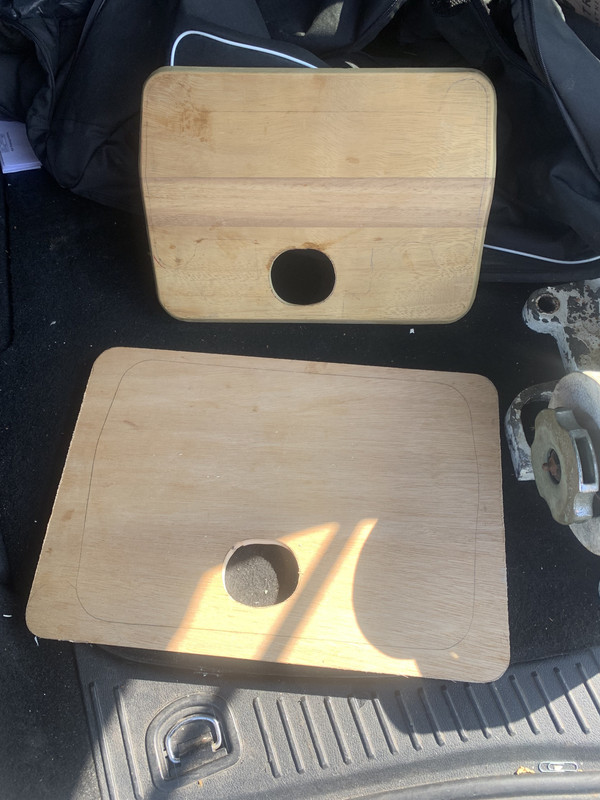
Top (iroko) and bottom (ply) pads; may add two sheets of stainless; will cut the bolt holes on the boat:

 
Top