Addicted to the fuel burn gauge

I've gone down this search a few years ago.
Now have two truck derived kits one on each engine. They measure both in and return flows, do the calcs and show them on the NMEA2000 network.
Problem is that I'm still in contact with the builders to finetune the output but too busy during the summer, should work on that again and hopefully have a solution around xmas.

such systems are used extensively from companies running lots of trucks to keep track of consumption and avoid drivers overspending on fuel (or so I was told). Problem is that typically these are fitted with a log on the meter that the owner checks everynow and again (or when the truck is back in base...) and that's of no use to us, hence the NMEA2000 conversion.

V

Sounds really interesting. Keep us posted.
 
Absolutely! And the chorus of "Are we there yet" from two prepubescent brats for 10 hours vs 2.5 is worth twice the fuel burn should I be shown massively wrong anyway.
If anyone can give me fuel burn from their KAD300/44 if they have figures for displacement speeds and just comfortably on the plane (not balls to the wall) I'd be very appreciative. I cant see there being that big a difference to it's older sibling.

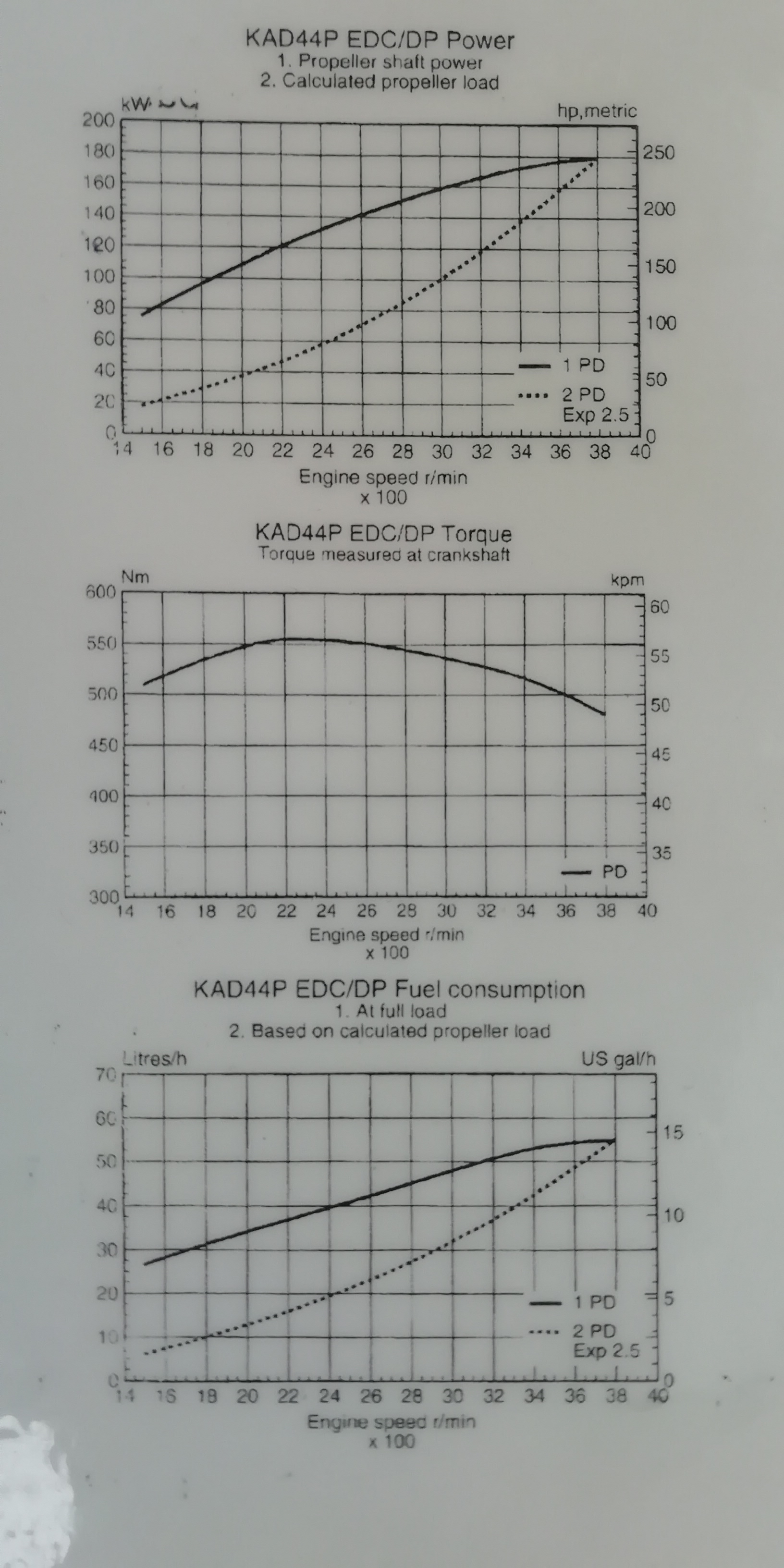
Does this help Bruce (obviously you need to convert this to knots for your boat)? ...

IMG_20181014_165126.jpg
 
That's great Pete, and Vas, it is fairly linear after all.

:encouragement:

Belief structure once again propped up. Happy days.
 
That's great Pete, and Vas, it is fairly linear after all.

:encouragement:

Belief structure once again propped up. Happy days.

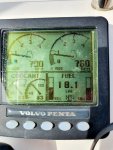
Not to be the voice of doom and gloom..but doesn't the fuel consumption line on the graph above start at 1,500 rpm. If so, that's not really showing the whole picture...my P50 has a minimal increase in speed between ~780rpm and 1,500 rpm....and a massive increase in fuel burnt. I am not on the boat atm, but I seem to think I was burning maybe at least 70-80 lph between both engines at 1,500 rpm, but only 18 lph between both at 760 rpms. The gain in speed was just a few knots.

WhatsApp Image 2019-09-30 at 3.42.44 PM.jpeg
 
Not to be the voice of doom and gloom..but doesn't the fuel consumption line on the graph above start at 1,500 rpm. If so, that's not really showing the whole picture...my P50 has a minimal increase in speed between ~780rpm and 1,500 rpm....and a massive increase in fuel burnt. I am not on the boat atm, but I seem to think I was burning maybe at least 70-80 lph between both engines at 1,500 rpm, but only 18 lph between both at 760 rpms. The gain in speed was just a few knots.

View attachment 80778

I’ve never been able to derive anything useful from engine manufacturers fuel graphs. Too many external factors.
 
:ambivalence: Everytime a fella gets comfortable on his pedestal someone wants to kick him off it!

:D

With outdrives puttering at idle isn't going to make more than a couple knots. 1000 rpm for me is going to make ~5 knts. One can extrapolate that from the graph but I dont think it really gets much more efficient than shown in No2 prop load @14k rpm which is about 7 knts and starting to push a wake
 
Last edited:
I’ve never been able to derive anything useful from engine manufacturers fuel graphs. Too many external factors.

Me too .
Are they derived from a auto type of dyno meter ?
If so , no spinning prop(s) in water , no slippage , no fwd motion effect on the props etc etc .
There’s a gear box and shafts too plus legs with OD boats .

I know MapisM and I have had disagreements over his consumption and mine .
I have the electronic inline 6 - 12.8 L MANs with screens so can see the L/h and load % .
He has 16.4 L iirc ? But V 8 ,s mech injection and from his chart , there’s huge enough discrepancies I suspect on his side , because it’s all he has .
I realise theses charts are all most folks have but I think they are over optimistic.

I think the manufacturers charts are good to compare between engines , but caution should be used for real boat fuel consumption, because as Elassar says there’s too many external factors .
 
Nonsense! That graph is conservative and it pleases me greatly because I'm returning better, I'm convinced. :encouragement:

What about you Pete? Do your findings corroborate the graph?
 
Just to add another dynamic to the equation, I need to do an engine service every 100 hours (also involved a lift out for me I'm afraid) and do around 250 hours a season. This used to be lower as in my first year I went everywhere at 26 knots and now do a fair bit of displacement speed on Autohelm. Whilst my litres per nautical mile has reduced, a good 20% over the first year, I need a minimum of 2 services in a season which does impact on my 'true' price per NM. I do feel we would benefit benefit in having services determined by type of usage as cars do rather than simple hours.
 
To be honest our fuel consumption is all over the place. Seems to be quite sensitive to sea conditions.

Just to give another variable there’s up wind and down wind .
Even with my arguably lower than av profile boat there’s a noticeable difference .
Obviously in a 3m head sea going each way ,but even in flat minimal waves any wind assistance or not can be seen on the fuel flow screens .

Another very basic measure I tend to use in addition to the L/hr real time and then the TTG time to target from the plotter is the sight glasses .
They have handy graduations .
So in the morning when doing the checks I can see the levels .
In terms of cm of fuel used per day .That way I can work out how many days fuel ( similar usage pattern planned ) I have to go at before it’s time to buy some more .
The gauges on the dash ( two day tanks on for each motor ) are like AN other gauge you can’t recall where it was from yesterday , morning , the evening after a trip out .OK it’s gone down just like a cars guage .
But the sight glass you can see you gone through say 4 cm that day because you saw it say 52 in the morning and now it’s at 48 , next day 42 , gone through 6 cm or what ever so .
I’d recommend anyone to if possible fit sight glasses , actually a plastic cocked pipe .
 
with twin KAD 44's on outdrives I average 2.5 miles per gallon,
From sea trails with Vodia connected the fuel burn is 20 litres per engine per hour at 2000 then 30 litres per hour at 3000 revs, at WOT it then shoots up to 57 Litres per hour, at 3000 revs we are though doing around 35 knots . I just go out and go with a speed that suits the conditions. Once it gets to time to fill up I fill up. the only shock is that I have separate tanks so once 1 is filled I know I have the same again to fill up. Never really worried about fuel used. The point of owning a boat for us is to go and have a fun day out.
 
with twin KAD 44's on outdrives I average 2.5 miles per gallon,
From sea trails with Vodia connected the fuel burn is 20 litres per engine per hour at 2000 then 30 litres per hour at 3000 revs, at WOT it then shoots up to 57 Litres per hour, at 3000 revs we are though doing around 35 knots . I just go out and go with a speed that suits the conditions. Once it gets to time to fill up I fill up. the only shock is that I have separate tanks so once 1 is filled I know I have the same again to fill up. Never really worried about fuel used. The point of owning a boat for us is to go and have a fun day out.

LOL...if WOT only used 57lph, I don't think I would worry too much about the fuel use neither. I think the point of everyone owning a boat is to go and have a fun day out.
 
Top