Actual tidal heights question

Lucky Duck

Well-Known Member
Joined
9 Jun 2009
Messages
8,792
Location
From the Needles to the Nab, from Cowes to St Kats
Visit site
With the promise of a good spring tide three of us set off to circumnavigate Potton Island yesterday. Having just got round by the skin of my teeth I'd be interested to know if the high pressure had surpressed the high water height.

I think people have provided links in the past for this kind of thing but I couldn't see any historical information on the Port of London website.
 
With the promise of a good spring tide three of us set off to circumnavigate Potton Island yesterday. Having just got round by the skin of my teeth I'd be interested to know if the high pressure had surpressed the high water height.

I think people have provided links in the past for this kind of thing but I couldn't see any historical information on the Port of London website.

When I had a mooring in the Middleway, as a member of Gt Wakering YC, I remember a particularly high tide with low pressure that cam nearly a foot over tidal prediction. The water was absolutely level with the top of the sea wall.
You would have to reckon the opposite would also be true.


I go round Potton Island at least once a year, but it is a bit easier for me, and I can take the tourist route into Barling Creek
 
With the promise of a good spring tide three of us set off to circumnavigate Potton Island yesterday. Having just got round by the skin of my teeth I'd be interested to know if the high pressure had surpressed the high water height.
I think people have provided links in the past for this kind of thing but I couldn't see any historical information on the Port of London website.

This http://www.ntslf.org/data/uk-network-real-time may be what you're thinking of.
 
Thanks, very useful. By the look of things the tide was a bit lower than predicted but not by very much.

Well no but yeah but no but yeah but...... Well it depends on what you were expecting. Visit my harbour predicted yesterday's tide at Sheerness as 5.39m at 11.20 GMT and the tide gauge showed it actually peaked at 11.23 at 5.506m. Of course over prediction at Sheerness does not mean over prediction everywhere. Harwich was predicted at 4m at 1025 and peaked at 3.876 at 1038. But 0.124m under predicted = 4.881889763779527 inches approximately. :D Mind you manys the time 4 inches has made a difference.:cool:
 
Interesting to note that at Harwich, for example, the actual tide regularly differes from the prediction by up to 0.5m or so. That's quite a lot!
 
Interesting to note that at Harwich, for example, the actual tide regularly differes from the prediction by up to 0.5m or so. That's quite a lot!

I wonder to what extent water coming down the rivers affects tidal height at Harwich. There are not many places where two rivers might affect tidal heights. I was approaching Felixstowe from the direction of the Deben once and I heard Harwich VTS tell a container ship that there was unusually high tidal rates (on the ebb) as we neared the green can to the west of Platters and the tidal flow was indeed extraordinary with very obvious river sediment.
 
I wonder to what extent water coming down the rivers affects tidal height at Harwich. There are not many places where two rivers might affect tidal heights. I was approaching Felixstowe from the direction of the Deben once and I heard Harwich VTS tell a container ship that there was unusually high tidal rates (on the ebb) as we neared the green can to the west of Platters and the tidal flow was indeed extraordinary with very obvious river sediment.

Tis a good point. Hadnt considered the effect of river flows ...

Hmm, the theory was sound but Sheerness shows very much the same pattern - particularly interesting to see that on Monday was a good 0.5m or more below prediction and high water was only about 4.4m instead of the predicted 5.2 (that's at Sheerness)

Interesting from a theoretical perspective but also of note practically speaking as I shall be rather more circumspect in future! OK, I knew that actual tides varied from predicted tides conceptually but that data hits one between the eyes with the cold fact that "oh, we'll have half a metre or so in hand, it'l be fine" might not quite be sufficient! :eek:
 
I believe there are all sorts of unpredictable effects in shallow tidal estuaries where wind strength and direction combine with different expected tidal heights and baro pressure (and, very likely, river flows) to produce wild variations from time to time.
We see this a lot off the Swale, where the tide is complicated enough normally. There can be occasions for instance in Oare Creek where I've seen the tide make as much as a meter either side of predicted, for no single discernable reason, and with no similar variation seen on local tide recording stations, and be back to predicted 12 hours later.
It just happens.
Some people seem to take tide tables as gospel. They ain't, not round here anyway.
 
Another point perhaps worth considering is that the people at Heybridge that they can sometimes see the effect of shutting the Thames Barrier (and maybe the Colne Barrier) reflecting in higher than expected high waters. I think Dick's point is very well made about the localised effect. When they were selling the opening of the seawall at Abbotts Farm (Salcott Creek, River Blackwater), part of the argument was that it would ease pressure on tidal heights up river. Whether that has proved to be true I cannot comment. I know that doing the height of tide reduction for my Bradwell chartlet is always far more difficult than anywhere else.
 
The theory says that each mb difference from 1013 = 1cm difference on the tide. This morning my barometer said 1027 therefore the tide should be depressed generally by 14cm...
 
It is not as simple as that, because the water displaced by high/low pressure has to go somewhere. So if there is a steep pressure gradient, or the high/low pressure persisted for a long time, then indeed high pressure leads to low tidal heights and vice versa. A more immediate factor is the wind. Strong long lasting NE winds force water out of the North Sea, and SW ones force it in, causing low or high heights respectively. So, in 1953, a low pressure combined with strong N winds and spring tides altogether combined to cause the disaster outs floods, but luckily not all of those three factors have coincided since. The website we used to use to monitor predictions of tidal heights was portsmouth uni : www.pol.ac.uk but it has now been taken over by another institution - I think you can get accurate predictions from links from that - quite possibly the address given in an earlier post!

Since we sailed in the German Frisian islands this summer, where depths of a few cm less than the charted depths can really spoil your day, I have a link to the predictions for those areas. Recently, depths of 1 metre higher or half a metre lower have been seen there. The extremes seemed to coincide with strong winds but it was very complicated!

Ok, that's all a bit nerdish, but I find it interesting as well as very puzzling!
 
I wonder to what extent water coming down the rivers affects tidal height at Harwich. There are not many places where two rivers might affect tidal heights. I was approaching Felixstowe from the direction of the Deben once and I heard Harwich VTS tell a container ship that there was unusually high tidal rates (on the ebb) as we neared the green can to the west of Platters and the tidal flow was indeed extraordinary with very obvious river sediment.


There is really only one river affecting Harwich, the Gipping that feeds into the "Orwell" is just a ditch. :D The Stour however is a sizeable river with significant flow after heavy rain. What effect it has on tidal heights I don't know. I think if you have a higher than normal tide there will always be a lot of visible sediment on the ebb?
 
Interesting to note that at Harwich, for example, the actual tide regularly differes from the prediction by up to 0.5m or so. That's quite a lot!

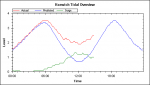
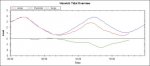
Happens quite regularly - the Harwich live feed will tell you current surge above/below predicted. Friday was 0.8m below.

Sometimes it can be more...

HarwichTidalGraph_2008_11_21.pngproxy.jpg
 
It is not as simple as that, because the water displaced by high/low pressure has to go somewhere. So if there is a steep pressure gradient, or the high/low pressure persisted for a long time, then indeed high pressure leads to low tidal heights and vice versa. A more immediate factor is the wind. Strong long lasting NE winds force water out of the North Sea, and SW ones force it in, causing low or high heights respectively. So, in 1953, a low pressure combined with strong N winds and spring tides altogether combined to cause the disaster outs floods, but luckily not all of those three factors have coincided since. The website we used to use to monitor predictions of tidal heights was portsmouth uni : www.pol.ac.uk but it has now been taken over by another institution - I think you can get accurate predictions from links from that - quite possibly the address given in an earlier post!

Since we sailed in the German Frisian islands this summer, where depths of a few cm less than the charted depths can really spoil your day, I have a link to the predictions for those areas. Recently, depths of 1 metre higher or half a metre lower have been seen there. The extremes seemed to coincide with strong winds but it was very complicated!

Ok, that's all a bit nerdish, but I find it interesting as well as very puzzling!

pol.ac.uk was the Proudman Oceanographic Laboratory in Liverpool... Now the National Tidal and Sea Level Foundation...
 
There is really only one river affecting Harwich, the Gipping that feeds into the "Orwell" is just a ditch. :D The Stour however is a sizeable river with significant flow after heavy rain. What effect it has on tidal heights I don't know. I think if you have a higher than normal tide there will always be a lot of visible sediment on the ebb?

It may be a ditch to you but I'd call it a river! http://www.geograph.org.uk/photo/193137 :D

Twas a mid range tide on that day as I recall but I agree that the big springs bring down a lot of crud.

On Lil's point, I've said this before, an artificial island in the estuary for an airport will heighten the risk of flooding significantly I think. A surge down the North Sea cannot go past the tide advancing up the English Channel, cannot go into the flood plains that once were the Dutch Delta, cannot go up the Thames or the Colne because of the barrier so ergo, must go up the wall!
 
There is really only one river affecting Harwich, the Gipping that feeds into the "Orwell" is just a ditch. :D The Stour however is a sizeable river with significant flow after heavy rain. What effect it has on tidal heights I don't know. I think if you have a higher than normal tide there will always be a lot of visible sediment on the ebb?

The problem with the Orwell is some of it has been filled in. Since 1953 (when I was flooded out in Duke Street Ipswich), the West Bank development has taken place which virtually halved the width of the river and of course Fox's and SYH have been built out into the river. At the estuary it is also blocked by the Felixstowe Dock development.

pete
 
pol.ac.uk was the Proudman Oceanographic Laboratory in Liverpool... Now the National Tidal and Sea Level Foundation...

There was another very important factor. It had been raining for a few days and the ground was waterlogged. I saw rainwater flooding down Bishops Hill and Back Hamlet, much of which drained into the dock. Unfortunately some came into Duke Street and flooded us out. As I said in an earlier post in this thread, that was before the West Bank Development and the various marinas.

pete
 
Top